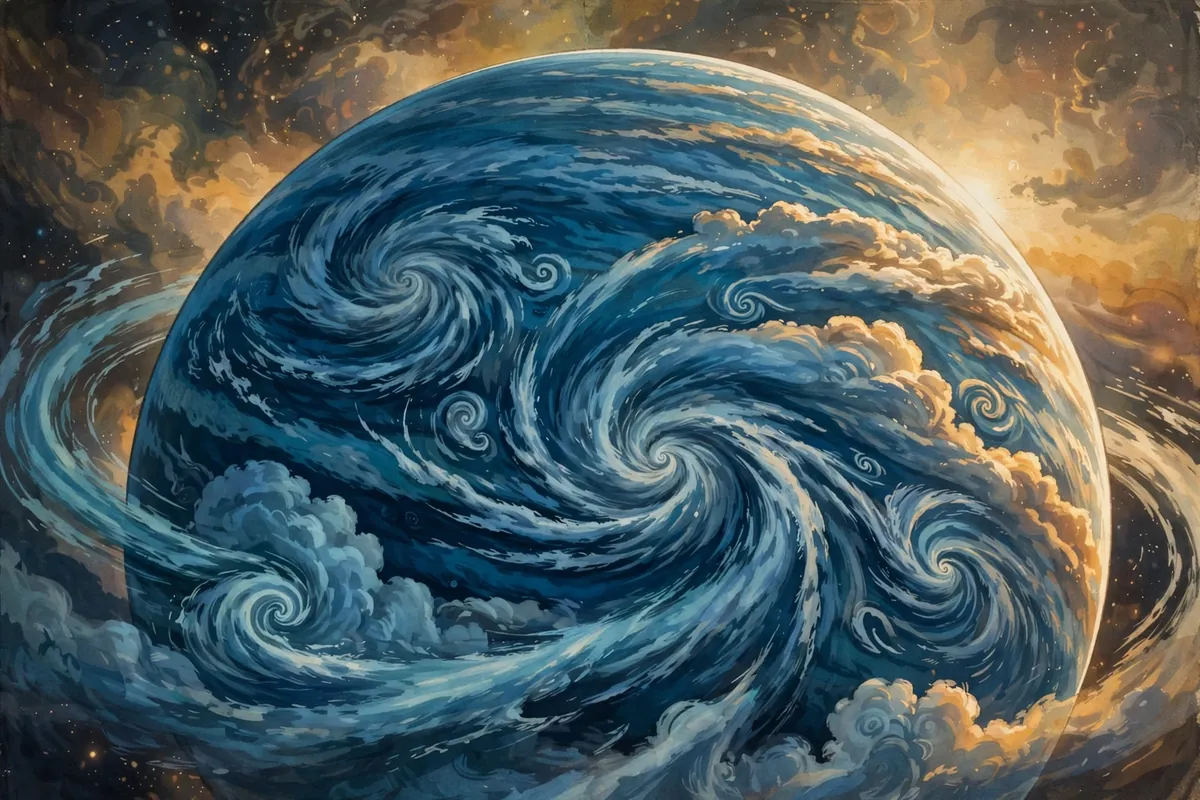
Imagine a planet that glows a rich cobalt blue, a bit like Earth seen from space. You might picture oceans and gentle skies. But this particular blue world is one of the most hostile places astronomers have ever studied.
Its name is HD 189733 b, a giant gas planet about 64.5 light-years from Earth. Researchers have found that its weather includes raining molten glass, driven by winds that may reach about 5,400 miles per hour. Its blue color doesn't come from water. It most likely comes from the way its hazy atmosphere scatters light.
A Hot Jupiter Next Door
HD 189733 b is what astronomers call a “hot Jupiter.” It's a bit bigger and heavier than Jupiter, about 11 percent wider and 11 percent more massive, but instead of keeping a safe distance from its star, it orbits incredibly close, circling once every 2.2 days.
That tight orbit makes it fast and hot. The planet races along at about 340,000 miles per hour, and estimates put its temperature somewhere around 1,950 to 2,300 degrees Fahrenheit. Like most hot Jupiters, it's thought to be tidally locked, meaning one side always faces its star in permanent day while the other stays in endless night.
Astronomers in France discovered it in 2005 by watching it pass in front of its star and dim the starlight slightly. It's the closest planet of its kind to Earth that crosses its star's face from our point of view, which makes it a favorite target for study.
Glass in the Forecast
So where does the glass come from? Studies of the planet's atmosphere suggest it may contain tiny particles of silicate, the same family of minerals that glass is made from. At these temperatures, those particles can form and fall as droplets of molten glass.
Then add the wind. Scientists at the University of Warwick found winds of up to about 5,400 miles per hour blowing from the planet's day side to its night side. That's several times faster than the speed of sound on Earth. Any glass rain there wouldn't fall gently. And in 2014, NASA reported that the planet's atmosphere appeared surprisingly dry, so whatever falls from those skies, it isn't ordinary rain.
Why It's Blue
HD 189733 b was the first planet outside our solar system to have its overall color measured. Astronomers found it reflects much more blue light than red.
The likely reason is Rayleigh scattering, the same effect that makes Earth's sky blue. Tiny particles in the atmosphere scatter blue light more than other colors. Funnily enough, a sunset seen from inside its atmosphere would look red.
A Planet of Firsts
This strange world has helped astronomers learn how to study distant planets. It was the first planet beyond our solar system to have a temperature map made of it, and the first confirmed to have carbon dioxide in its atmosphere.
In 2024, scientists also detected hydrogen sulfide in its air, the gas famous for smelling like rotten eggs. So on top of the heat, the wind, and the glass, the place might not smell very nice either.
We'll never visit HD 189733 b, and that's probably for the best. But it's a good reminder that a pretty face can hide some truly wild weather. Next time you grumble about a rainy day, at least it's only water.