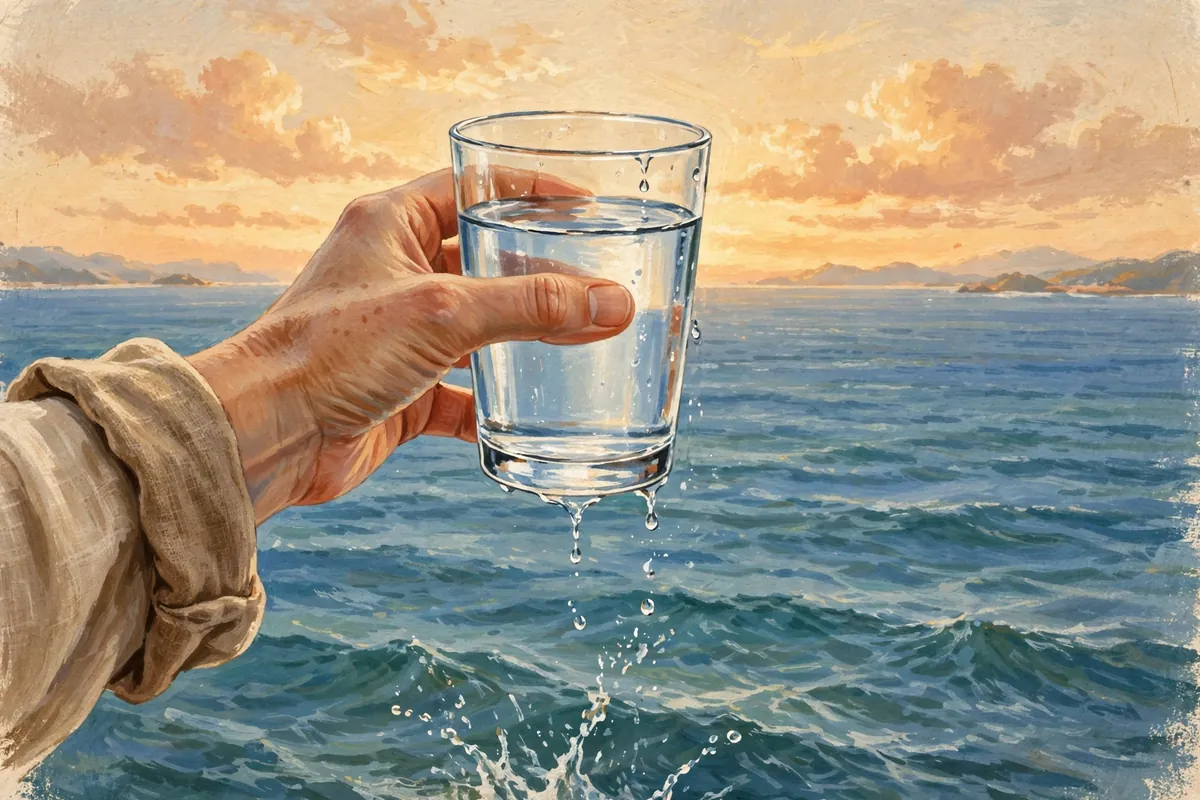
Stand on a beach and the ocean stretches out in shades of blue and turquoise. Then scoop some into a cup, and it's as clear as tap water. It's one of those little puzzles that most of us notice as kids and never quite get answered.
Here's the short answer: water isn't truly colorless. Pure water has a very faint blue tint, too weak to notice in a glass but obvious when you look through a lot of it. Water soaks up a little of the red, orange, and yellow in sunlight, leaving the blue and green behind. A reflected sky adds to the effect, but it's not the main reason.
Water's Hidden Color
Water absorbs a tiny bit of red light. In a glass, there's so little water that you can't see any difference. But the effect builds up as light travels through more and more water, and the blue tint gets deeper.
Scientists can show this in a lab. If you fill a long pipe, a meter or more, with highly purified water and look at a white light through it, the water appears light sky blue.
There's a neat twist that proves the point. Heavy water, a form of water made with a heavier kind of hydrogen, doesn't absorb red light the same way. A big body of heavy water wouldn't have that typical blue tint.
So What About the Sky?
Many people believe the ocean is blue only because it reflects the sky. That's a common misconception. The surface does reflect the sky, and that can add a lighter shade, depending on how bright the sky is and the angle you're viewing from.
But here's the clincher: a swimming pool with white sides and bottom looks blue even indoors, where there's no sky to reflect. And the deeper the pool, the more intense the color gets.
Why Some Water Looks Green or Brown
Not every body of water is blue, and tiny particles are the reason. Scattering from suspended bits of living matter and minerals bounces light back up toward your eyes. Without that scattering, deep water would actually look black, since a few tens of meters of water absorbs all the light.
What's floating in the water matters a lot. Microscopic algae called phytoplankton contain chlorophyll, which absorbs blue and red light and leaves green behind. That's why waters rich in plankton look greener. Dissolved plant compounds called tannins can turn water dark brown, like tea.
Scientists even use this to their advantage. Satellites measure ocean color to estimate how much phytoplankton is growing. Productive regions show up green or yellow in satellite images, while less productive waters appear blue.
The Blue Inside a Glacier
The same idea explains why glaciers can glow a deep blue up close. Ordinary ice looks white because it's full of tiny air bubbles. In a glacier, the heavy pressure squeezes those bubbles out, and light travels a long way through dense ice, so the blue shows through.
A Color Hiding in Plain Sight
So the next time you look out at the ocean, you're seeing the true color of water itself, deepened by all that volume and touched up by the sky and whatever is floating in it.
That clear glass on your kitchen table is blue too. There's just not enough of it to show off.