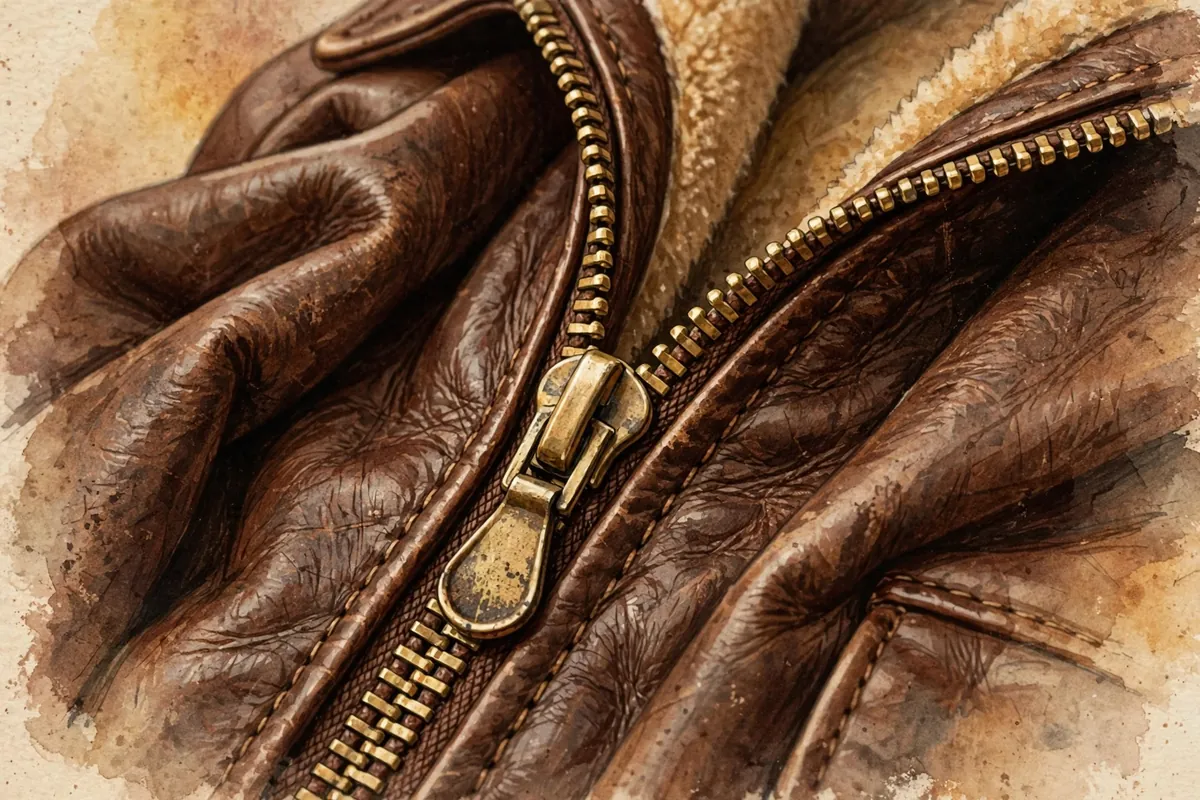
It's hard to imagine life without zippers. They hold our jackets closed, keep our suitcases shut, and seal up tents and sleeping bags. Yet this everyday gadget had one of the slowest starts of any invention you can name.
The first version, called a clasp locker, made its public debut at the 1893 Chicago World's Fair and barely got noticed. It tended to jam. It took about 20 years of reworking before a durable, modern-style zipper finally went on sale in 1913. Even then, it didn't really show up on clothing until the mid-1920s, and it didn't win over men's trousers until 1937.
A Shoelace Replacement That Jammed
The story starts with Whitcomb L. Judson, an inventor from Chicago. In 1893, he patented a device meant to replace the laces on boots and shoes. It worked as a fancier kind of hook-and-eye fastener.
Judson and his business partner, Colonel Lewis Walker, even put the device on their own boots and started the Universal Fastener Company to make it. But the early prototype had mechanical problems and kept jamming. At the World's Fair, the public paid it little attention.
Judson wasn't even the first to try. Back in 1851, Elias Howe, the sewing machine inventor, had patented a garment fastener. But his device was more like a fancy drawstring than a true slide fastener, and he never seriously tried to sell it.
The Engineer Who Fixed It
The breakthrough came from Gideon Sundback, a Swedish-American electrical engineer hired by the company in 1906. He redesigned Judson's fastener to make it far more durable.
Sundback increased the number of fastening teeth from about four per inch to ten or eleven. He also created two facing rows of teeth that the slider pulled together into a single piece. His improved fastener went on sale in 1913, and his patent was issued in 1917. He even built the machine to manufacture it.
Sundback also kept the rights outside the United States and used them to set up a fastener company in St. Catharines, Ontario. That's why many people mistakenly believe he was Canadian and that the zipper was invented in Canada. In 1923, he sold his European rights to Martin Winterhalter, whose company Riri went on to produce zippers on a large scale.
Saved by Galoshes
The name zipper didn't come from the inventors at all. In 1923, the B. F. Goodrich Company used Sundback's fastener on a new type of rubber boots, or galoshes. The boots could be closed with a single zip of the hand, and the company called them Zippers. The name stuck.
In those early years, the fastener's two main jobs were closing boots and tobacco pouches. Clothing came later. In 1925, the company Schott NYC began putting zippers on leather jackets.
The Battle of the Fly
In the 1930s, a sales campaign promoted zippers on children's clothing, praising them for helping young kids dress themselves. Then came the big showdown. In 1937, the zipper beat the button in what was called the Battle of the Fly, after French fashion designers praised zippers in men's trousers.
An advertisement in the first issue of Esquire magazine called the zipper the newest tailoring idea for men. One of its selling points, it promised, was preventing unintentional and embarrassing disarray.
Today the zipper is by far the most widespread fastener in the world. Not bad for an invention that started out as a jammed boot fastener nobody wanted. Sometimes a good idea just needs a little time, and a lot of patience.