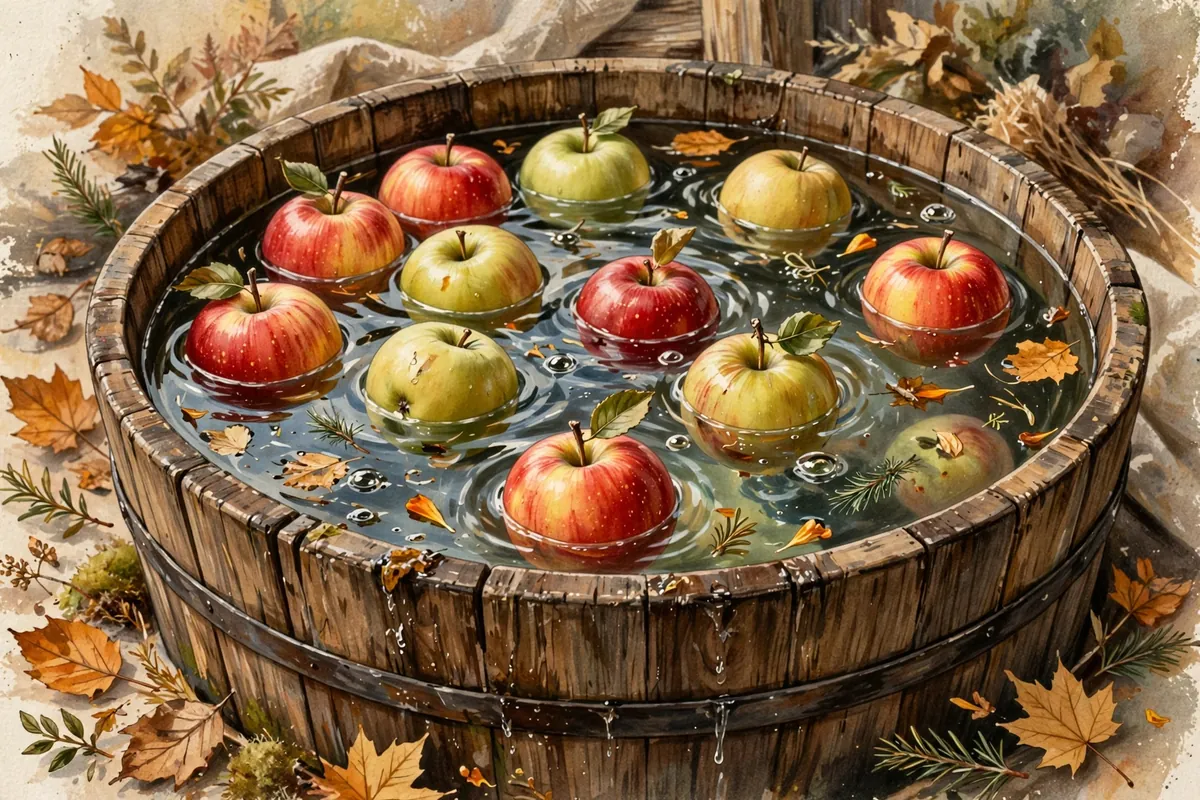
Anyone who has bobbed for apples at a fall party knows the struggle. You lean over the tub, open wide, and the apple just bobs away from your teeth. An apple feels solid and heavy in your hand. Yet in water, it floats as if it were made of cork. Why doesn't it sink?
The short answer is density. Apples are less dense than water, which means that, size for size, an apple weighs less than the same amount of water. Anything less dense than water floats. Apple flesh isn't packed solid, either. It's crisp and spongy, with air tucked into the tiny spaces between its cells, and that helps lighten the load.
Density in Plain English
Density is simply how much stuff is packed into a certain amount of space. A brick and a loaf of bread can be about the same size, but the brick is far denser. Scientists often compare a material's density to water's. If the number is less than one, the object floats.
An apple is about 86 percent water, so you might think it would act just like water. But the rest of it, including those little pockets of air, tips the balance. Overall, the apple ends up lighter than the water it pushes aside, so it rises to the surface.
Thank Archimedes
The rule behind this is named after Archimedes, the ancient Greek thinker from Syracuse. Archimedes' principle says that an object in water is pushed upward with a force equal to the weight of the water it displaces. Pressure in water increases with depth, so the water below an object pushes up harder than the water above pushes down.
If that upward push is greater than the object's weight, it floats. For an apple, it is. A rock the same size displaces the same amount of water, but it's much heavier, so it sinks straight to the bottom.
Salt can change the outcome, too. Saltwater is denser than fresh water, so it gives a stronger upward push. The ancient Greek philosopher Aristotle noticed that if you make water very salty, eggs will float in it, even though they sink in plain water.
A Game as Old as Halloween
Apples' talent for floating gave us a classic party game. Bobbing for apples is often played on Halloween and, in Britain, on Bonfire Night. The tub is filled with water, apples are tossed in, and players try to grab one with their teeth, usually with their hands tied behind their backs to prevent cheating.
The game goes by different names in different places. In Scotland, it's called dooking, and in northern England, apple ducking or duck-apple. In Ireland and in Newfoundland and Labrador, Halloween itself has been called Snap Apple Night. According to one popular account, young unmarried people once played the game believing that the first to bite an apple would be the next to marry.
Apples Get Around
The apples in your kitchen have a long family history. Scientists consider Central Asia the center of origin for apples, where their wild ancestor still grows in the mountains of Kazakhstan, Kyrgyzstan, Tajikistan, and northwestern China. Today there are more than 7,500 kinds of apples.
So the next time you drop an apple into a bowl of water to rinse it, watch it bob back up to say hello. It's a tiny science lesson, courtesy of Archimedes, right in your kitchen sink.