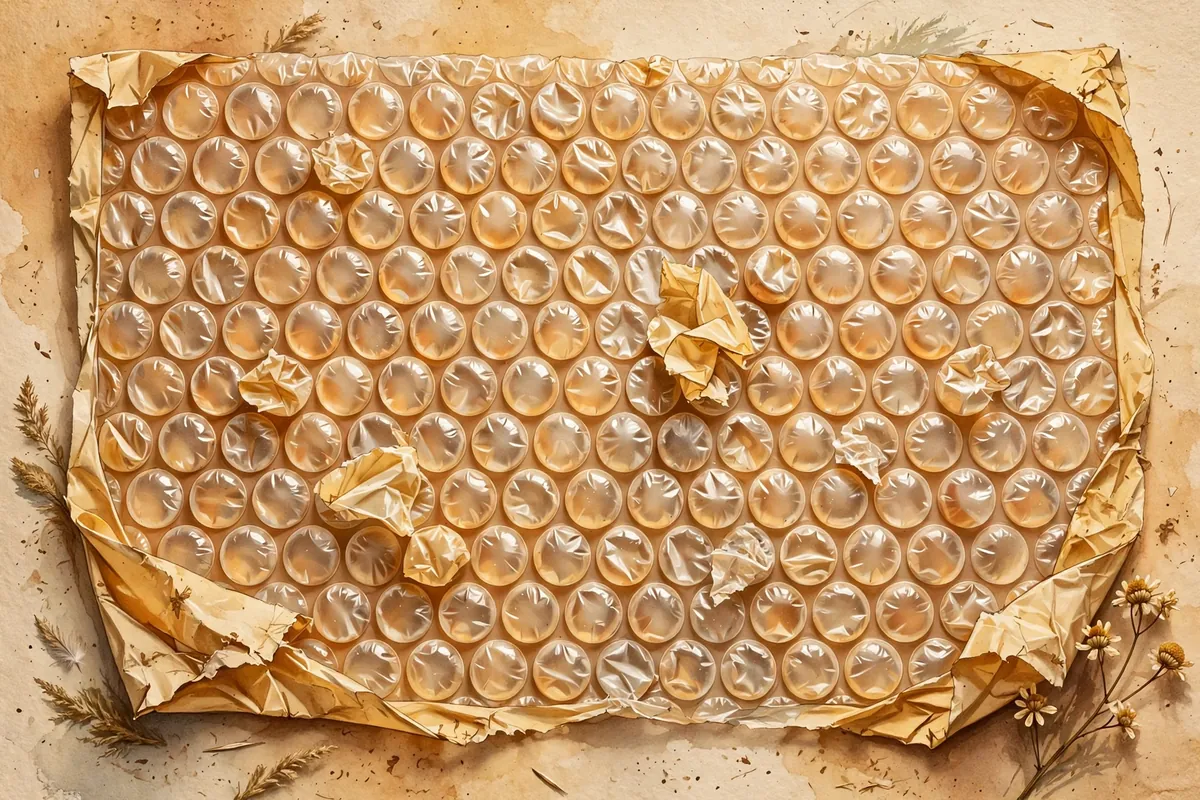
Hand someone a sheet of bubble wrap and watch what happens. Within seconds, they're popping bubbles and grinning like a kid. It's one of the most satisfying materials ever made. But it was never supposed to be packing material at all.
Bubble wrap began as a failed attempt at wallpaper. In 1957, American engineer Alfred W. Fielding and Swiss inventor Marc Chavannes were trying to create a textured, three-dimensional plastic wallpaper with a paper backing. The wallpaper flopped, but the pair realized their bumpy invention might make excellent cushioning for shipping.
From Walls to Greenhouses to Boxes
It didn't find its calling right away. Before it became famous as packaging, the failed wallpaper was also put to work as insulation for greenhouses.
In 1960, Fielding co-founded the Sealed Air company to make and sell it. That same year, the company raised $85,000 when it first offered shares to the public. Fielding became an executive vice president and director, while Chavannes worked mostly as a consultant.
Early bubble wrap had a flaw: the bubbles leaked. By the mid-1960s, the company had developed a coating that kept them from losing air.
The Computer That Made It Famous
One of bubble wrap's first widespread uses came in 1960, when IBM shipped its new 1401 computers to customers. Most of those customers had never seen this kind of packing material before.
It caught on. By 1969, Sealed Air reported $4 million in sales, mostly from bubble wrap, which was still its own proprietary product. The name Bubble Wrap is still owned by Sealed Air, but it has become a generic term people use for any brand.
How It Works
Bubble wrap is usually made from low-density polyethylene film. A shaped sheet is bonded to a flat sheet, trapping air in rows of little domes. The bubbles range from about a quarter inch to an inch or more across, and the most common size is 1 centimeter, about four-tenths of an inch.
Several layers can be stacked to soak up shocks and vibration, while a single layer may simply protect a surface from scratches. Bubble wrap is also used to line some kinds of mailing envelopes.
There are special versions, too. To protect sensitive electronic chips, some bubble wrap is made from antistatic plastic that safely drains away static charge. In 2015, Sealed Air launched a version that ships flat and is inflated by the retailer, taking up about 1/50 of the space in transit. Its bubbles are connected in strips, so they can't be popped.
A Holiday for Popping
Of course, plenty of people love bubble wrap for reasons that have nothing to do with shipping. Its popping sound has made it a popular stress reliever, and some websites even offer virtual sheets you can pop with a click. A compact electronic toy called the Mugen Puchipuchi even imitates the popping.
It even has its own holiday. Bubble Wrap Appreciation Day falls on the last Monday of January. It started after a radio station in Bloomington, Indiana, received a shipment of microphones wrapped in bubble wrap and broadcast the sound of the wrapping being popped.
So the next time you pop a bubble or two, remember you're squeezing a happy accident. It failed as decor, but it found a much better home, protecting our treasures and soothing our nerves.