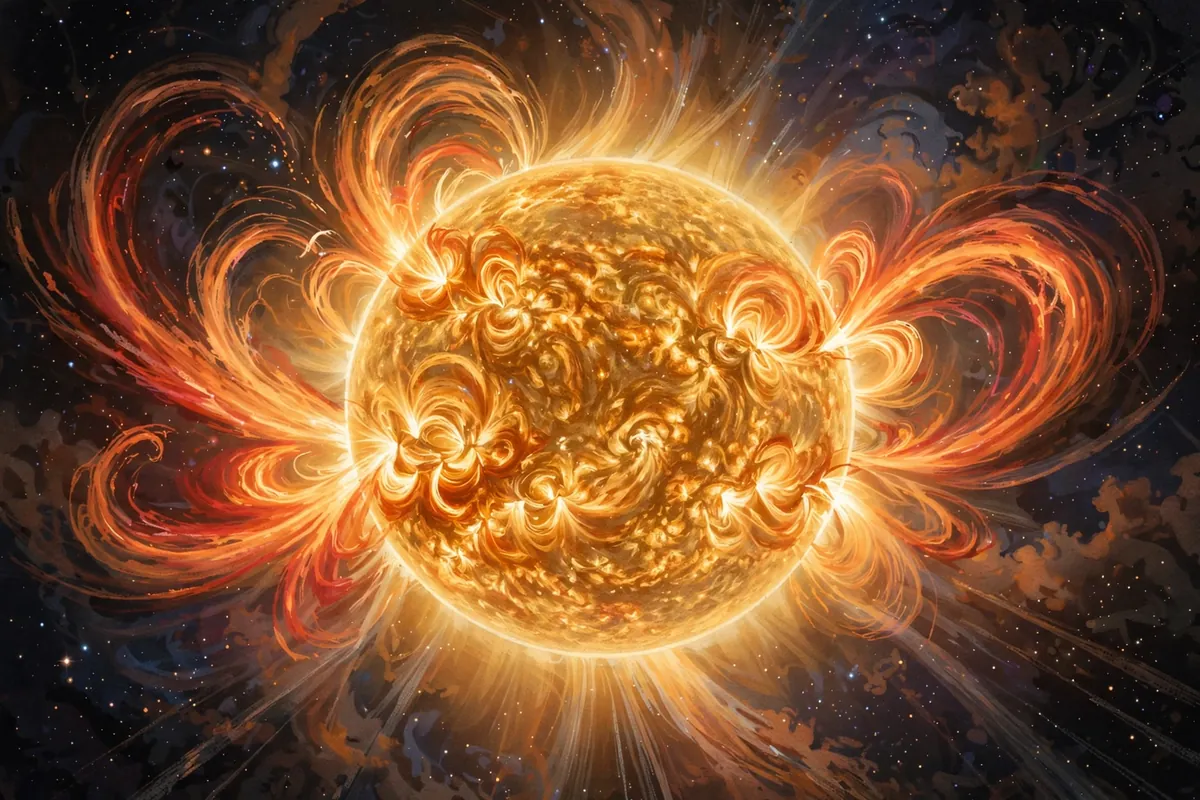
We all know the Sun is hot. Step outside on a July afternoon and you don't need a thermometer to tell you that. But just how hot is it up there, and is it the same temperature all the way through?
The short answer is that it depends on where you look. The Sun's visible surface is about 5,800 kelvins, roughly 10,000 degrees Fahrenheit. Its core is close to 15.7 million kelvins, or about 28 million degrees Fahrenheit. And its thin outer atmosphere, the corona, averages one to two million kelvins, far hotter than the surface beneath it.
The Furnace at the Center
The core is where the Sun makes its energy. It reaches from the center out to about a fifth or a quarter of the way to the surface. There, nuclear fusion turns hydrogen into helium, releasing the energy that eventually reaches us as sunlight.
Conditions in the core are hard to picture. Along with the temperature of about 28 million degrees Fahrenheit, the material there can be packed up to 150 times denser than water.
A Very Slow Trip Outward
Above the core sits the radiative zone, the thickest layer of the Sun. Temperatures there drop from about 7 million to 2 million kelvins as you move outward.
Here's a mind-bender. The gas in this zone is so dense that particles of light keep bumping into it and bouncing around. As a result, it takes light about a million years just to cross this one layer. The sunshine warming your face today began its journey long before there were any calendars.
The Surface and Its Cooler Spots
By the time energy reaches the surface, things have cooled to about 5,800 kelvins. That's still roughly 10,000 degrees Fahrenheit, plenty hot enough to melt anything we could send there.
The surface isn't the same temperature everywhere, though. Sunspots are darker patches that are cooler than their surroundings. They form where concentrated magnetic fields block the flow of heat from below. Their numbers rise and fall in a cycle that lasts about 11 years. In the early 1800s, the astronomer William Herschel even wondered whether sunspots were connected to temperatures here on Earth.
The Mystery of the Corona
Now for the strange part. Above the surface, the temperature first climbs to around 20,000 kelvins in a layer called the chromosphere. Then, across a thin transition zone only about 125 miles thick, it leaps to around a million kelvins.
The corona averages about 1 to 2 million kelvins, and its hottest regions reach 8 to 20 million kelvins. That's like walking away from a campfire and feeling the air get hotter. Scientists still don't have a complete theory to explain it, though they know at least some of the heat comes from a process involving snapping and reconnecting magnetic fields.
You usually can't see the corona, because the Sun's glare drowns it out. During a total solar eclipse, though, it appears as a pale, glowing halo around the darkened Sun. In 2021, NASA's Parker Solar Probe became the first spacecraft to cross the outer edge of the corona.
So the next time somebody tells you it's hot enough to fry an egg on the sidewalk, you can smile. Compared with the Sun's corona, even a heat wave is a cool breeze.