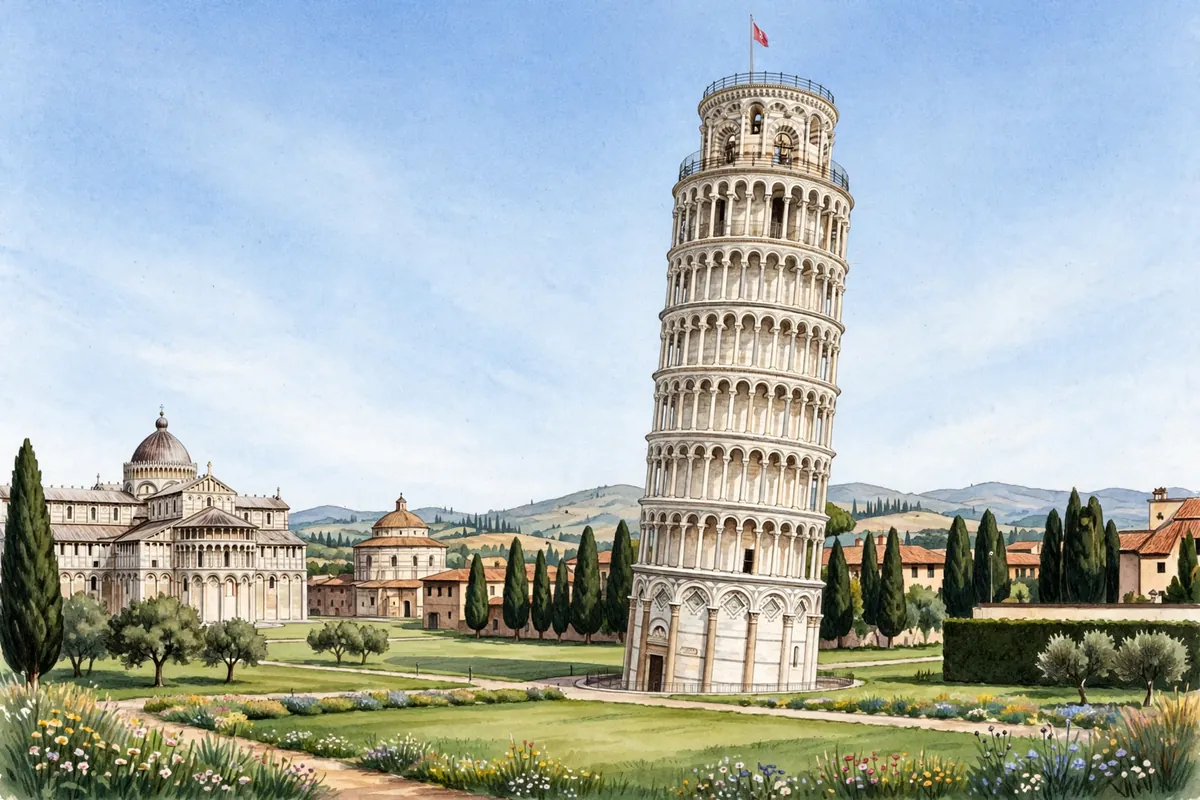
Millions of tourists every year stand in front of it and strike the same pose, pretending to hold it up. The Leaning Tower of Pisa is one of the most famous mistakes in the world. But how does a tower made of marble end up tilted in the first place?
The answer is in the ground. The tower was built on soft, unstable soil with a foundation only about 10 feet deep. That ground couldn't properly support the tower's weight, so it started to sink on one side while builders were still working on it.
Trouble on the Second Floor
The tower is the freestanding bell tower of Pisa Cathedral. Its foundations were laid on August 9, 1173. Just five years later, in 1178, when construction had only reached the second floor, the tower began to sink. The design was flawed from the start.
Then history stepped in. The Republic of Pisa was almost constantly at war with Genoa, Lucca, and Florence, and work stopped for the better part of a century. That long pause gave the soil underneath time to settle. Without it, the tower would almost certainly have fallen over.
Why the Tower Is Actually Curved
When building resumed in 1272, engineers tried a clever fix. They made the upper floors taller on one side than the other to make up for the tilt. The result is that the tower isn't just leaning. It's slightly curved, like a banana.
Work stopped again in 1278 after Pisa lost a sea battle to Genoa. The seventh floor was finally finished in 1319, and the bell chamber was added in 1372. All told, construction took 199 years. The lean kept getting worse through the whole process.
Even today, the tower is 183 feet tall on its low side and nearly 186 feet on its high side. It weighs an estimated 16,000 tons and holds seven bells, one for each note of the musical major scale.
The Rescue That Saved It
By 1990, the tilt had reached 5.5 degrees, and experts were worried. That year the tower was closed to the public, helped along by the sudden collapse of another old tower in the Italian city of Pavia in 1989. The bells were removed to cut weight, and cables were wrapped around the third level and anchored far away.
The solution was surprisingly gentle. Engineers didn't try to straighten the tower. Instead, they carefully removed soil from underneath the raised side, about 77 tons in all, so the tower could settle back a little. The tilt was reduced by about 17 and a half inches, back to where it had been in 1838.
After about a decade of work, the tower reopened on December 15, 2001, with a tilt just under four degrees. It was declared stable for at least another 300 years.
The Soft Soil's Silver Lining
Here's a twist worth savoring. The tower has survived at least four strong earthquakes since 1280. A 2018 engineering study found the reason: the soft soil changes how the tall, stiff tower vibrates, so it doesn't sway in rhythm with earthquake shaking. The same ground that made it lean also helped keep it standing.
There's a famous story, too, that the scientist Galileo dropped two cannonballs of different weights from the top to show they fall at the same speed. It comes from a biography written by his secretary, so historians treat it as "said to have happened."
So the most famous tilt in the world wasn't planned, and it nearly ended in disaster. Instead, a lucky pause, some creative building, and a modern rescue turned a mistake into a treasure that still draws crowds today.