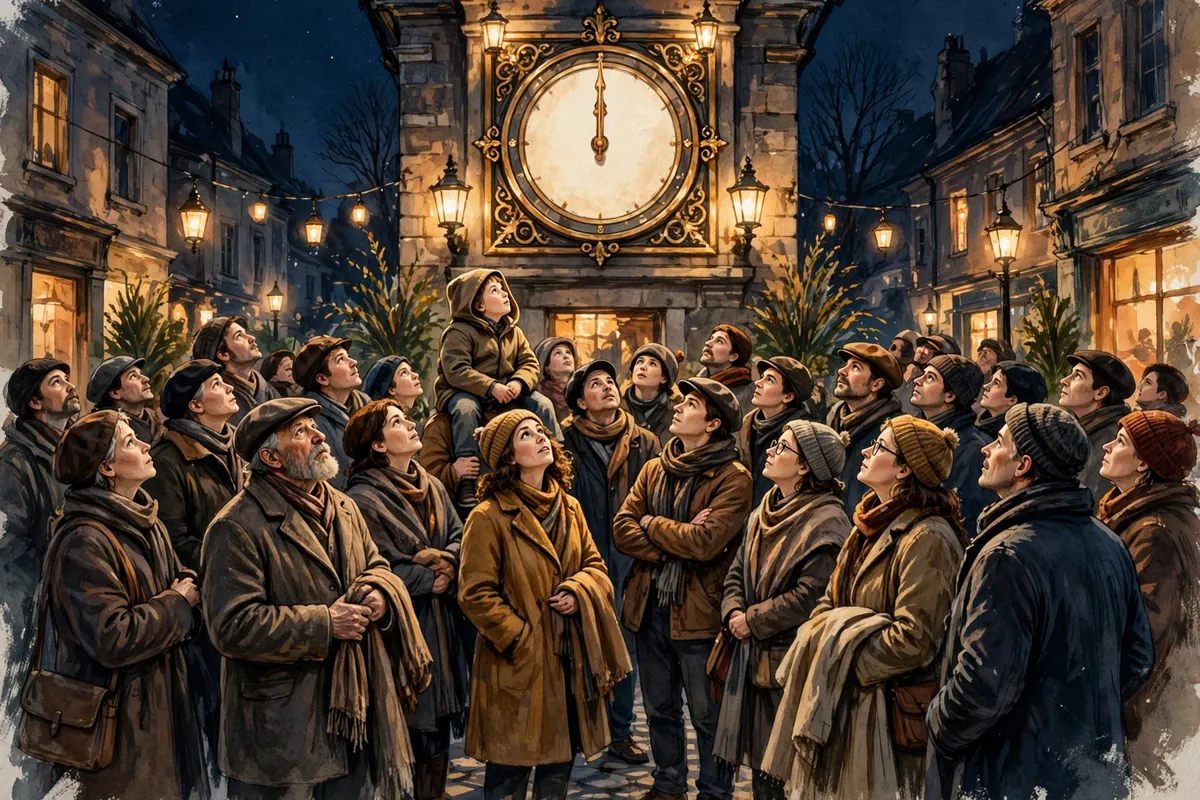
Party hats, noisemakers, a glass of something bubbly, and every eye on the clock. When the countdown hits zero, people kiss, cheer, and sing. Celebrating the new year at the stroke of midnight feels so natural that most of us never stop to ask why we don't wait for sunrise instead.
Here's the short answer: we celebrate at midnight because, in modern timekeeping, midnight is the official moment one day ends and the next begins. Since January 1 is the first day of the year, the new year starts at midnight on that date. Using midnight as the start of the day goes back to ancient Roman timekeeping, and the Romans also gave us January 1 as New Year's Day.
When Does a Day Begin?
It might seem obvious, but people have answered that question in different ways. Many ancient cultures started a new day at sunrise or sunset. The Jewish religious calendar still counts days from sunset. In astronomy, a day has traditionally begun at noon, so that observations made through a single night all counted as the same date.
The Romans took a different approach. They used the midpoint of the night, halfway between dusk and dawn, as the base for their civil day. Today, midnight marks the beginning and end of each day in civil time throughout the world.
How January 1 Became New Year's Day
The Romans dedicated the first day of January to Janus, the god of gateways and beginnings, whose name gave us the word January. Fittingly, he was often pictured with two faces, one looking back and one looking forward.
January 1 became especially important after 153 BC, when it became the day new Roman consuls took office. Since Romans dated their years by who was consul, starting the year on January 1 made sense. Even so, for centuries afterward, parts of Christian Europe celebrated the new year on other dates, including December 25, March 1, March 25, and Easter, until the mid-1700s.
The Ball That Made Midnight Famous
In America, one tradition turned midnight into a nationwide event: the Times Square ball drop. New York Times owner Adolph Ochs organized the first one on December 31, 1907, to welcome 1908. The original ball was made of iron and wood, lit by a hundred light bulbs, and weighed 700 pounds. It began dropping ten seconds before midnight.
To drum up excitement for that first drop, waiters at nearby hotels and restaurants wore top hats with battery-powered lights spelling out "1908," which they switched on right at midnight.
The idea came from time balls, which were dropped at a set time so ships could check their clocks. The Times Square ball has dropped every year since, except in 1942 and 1943, when it was paused for wartime blackouts.
Midnight Travels Around the World
Because every time zone has its own midnight, New Year's arrives in waves. The first places to welcome it are Pacific islands just west of the International Date Line, including Kiribati's Line Islands, Samoa, and Tonga. Among the last are American Samoa and two tiny U.S. islands, Baker and Howland.
So when you raise a glass at midnight this year, you're following a schedule set by Roman timekeepers and a Roman god of doorways. Here's to stepping through that doorway together, right on the dot.