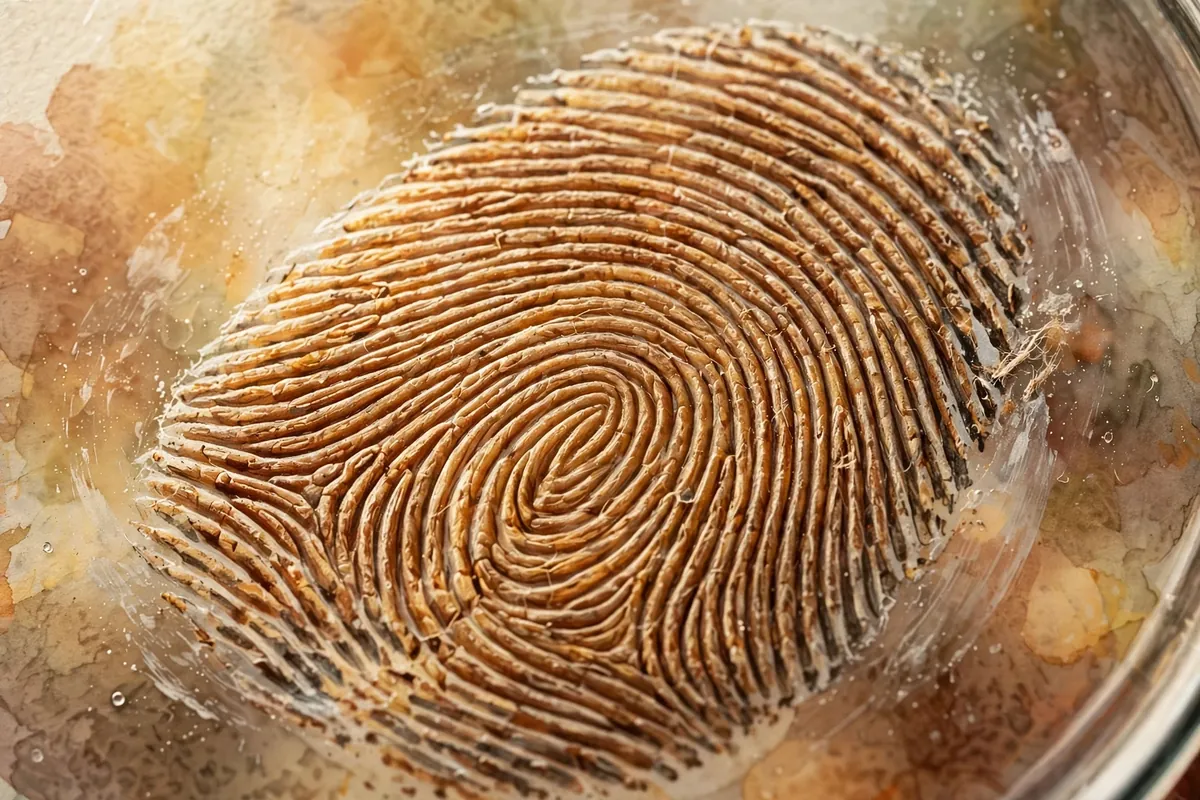
Look closely at the tip of your finger. You'll see tiny raised lines curving into loops, arches, or swirls. Everyone has them, no two people share the same set, and they stay with you your whole life. But why did nature bother giving us these little patterns in the first place?
The short answer is that scientists think fingerprints help us feel. The ridges seem to amplify the tiny vibrations made when your fingertips slide across a surface, sending clearer signals to the nerves that sense fine texture. They may also help a bit with grip on rough or wet surfaces. Surprisingly, though, researchers think it's unlikely they improve grip in general.
Built for Touch
Run your finger over a piece of fabric or a wooden tabletop and you can tell them apart instantly, even with your eyes closed. Those ridges play a part in that. As they brush over bumps and grooves, they boost the vibrations your skin picks up, a bit like how the grooves on a record help a needle pick up music.
The grip idea is the one most people have heard, and it isn't completely wrong. The ridges may help on rough surfaces and may improve contact in wet conditions. But the old notion that fingerprints are simply nature's non-slip coating doesn't hold up as well as their role in touch.
Made Before You Were Born
Your fingerprints formed long before you took your first breath. Around the 13th week of pregnancy, cells at the bottom layer of a baby's skin begin multiplying rapidly and form ridges underneath. By around the 15th week, the patterns are set, and they last a lifetime.
Genes decide the general type of pattern, which is why fingerprints tend to run in families. But small differences in the womb make each one unique. One idea is that the fluid around each developing finger varies slightly, so every fingertip grows in its own tiny environment. That's why even your own ten fingers don't match each other.
It's also why identical twins, who share the same DNA, don't have identical fingerprints. Their prints are very similar, but never the same.
From Skin Patterns to Solving Crimes
People noticed fingerprints for centuries, but using them to identify people is fairly modern. In 1880, a Scottish surgeon named Henry Faulds, working at a hospital in Tokyo, published a paper suggesting fingerprints could identify people and proposed recording them with printing ink. When he offered the idea to London's police a few years later, they turned it down.
In 1892, the scientist Francis Galton published a book called Finger Prints. He calculated that the chance of two different people having the same fingerprints was about 1 in 64 billion. Since the late 1800s, police around the world have used fingerprints to identify suspects and victims.
Surprising Fingerprint Facts
We're not the only ones with them. Gorillas and chimpanzees have fingerprints, and so do koalas. In fact, one study found that even under an electron microscope, a koala's fingerprint can be hard to tell apart from a human's.
A very rare condition called adermatoglyphia leaves people with completely smooth fingertips. It causes no other symptoms, but it led researchers to nickname it immigration delay disease, since people with it often have trouble proving who they are at borders.
So the next time you leave a smudge on a glass or unlock your phone with a touch, remember that those swirls do more than identify you. They're quietly helping you feel the world, one tiny vibration at a time.