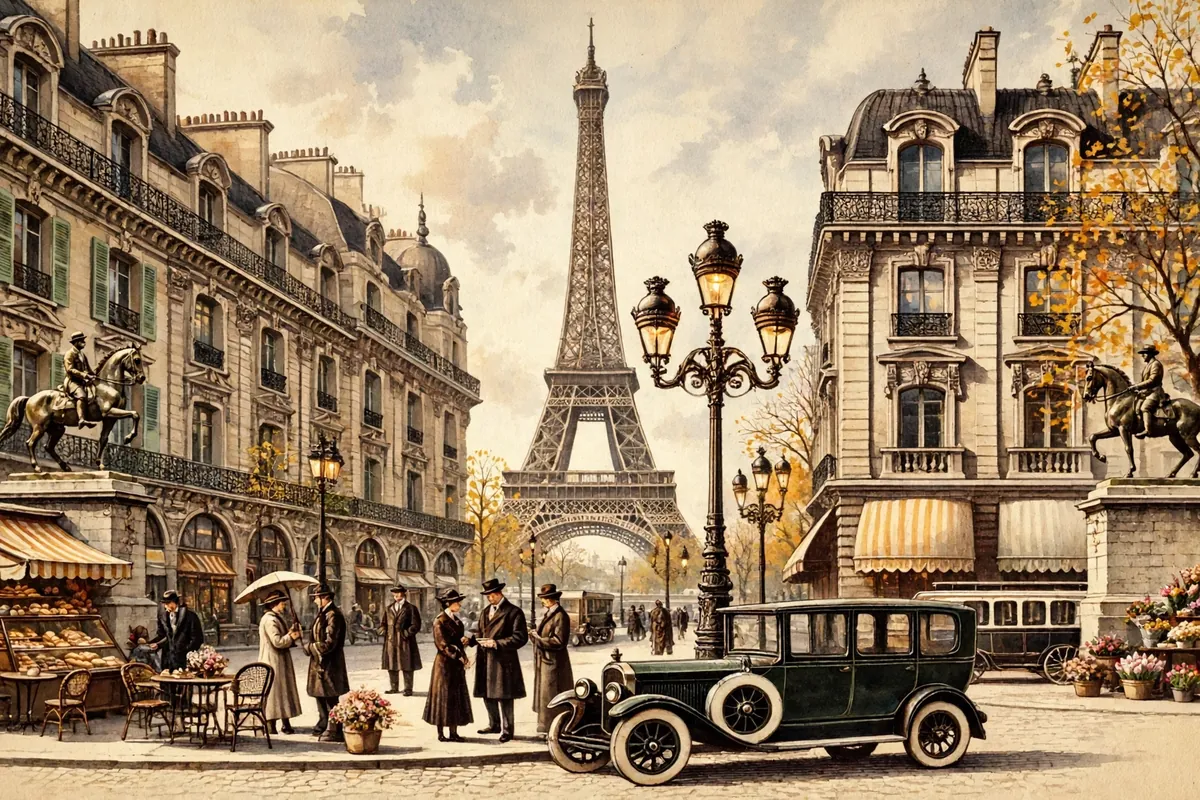
Imagine being offered the chance to buy the Eiffel Tower. Not a souvenir, the actual tower, all of it, to tear down and sell for scrap metal. It sounds absurd, but in 1925 a group of Paris businessmen heard exactly that pitch from a polished official with government paperwork. He was nothing of the sort.
His name was Victor Lustig, a con artist from Austria-Hungary, and he's often called "the man who sold the Eiffel Tower twice." The truth is a little different. Lustig really did "sell" the tower once and walked away with the money. When he came back to try it a second time, his new victim went to the police, and Lustig had to flee before he could collect.
A Newspaper Article Sparks an Idea
In 1925, while staying in Paris, Lustig read a newspaper story about the trouble of maintaining the Eiffel Tower. The monument had begun falling into disrepair, and it was getting more and more expensive to maintain and repaint. The article even suggested public opinion might turn toward removing it.
That was all Lustig needed. He hired a forger to produce fake government stationery and invited a small group of scrap metal dealers to a confidential meeting at an expensive hotel. There he introduced himself as a deputy director-general of the Ministry of Posts and Telegraphs.
The Perfect Pitch
Lustig told the dealers the city could no longer afford the tower's upkeep and the government wanted to sell it for scrap. Because the deal would cause a public uproar, he said, it had to stay secret. He flattered the men by saying they'd been chosen for their reputations as "honest businessmen."
He picked his target carefully: André Poisson, an insecure man eager to climb into the inner circle of the Paris business world. Lustig met him privately and hinted that he was a poorly paid, corrupt official. Poisson took the bait and paid a large bribe on top of the money for the "sale," around 70,000 francs. Lustig promptly fled to Austria.
Why the Second Try Failed
Lustig guessed that Poisson would be too embarrassed to report the scam, and he was right. Watching the newspapers from Austria, he found no mention of it at all. So later that year he returned to Paris to run the same scheme again.
He even found a new buyer willing to purchase the tower. But this time the police were informed, and Lustig fled to the United States to avoid arrest. So the famous nickname stretches the truth: he sold the Eiffel Tower once and tried to sell it twice.
A Career Full of Cons
The tower wasn't his only trick. Lustig also ran the "Rumanian Box" scam, selling a mahogany box he claimed could copy any bill in six hours. He secretly loaded it with real money beforehand. He even pulled a cautious con on Al Capone, borrowing $50,000, returning it untouched to look honest, and then accepting a smaller "loan" to tide him over.
His luck finally ran out over counterfeiting. Arrested in New York in 1935, he escaped from jail with a homemade rope, was caught 27 days later in Pittsburgh, and was sentenced to prison on Alcatraz. He died in 1947 at a federal prison medical center in Springfield, Missouri.
The Eiffel Tower, of course, is still standing. Its only real loss in the whole affair was a little dignity, and perhaps a lesson for every buyer who hears a deal that sounds too good to be true.