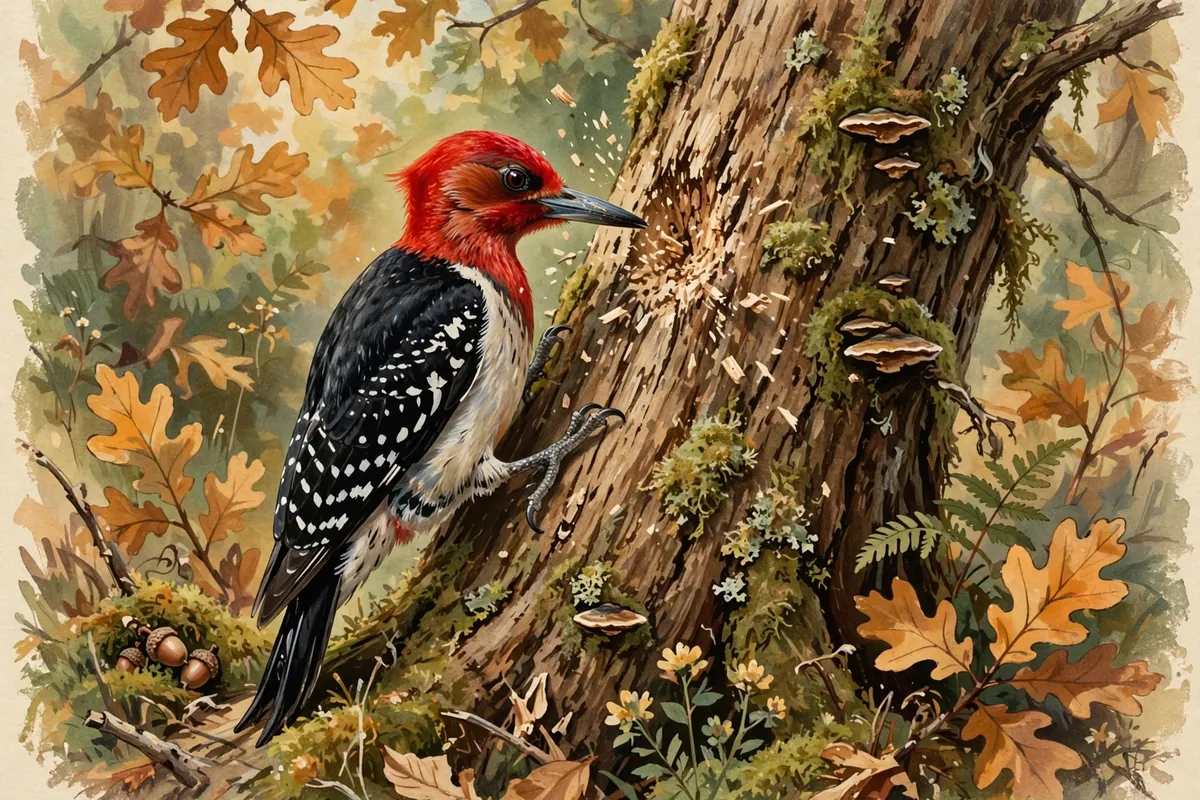
Tap, tap, tap, tap. If you've ever heard a woodpecker at work, you know how fast and hard it hits. The bird is basically using its face as a hammer, over and over, all day long. So why doesn't it end up with a pounding headache, or worse?
The short answer is that a woodpecker's head is built like a piece of safety gear. A small, snug brain, a spongy skull, a flexible beak and an unusually long tongue bone all work together. Computer models suggest that almost all of the energy from each peck gets spread into the bird's body, and only a tiny fraction ever reaches the brain.
A Brain That Doesn't Rattle
Woodpecker brains are relatively small and smooth, and they fit tightly inside the skull. There's very little fluid around the brain and only a narrow space between it and the skull, so it can't slosh back and forth during each strike.
The brain's position matters too. It sits so that it presses against a large area of the skull, which spreads out the stress. Each impact is also extremely short, and the bird's small size helps it handle those sudden stops.
A Skull Like a Sponge
The woodpecker's skull is made of strong but squishy, sponge-like bone. Micro-CT scans show that this spongy bone isn't spread evenly. It's packed into the forehead and the back of the skull, right where the forces hit hardest.
The beak helps as well. It has three layers, including a porous middle layer of bone, and the upper and lower halves are different lengths. Researchers found that this uneven design greatly reduces strain compared with a beak whose halves are the same length.
The Tongue That Works Like a Seat Belt
Here's the oddest part. The woodpecker's tongue is anchored to a hyoid bone that is enormously long. It splits in two, runs along both sides of the neck, wraps all the way around the back of the skull, and ends in the right nostril cavity.
Scientists describe this bone as a kind of safety belt that helps cushion the brain. That long tongue has a day job too. It's sticky and barbed, and the bird uses it to wrap around insects hiding deep inside a hole in the wood.
Taking Breaks and Shielding the Eyes
Pecking warms up the woodpecker's skull. That's one reason the birds tend to hammer in short bursts with little pauses between them, giving their heads a moment to cool off.
Their eyes get protection, too. In the split second before the beak hits the wood, a thick inner eyelid called the nictitating membrane closes. It keeps flying wood chips out and also helps keep the retina from tearing. Their slit-like nostrils are often covered by special feathers to keep out dust.
Scientists Are Still Debating
Not every researcher agrees that the skull acts mainly as a shock absorber. Some argue the real protection lies in adaptations inside the brain itself. Others have found that woodpecker brains build up a protein called tau, which is also linked to brain injury in athletes who suffer repeated concussions. It isn't yet known whether that buildup is harmful, so woodpeckers are now being studied as a model for head injuries.
Engineers have been taking notes all along. The woodpecker's spongy skull and flexible beak have inspired designs for protective helmets and airplane black boxes. Researchers have even built layered, shock-absorbing beams that copy the bird's beak, tongue bone, spongy bone and skull.
So the next time you hear that rapid drumming in the backyard, give the little carpenter some credit. It's not just tough. It's wearing a helmet it was born with.