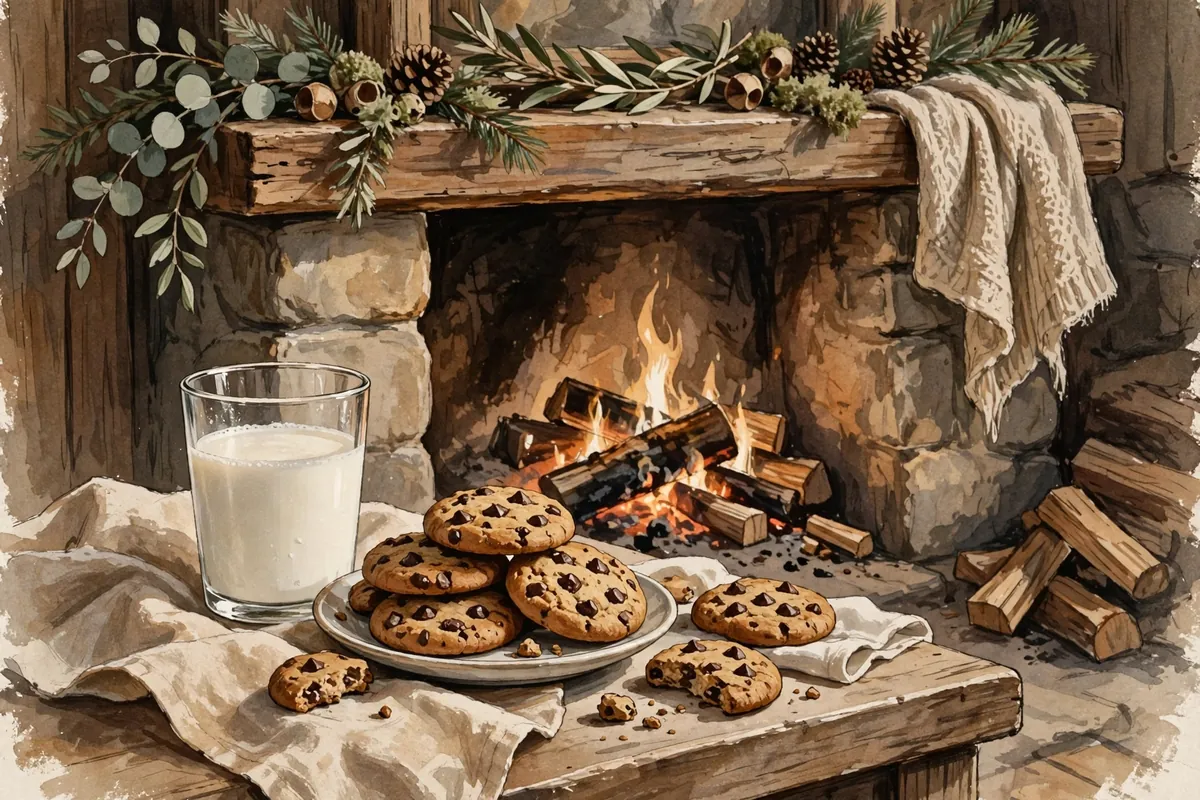
It's one of the sweetest parts of Christmas Eve. The stockings are hung, the tree is lit, and the kids carefully set out a plate of cookies and a glass of milk for Santa. In the morning, there are crumbs on the plate and the glass is empty. Proof, right?
Here's what we know. In the United States and Canada, children have been leaving cookies and milk for Santa on Christmas Eve since the 1930s. Nobody can point to a single moment when it began. But the idea of leaving a treat for a holiday gift-giver is much older, and it has a close cousin in the Dutch tradition of Sinterklaas.
A Carrot for Sinterklaas's Horse
In the Netherlands, children celebrate Sinterklaas, based on Saint Nicholas, in early December. Before bed, each child leaves a shoe by the fireplace, often with a carrot or some hay in it and a bowl of water nearby, all for Sinterklaas's horse. The next morning, they find candy or a small present in the shoe.
In Belgium, families sometimes add a cup of coffee for Sinterklaas himself. It's the same sweet idea: a small thank-you left out for a visitor who brings gifts in the night.
How Santa Came to America
The link to the Dutch makes sense. Dutch settlers brought the legend of Sinterklaas to New Amsterdam, which later became New York City, in the 1600s. Over the 19th century, that figure grew into the American Santa Claus.
A big boost came from the 1823 poem "A Visit from St. Nicholas," which describes Saint Nicholas arriving on Christmas Eve in a sleigh pulled by flying reindeer. That poem helped shape the Santa we picture today.
Some folklorists see even older roots. Before Christianity, Germanic peoples celebrated a midwinter festival called Yule, and the god Odin was said to ride the winter sky on an eight-legged horse named Sleipnir, bringing gifts. One folklorist argued that Santa's look and his nighttime rides owe a lot to Odin, the white-bearded gift-bringer of the north.
Cookies Had Their Own Journey
Christmas cookies have deep roots too. In medieval Europe, new ingredients like cinnamon, ginger, and almonds made spiced holiday biscuits possible, and by the 1500s they were popular across Europe. The Dutch brought some of the earliest Christmas cookies to America in the early 1600s.
Shaped cookies took off in the U.S. at the end of the 1800s, when cheap imported cookie cutters from Germany became easy to find. That's why so many Santa cookies today come shaped like candy canes, reindeer, Christmas trees, stars, and angels.
The Evidence Kids Look For
Psychology professor Jacqueline Woolley has studied how children decide whether Santa is real. She found that kids reason quite logically, weighing evidence just as adults do. And one piece of "hard evidence" that convinces them, she noted, is the sight of half-eaten cookies and empty milk glasses on Christmas morning.
Of course, many grown-ups will admit that the cookies don't always go to Santa. Plenty of parents end up eating them themselves.
Whatever its exact beginnings, the tradition does something lovely. It teaches kids to think of someone else on the busiest night of the year, even if that someone has a big belly and a sleigh. And it gives the grown-ups a good excuse for a midnight snack.