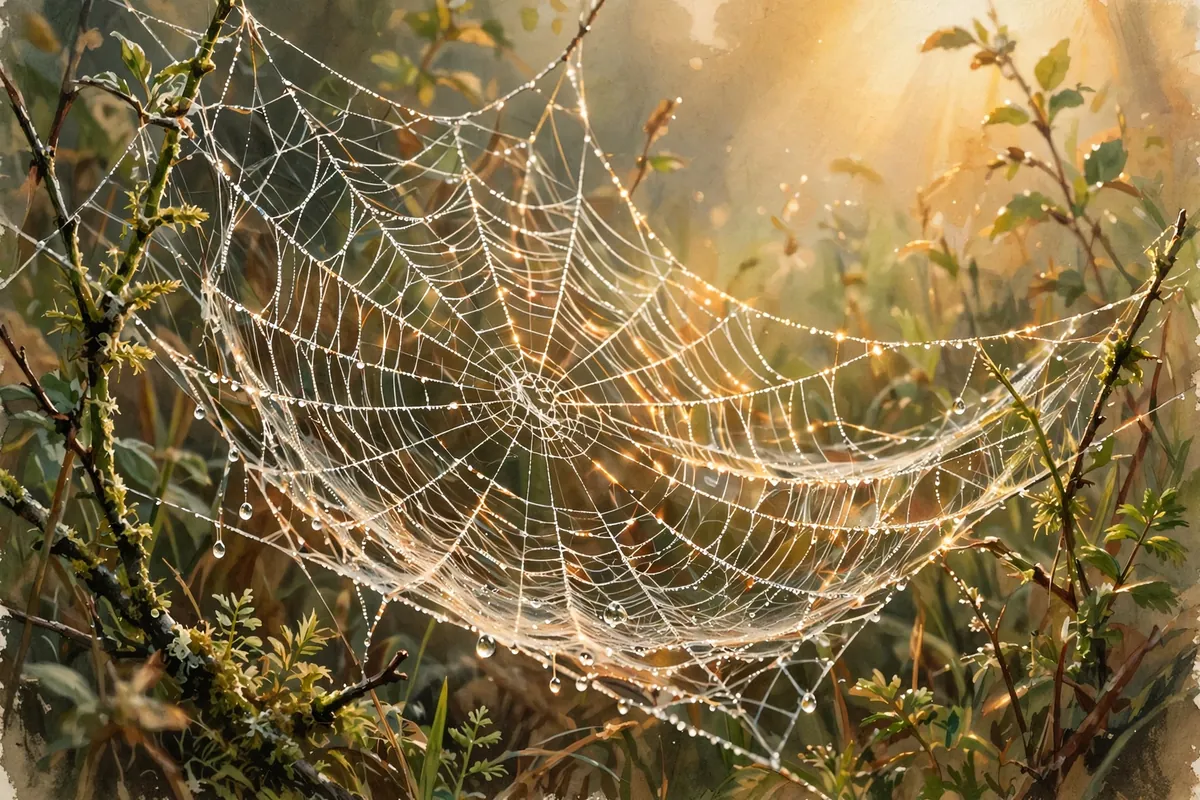
A spider web looks like the most fragile thing in the garden. One swipe of a broom and it's gone. Yet you've probably heard the claim that spider silk is stronger than steel. How can a thread you can barely see compete with the metal in bridges and skyscrapers?
The claim is true, with a catch: it's true weight for weight. A strand of the spider's dragline silk is roughly as strong as high-grade steel of the same thickness. But silk is about one-sixth as dense as steel, so a given weight of silk is about five times as strong as the same weight of steel. And in one key way, silk beats steel outright.
Strong Versus Tough
Scientists separate two ideas that we often lump together. Strength is how much pulling force a material can take before it snaps. Toughness is how much energy it can soak up before breaking. A material can be strong but brittle, or a little weaker but able to stretch and absorb a blow.
Spider silk is unusual because it is both strong and stretchy. Steel and Kevlar are stiff. Silk gives a little. That combination lets a silk fiber absorb a large amount of energy before it fails, which is exactly what a web needs when a fast-flying insect slams into it. Weight for weight, silk isn't as strong as Kevlar, but it is tougher than both Kevlar and steel.
A Thread Light Enough to Wrap the Planet
Because silk is made mostly of protein, it's incredibly light. A strand of spider silk long enough to circle the entire Earth would weigh only about 2 kilograms, or roughly 4.4 pounds. That's less than a bag of sugar.
Dragline silk, the line a spider uses as a safety rope and for the frame of its web, also holds up well in extreme conditions. It keeps its strength below minus 40 degrees and up to about 428°F. Oddly, it reacts to water by shrinking, sometimes up to half its length. One popular idea is that this helps keep webs taut.
The Champion Spinner
Not all silk is equal. The toughest known spider silk comes from Darwin's bark spider, discovered in Madagascar in 2009. Researchers measured its silk as more than twice as tough as any silk described before it, and over 10 times tougher than Kevlar. This spider builds the largest known orb webs, hung right above rivers and lakes, with bridge lines spanning up to 82 feet.
Spiders also make different kinds of silk for different jobs. They have two to eight spinnerets, usually in pairs, each connected to glands inside the body. Some silk is for safety lines, some for sticky capture threads, and some for gluing a web to a surface. All spiders make silk, even the ones that never build webs.
Why Don't We Use It Everywhere?
If spider silk is so amazing, why aren't we wearing it? The trouble is collecting it. Extracting and processing spider silk is slow and difficult. The largest known piece of cloth made from spider silk is a golden textile about 11 feet by 4 feet, made in Madagascar in 2009. It took 82 people four years and more than a million golden orb spiders.
Scientists have tried some creative shortcuts. A Canadian company once bred goats that produced spider silk protein in their milk. Turning that protein into a fiber as good as the real thing proved difficult, though. In 2012, spider silk fibers were even used to make a set of violin strings.
So the next time you walk face-first into a web on the back steps, give the little builder some credit. It just spun a thread that engineers still can't quite match.