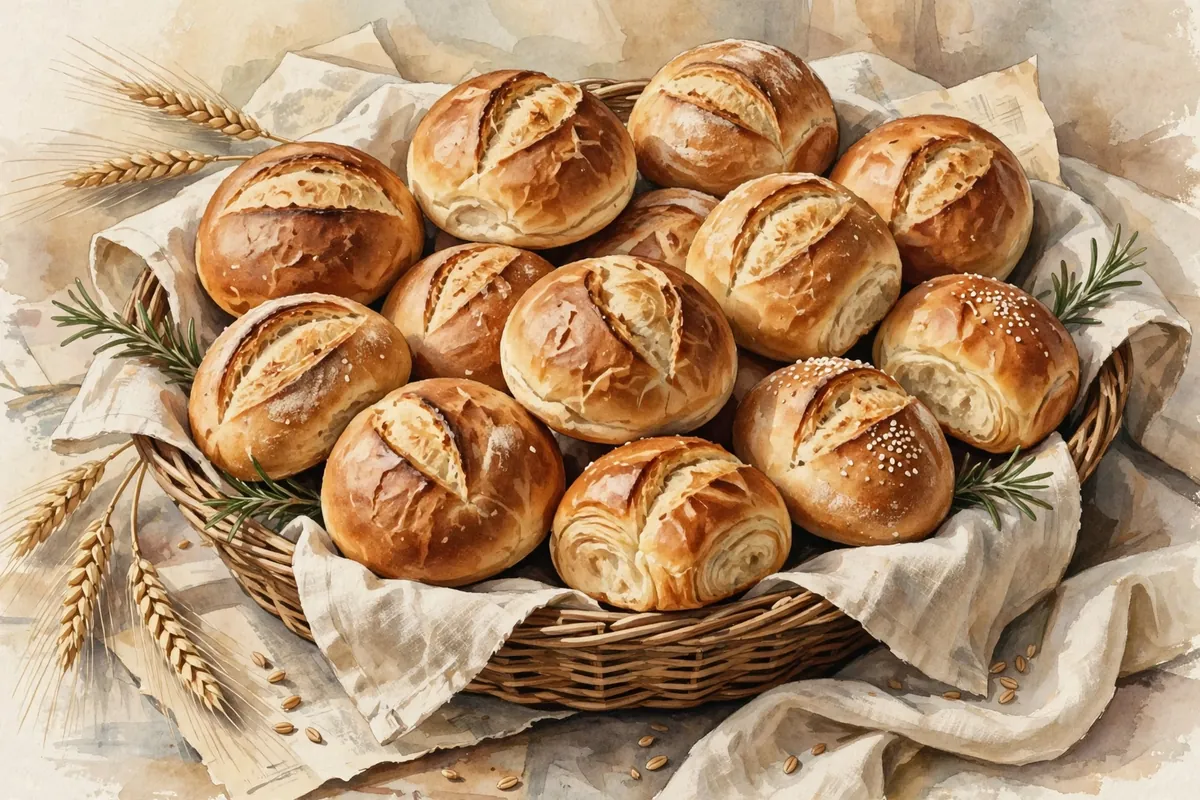
Walk into a bakery and ask for a baker's dozen, and the clerk knows exactly what you mean: thirteen. It's a cheerful little bonus, one extra roll for nothing. But why would bakers, of all people, decide that a dozen was really thirteen?
The best-documented explanation is about business, not generosity. In medieval England, bakers sold bread to middlemen who resold it, and they handed over thirteen loaves for the price of twelve. That extra loaf, called the vantage loaf, was the reseller's profit. A more famous story says bakers added the loaf to avoid punishment for underweight bread, but that explanation has a problem.
The Vantage Loaf
The Oxford Dictionary of English traces the phrase to this old practice of giving a retailer a thirteenth loaf with every dozen. The custom is documented in medieval bread regulations.
The Liber Albus, compiled in the early 1400s, records an “ancient manner” in which bakers gave female bread sellers thirteen pieces of bread for twelve. Historian Sharon Wells has described the rule as legislation that set the profit margins of these bread hucksters, who bought from bakers and resold to customers.
The Story About Harsh Penalties
The explanation most people have heard involves the law. In the 13th century, England adopted the Assize of Bread and Ale, the first law in British history to regulate the sale of food. It controlled the price, weight, and quality of bread and beer, and lawbreakers faced fines and punishments.
The rules were strict and a little odd. The price of a loaf stayed the same, but its required weight rose or fell with the price of wheat. When wheat got more expensive, the loaf simply got smaller.
According to the popular story, bakers threw in a thirteenth loaf so nobody could accuse them of shortchanging customers. But surviving records show inspectors weighed individual sample loaves. It's unclear how an extra loaf would have protected a baker if one particular loaf came up short. Records from Leicester even describe thirteen pennyworth of bread sold for twelve pence while still requiring every loaf to be full weight.
Thirteen, Fourteen, or Fifteen
The phrase shows up in writing from the late 16th century. It has also been called a devil's dozen or a long dozen. Today, its broadest use is simply any group of thirteen things, baked or not.
And it hasn't always meant thirteen. An 1811 dictionary of slang by Francis Grose defined a baker's dozen as fourteen, explaining that fourteen rolls were allowed to anyone buying a dozen. In Texas, you may even hear of a Texas dozen, which usually means fifteen, for things like flowers or baked goods.
Why Twelve in the First Place?
The dozen itself is very old. It may be one of the earliest groupings people used, perhaps because there are about twelve cycles of the Moon in a year. Twelve is also handy because it divides evenly by 2, 3, 4, and 6. The word comes from the French douzaine, meaning a group of twelve.
So the next time a baker slips that extra roll into your bag, you're getting a taste of medieval business history. It may have started as a reseller's profit, but today it just feels like a small kindness, and somehow it tastes even better that way.