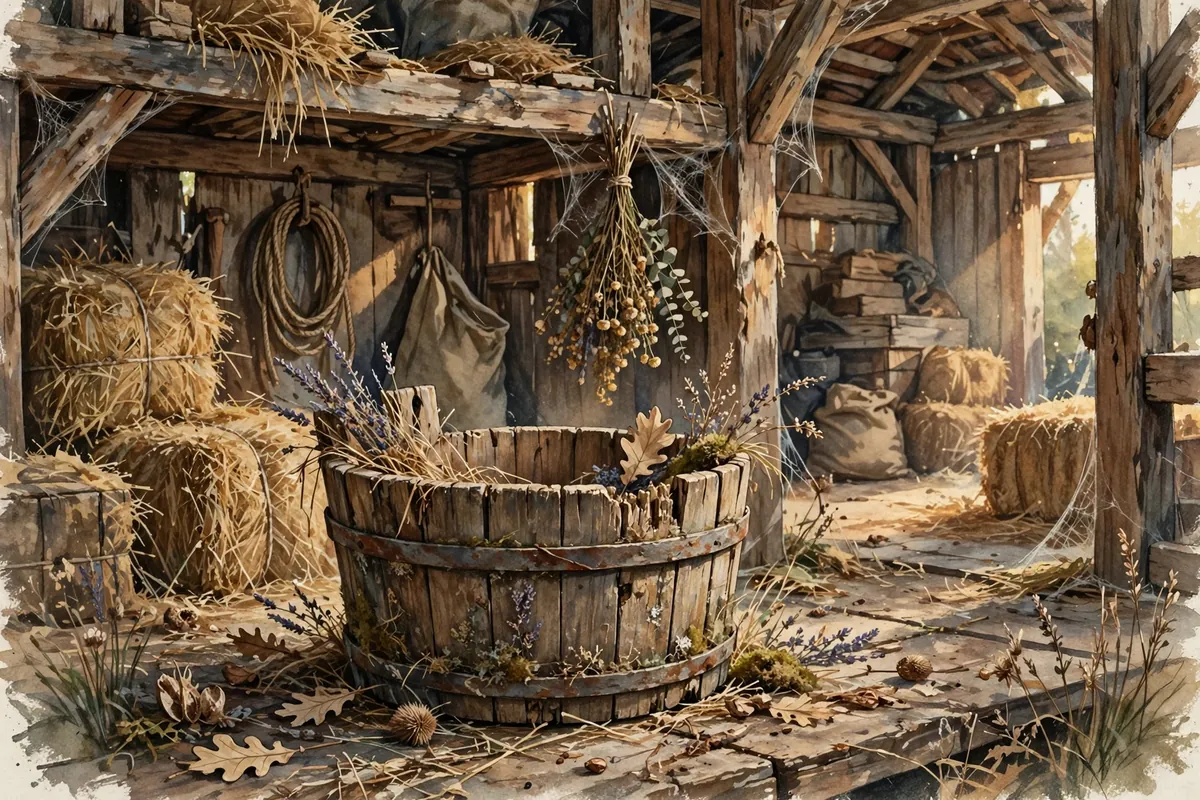
We use it with a wink: Grandpa says he's not planning to kick the bucket anytime soon, or someone's old car finally kicks the bucket on the highway. Everyone knows it means to die. But why a bucket? And why kick it?
Here's the honest answer: nobody knows for sure. The phrase first shows up in print in a 1785 slang dictionary, defined simply as to die. Since then, people have offered several explanations. The one favored by the Oxford English Dictionary says the bucket wasn't a pail at all, but an old word for a wooden beam used to hang things, including animals at slaughter.
The Beam Theory
Centuries ago, bucket could mean a beam or yoke used to hang or carry things. Slaughtered pigs were hung from such a beam, and the animals might kick against it as they died. That struggle, the theory goes, gave us the expression.
This meaning of bucket may come from French words such as trébuchet or buque, meaning balance. It hasn't vanished, either. In the Norfolk dialect of England, bucket can still mean that kind of beam. Even Shakespeare used the word this way in Henry IV, Part 2, when Falstaff mentions someone who gibbets on the brewer's bucket.
The Grim Pail Theory
The most common popular explanation is darker. It imagines a person standing on an upturned pail with a noose, then kicking the pail away. An 1823 slang dictionary even told a story about a man named Bolsover who supposedly did exactly that.
It's a vivid tale, and that's probably why so many people repeat it. But scholars point out that the true origin is still disputed, so the story may have been invented to explain a phrase that already existed.
Holy Water and a Stubborn Goat
Another explanation comes from an old Catholic custom. After a death, a bucket of holy water was placed at the feet of the body so visitors could sprinkle it as they prayed. Some writers argued the phrase grew from that tradition.
Others look even further back, to a Latin proverb about a goat that kicks over its pail after being milked. A 1524 poem used that image for anyone who spoils a fine beginning with a bad end. Still another idea is simpler: a dying person might stretch out their legs and kick a nearby bucket.
The Bucket List and Other Cousins
The phrase has plenty of relatives. In North America, people sometimes say someone kicked off. A related British expression is to hand in your dinner pail, the bucket that once held a worker's lunch.
There's also a false cousin. The old American and Caribbean word kickeraboo, meaning to die, was once explained as a garbled version of kick the bucket. Today, experts think it more likely came from West African creole languages. A similar word with the same meaning was recorded in Sierra Leone as early as 1721.
And of course there's the bucket list, a list of things you want to do before you die, which comes straight from kick the bucket. The phrase even appears in Old Man Mose, a jazz song recorded by Louis Armstrong in 1935.
So the next time someone jokes about kicking the bucket, you can share a few theories. Just don't promise them a final answer. Even the experts are still arguing about this one.