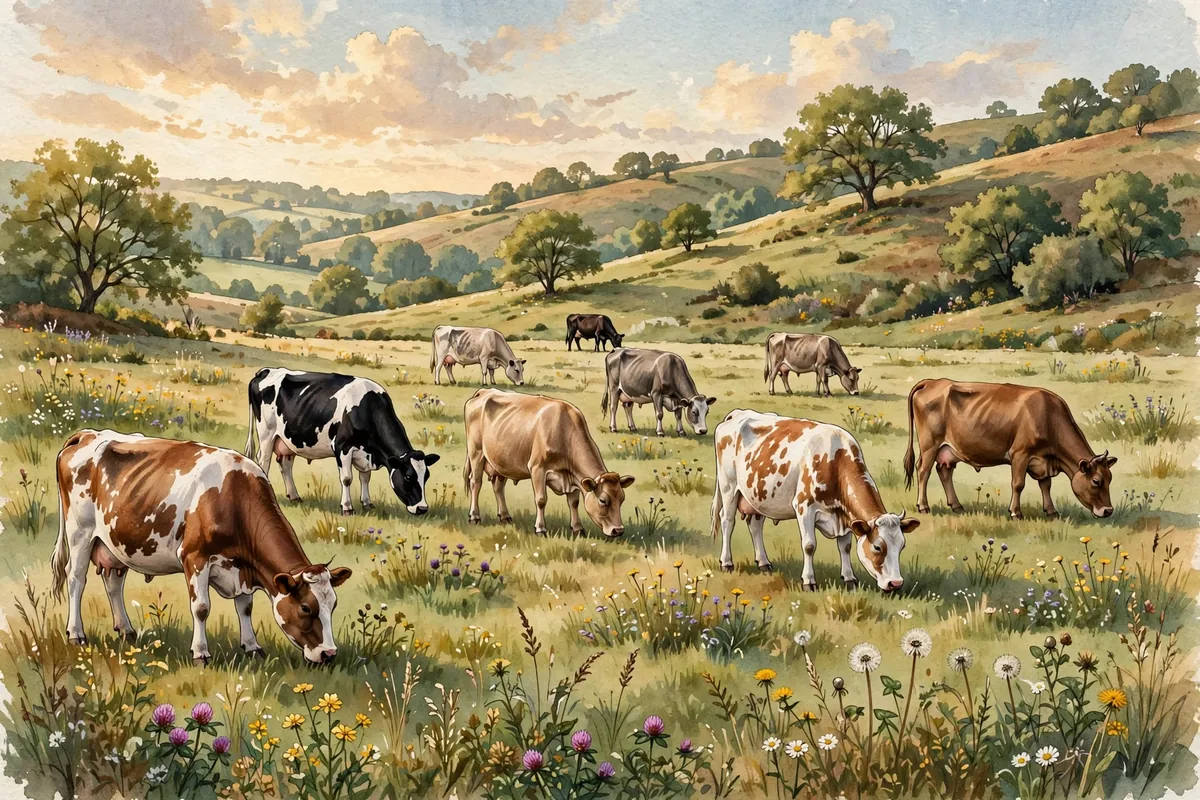
You may have heard that cows like to face north. It sounds like the kind of trivia someone tosses out on a long drive past farm country. But scientists actually went looking, and what they found is more interesting than a simple yes or no.
Here's the short answer: not exactly. Some researchers found that cows and wild deer tend to line their bodies up along a north–south line while they relax, which means a cow could be facing north or south. Other scientists later tried to repeat the finding and couldn't, so the question is still open.
What the Researchers Noticed
The idea came from looking at herds from above, in satellite pictures. In the images, resting cows and deer tended to point their bodies north–south rather than in random directions.
Then came the detail that got people talking. Under high-voltage power lines, the pattern disappeared. Power lines create magnetic fields of their own, so the finding suggested that magnetism was behind the lineup, and that the lines were throwing the animals off.
Then the Doubts Rolled In
Science works by checking and checking again. In 2011, a different group of researchers reported that they could not replicate those findings using different Google Earth images. When a result can't be repeated, scientists treat it with caution until more evidence comes in.
That doesn't prove the first team was wrong, and it doesn't prove they were right. It simply means the jury is still out. For now, "cows face north or south, maybe" is about as far as the evidence goes, which makes the "maybe" in this story an honest one.
Can Animals Really Sense Magnetism?
The idea isn't as far-fetched as it sounds. Many animals can detect Earth's magnetic field, a sense called magnetoreception. It has been found in fish, amphibians, reptiles, birds, and mammals, and it's mainly used for finding direction and navigating.
Migratory birds are the best-known example. Experiments suggest they use a special protein in their eyes to perceive magnetic fields. Among mammals, wood mice taken away from home and deprived of sight and smell cues still turned toward home, until scientists flipped the magnetic field around their cage.
Dogs may have a version of this sense too. One study found that dogs prefer to line their spines up north–south when they do their business, at least when the magnetic field is calm. Research on the magnetic sense of dogs even earned an Ig Nobel Prize in 2014, an award meant to honor work that makes people laugh and then think.
Red foxes may be in on it as well. When they pounce on mice and voles with their famous high jump, they seem to prefer a north-eastern direction, and their successful attacks are tightly clustered to the north.
A Few Things We Do Know About Cows
While the compass question gets sorted out, cows have plenty of other surprises. Their eyes sit on the sides of their heads, giving them a field of view of about 330 degrees. As prey animals, cattle evolved to watch for predators coming from almost any direction.
They also sleep less than you might guess, about 4 hours a day on average. And despite what you may have heard, cattle don't sleep standing up. They lie down to sleep deeply.
So the next time you drive past a pasture and the whole herd seems to be pointing the same way, take a second look. You might be seeing a built-in compass at work. Or you might just be seeing cows who agree on the best patch of grass.