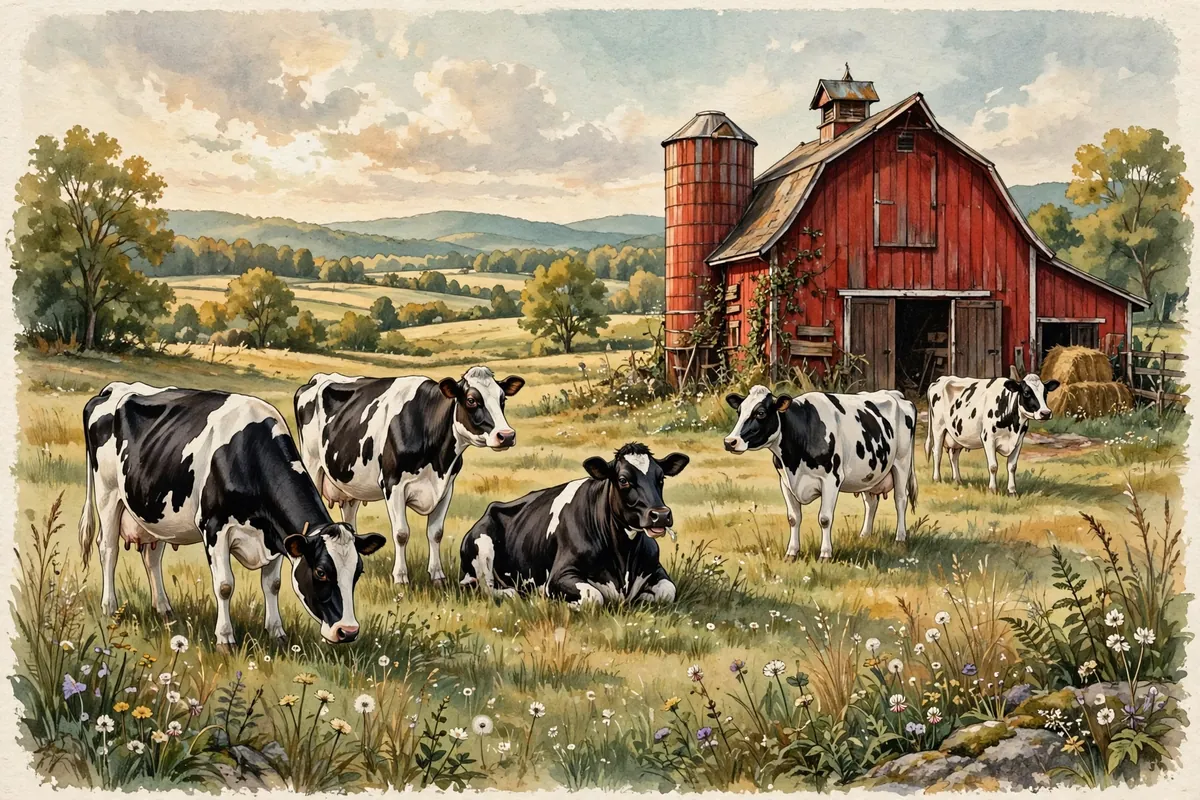
Wisconsin wears its nickname proudly. "America's Dairyland" has appeared on its license plates for decades, and the state quarter features a wheel of cheese and a Holstein cow. Some fans even wear foam cheese wedges on their heads at football games. But how did one state become so closely tied to milk and cheese?
The short answer: Wisconsin was the nation's top dairy-producing state from 1915 until 1993, and it built its whole identity around that success. The nickname became the state's official slogan in 1940 and soon went on license plates, at first replacing the word Wisconsin itself. But the dairy boom actually began with a crisis, when Wisconsin's early wheat farms ran into serious trouble in the 1800s.
When Wheat Was King
Wisconsin's first farms grew wheat almost exclusively. At their peak, they produced around 27 million bushels. But by the 1860s, the wheat fields were suffering from badly depleted soil and insect infestations, and harvests and quality dropped.
In the 1880s, encouraged by the Wisconsin Dairymen's Association, farmers across the state began switching to dairy. Raising cows and the crops to feed them proved far better suited to the land.
The Railroad Car That Helped Build Dairyland
A key invention made the switch possible: the refrigerated rail car. Milk, butter, and cheese spoil quickly, so dairy farmers need a way to get their products to distant markets. Cold rail cars opened those markets up. By the start of the 1900s, more than 90 percent of Wisconsin farms were dairy farms.
Science helped too. In 1890, Stephen Babcock of the University of Wisconsin–Madison developed a test to measure the fat content of milk. That led to higher-quality milk and dairy products, and by 1915 Wisconsin had become the leading dairy state.
A State That Takes Cheese Seriously
In the 1800s, much of Wisconsin's milk was turned into cheese because it kept longer than milk or butter. Local cheesemakers even invented new kinds. Colby cheese was created by Joseph Steinwand and named after the township of Colby, Wisconsin, and brick cheese, now traditional on Detroit-style pizza, was born there too.
Wisconsin was the first state to grade cheese by quality, starting in 1921. It's also the only state that requires cheese to be made or supervised by a licensed cheesemaker, and it requires buttermakers to be licensed as well. As of 2020, Wisconsin produced about a quarter of all the cheese made in the United States. Even the nickname Cheesehead started as a jab from Illinois sports fans before Green Bay Packers supporters made it their own, cheese-shaped foam hats and all.
The Great Margarine Fight
Wisconsin's devotion to butter led to some odd laws. In 1895, the state banned the sale of yellow margarine to protect its dairy industry, so manufacturers made pink margarine instead. The ban lasted until 1967, making Wisconsin the last state to drop its margarine ban. Even today, restaurants there aren't supposed to serve margarine in place of butter unless a customer asks for it.
California overtook Wisconsin in milk production in 1993, and many small family farms have closed since. Still, the state remains a dairy powerhouse with thousands of dairy farms. So the next time you enjoy a slice of Colby or a pat of real butter, tip your hat to the cows of America's Dairyland.