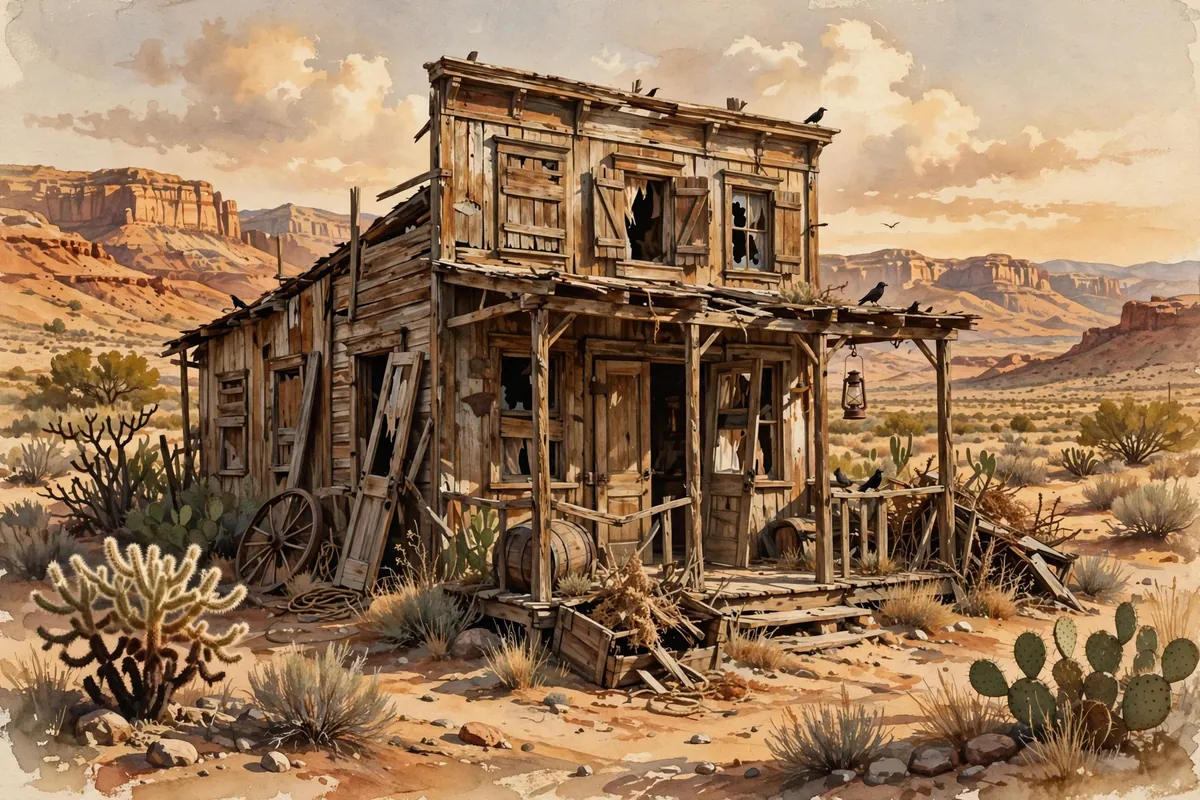
Ghost towns have a special pull on the imagination. Empty saloons, sun-bleached churches, a hotel with the curtains still hanging. It's natural to wonder which state is the ghost town capital of America.
The honest answer is that there's no official winner, because experts don't even agree on what a ghost town is. Lists are incomplete and counts depend on the definition. But if you widen the map to all of North America, one place stands out: the Canadian province of British Columbia, which has more than 1,500 abandoned or semi-abandoned towns and localities, more than any other jurisdiction on the continent.
What Counts as a Ghost Town?
Generally, a ghost town is an abandoned or largely emptied settlement that still has visible buildings or roads. But writers argue over the details. Some only count places deserted for economic reasons. Some insist there must be visible ruins. Others allow for a few people still living there. A few writers even argue that a place with visible ruins shouldn't be called a ghost town at all.
T. Lindsey Baker, author of Ghost Towns of Texas, offered a simple definition: a town for which the reason for being no longer exists. With rules that loose, the same place can make one list and miss another, which is why state-by-state rankings are so slippery.
Boom and Bust in the West
The western United States is full of ghost towns, many of them former mining and railroad towns. In Nevada, most ghost towns were mining boomtowns abandoned when the mines closed. Others were built as mill sites or supply points for nearby mines.
California's Bodie is one of the most famous. After a profitable vein of gold was found, it boomed in 1876, and by 1879 it had about 2,000 structures and around 8,000 people. By 1915 it was being called a ghost town. Today it's a state historic park that draws about 200,000 visitors a year.
Prairie Towns That Faded Away
Not every ghost town was a mining camp. In Kansas, many towns boomed along the Oregon and Santa Fe Trails, then faded when railroads went elsewhere. Some towns even picked up and moved to be near the tracks.
Politics played a part, too. Before the Civil War, Kansas towns were often either proslavery or abolitionist, and when Kansas became a free state in 1861, proslavery towns died out. Others bet everything on becoming the county seat, and if they lost, residents drifted away. Later, highways let people drive to bigger towns to shop, and small-town businesses closed.
Ghost Towns Everywhere
Ghost towns exist on every continent, even Antarctica. Some were emptied by disease, like hamlets in England after the Black Death, or places in eastern Arkansas abandoned after more than 7,000 Arkansans died in the Spanish flu epidemic of 1918 and 1919. Dams, wars, forced moves and rerouted roads have emptied towns, too. Others were poisoned. Picher, Oklahoma, near the Kansas border, was once a major source of zinc and lead, but decades of mine waste contaminated the area and led to lead poisoning in children.
A few ghost towns have even come back to life through tourism. So whether you're road-tripping through Nevada or British Columbia, keep an eye out for an old storefront at the side of the road. Every one of them has a story to tell.