Cities are supposed to stay put. Streets, churches, and theaters sit on solid ground and stay there for centuries. But in Mexico City, one of the largest cities in North America, the ground itself has been slowly giving way.
The short answer: Mexico City is built on the bed of a drained lake, and its soft, waterlogged clay is collapsing as groundwater is pumped out. Since the early 20th century, some areas have sunk as much as 30 feet, and parts of the city continue to sink by up to about 20 inches a year.
A City Built on a Lake
Mexico City began as Tenochtitlan, the capital of the Mexica, built around 1325 on islands in Lake Texcoco. Much of the valley once lay under a system of connected salt and freshwater lakes. The Aztecs built dikes to separate fresh water for farming and to prevent floods. By the time the Spanish arrived, the Aztec Empire reached across much of Mesoamerica, touching both the Gulf of Mexico and the Pacific.
After the Spanish siege of 1521, the city was nearly destroyed and rebuilt. Those dikes were wrecked, and in colonial times the Spanish regularly drained the lake to prevent flooding. Starting in the 1600s, Lake Texcoco was drained until, within the city, none of its water remained.
Why the Ground Keeps Dropping
With the lake gone, the city rests on the old lake bed's heavily saturated clay. As people pump out more and more groundwater, that soft clay compacts and collapses. Scientists call this groundwater-related subsidence.
The sinking isn't just a curiosity. It causes problems with runoff and wastewater, leading to flooding, especially in summer. Today the entire old lake bed is paved over.
A Cathedral on Shaky Ground
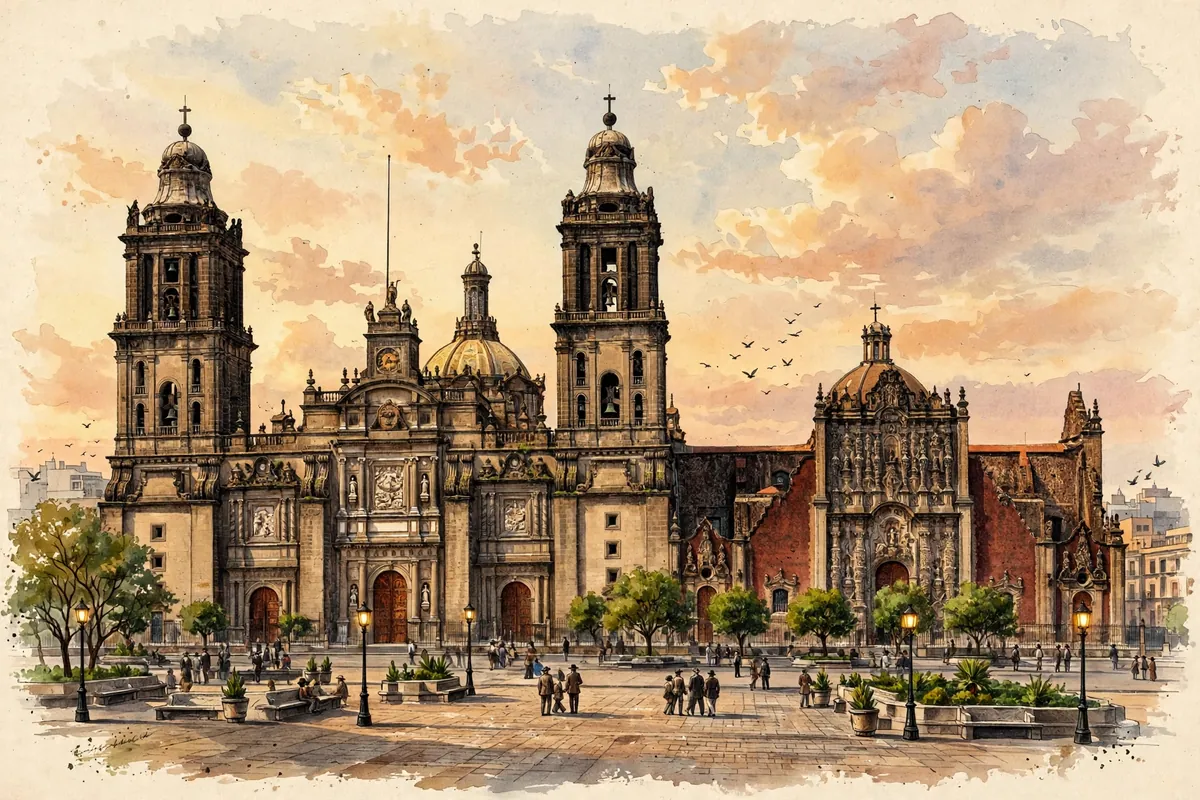
The Metropolitan Cathedral, one of the city's great landmarks, shows the struggle. Its builders knew the soft soil was dangerous, and it took 42 years just to lay the foundation. Even so, much of the cathedral was built over the remains of earlier pre-Hispanic structures, which left it with an uneven foundation from the start.
Falling water tables and faster sinking eventually put the cathedral on the World Monuments Fund's list of the 100 Most Endangered Sites. Restoration work beginning in the 1990s stabilized the building, and it was removed from the list in 2000.
A Theater Too Heavy for the Soil
Another landmark, the Palacio de Bellas Artes, is a white marble theater and museum. It is so heavy that it has gradually been sinking into the soft ground below.
Construction began under President Porfirio Díaz and, after an interruption during the Mexican Revolution, finished in 1934. It remains one of the city's most admired buildings, sinking or not.
A City on the Move
Mexico City is the oldest capital city in the Americas and one of only two founded by Indigenous peoples. Its history is layered right into the ground, from Aztec islands to Spanish churches to modern streets.
Earthquakes are frequent there too, adding another challenge for buildings on soft clay. Engineers and city leaders face a long, difficult job keeping the city steady.
Still, millions of people live, work, and celebrate in Mexico City every day. It's a living reminder that even the ground beneath a great city has a story, and sometimes that story is still being written, one inch at a time.