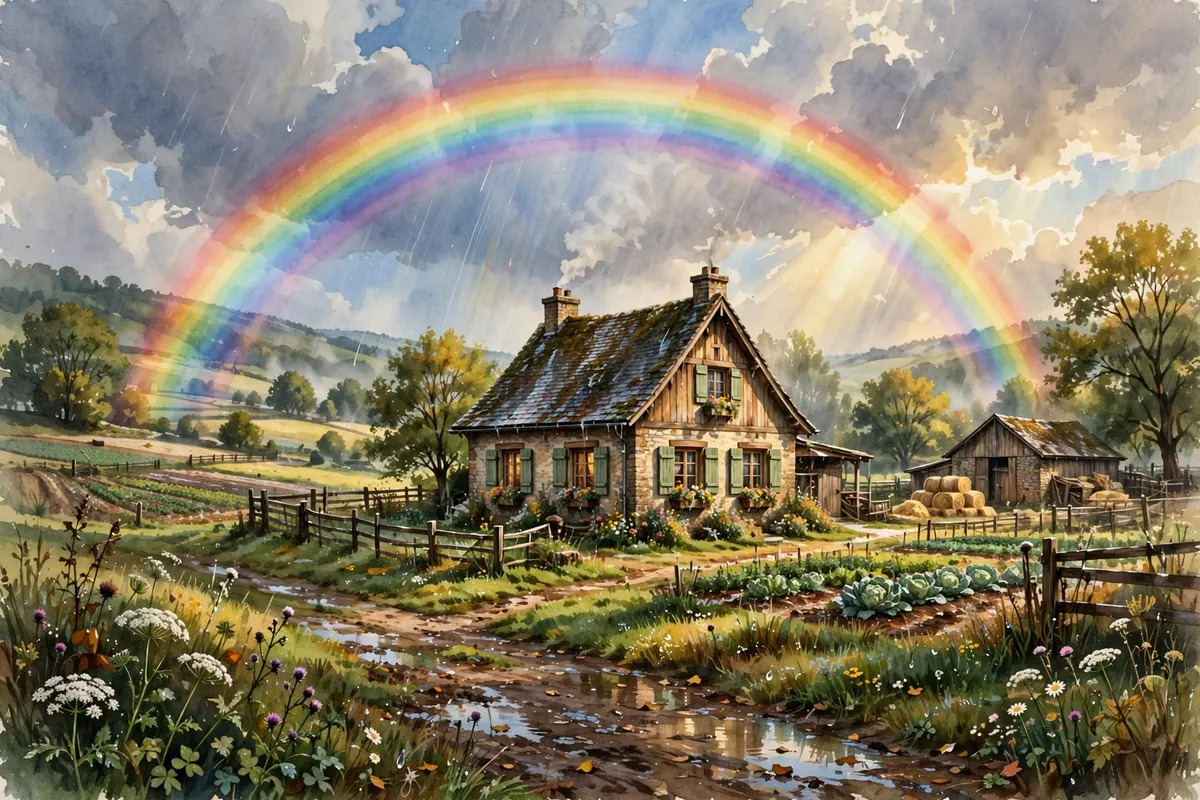
There's something about a rainbow that makes people stop what they're doing. A storm rolls away, the sun peeks out, and a perfect band of color stretches across the sky. It looks almost too good to be real. So what's actually happening up there?
The short answer is that each raindrop acts like a tiny prism. Sunlight enters a drop and bends, bounces off the back of the drop, and bends again as it leaves. Because each color bends by a slightly different amount, white sunlight gets split into a spread of colors. Millions of drops working together paint the arc you see, always in the part of the sky directly opposite the Sun.
Inside a Single Raindrop
When sunlight hits a raindrop, some of it bounces off, but some goes inside. As it enters, the light bends. Then it reflects off the back of the drop and bends again on the way out. This bending is called refraction, and the splitting of colors is called dispersion.
The light coming back out is brightest at an angle of about 42 degrees from the point directly opposite the Sun. That angle doesn't depend on how big the drops are. Since blue light bends more than red, the colors come out at slightly different angles. That's why a main rainbow always has red on the outside edge and violet on the inside.
Why the Sun Must Be Behind You
To see a rainbow, you need water drops in the air in front of you and the Sun shining from behind you, fairly low in the sky. That's why rainbows tend to show up in the western sky in the morning and the eastern sky in the late afternoon or early evening.
Here's a fun twist. The center of a rainbow is always on a line from the Sun through your eye. From the ground, the earth cuts it off, so we see an arc. But from an airplane, with enough mist below, a rainbow can sometimes appear as a full circle.
Rain isn't the only source. Mist, sea spray, waterfalls, garden sprinklers, and fountains can all make rainbows on a sunny day. On rare, bright moonlit nights, you might even see a moonbow, though our eyes see so little color in dim light that it often looks white.
Double Rainbows and a Dark Band
Sometimes a second, fainter rainbow appears about 10 degrees outside the first. It forms when light bounces twice inside each drop, and its colors are flipped, with red on the inside. It's dimmer because more light escapes with that extra bounce.
Look closely and you'll notice the sky inside the main rainbow is brighter than the sky outside it. The darker strip between the two bows even has a name: Alexander's band, after Alexander of Aphrodisias, the ancient thinker who first described it.
How Many Colors, Really?
We learn that a rainbow has seven colors: red, orange, yellow, green, blue, indigo, and violet. That list comes from Isaac Newton. He first named only five main colors in 1672, then added orange and indigo, partly to match the seven notes of a musical scale. In truth, a rainbow is a smooth, continuous blend, and the number of colors is a somewhat arbitrary choice.
People were puzzling over rainbows long before Newton. In 1637, René Descartes passed light through a large glass globe filled with water and correctly worked out the angles for both the main and the double rainbow.
So the next time a rainbow shows up after a summer storm, turn around and check where the Sun is. Then turn back and enjoy the show. You're watching sunlight take a quick tour through a sky full of tiny raindrop prisms.