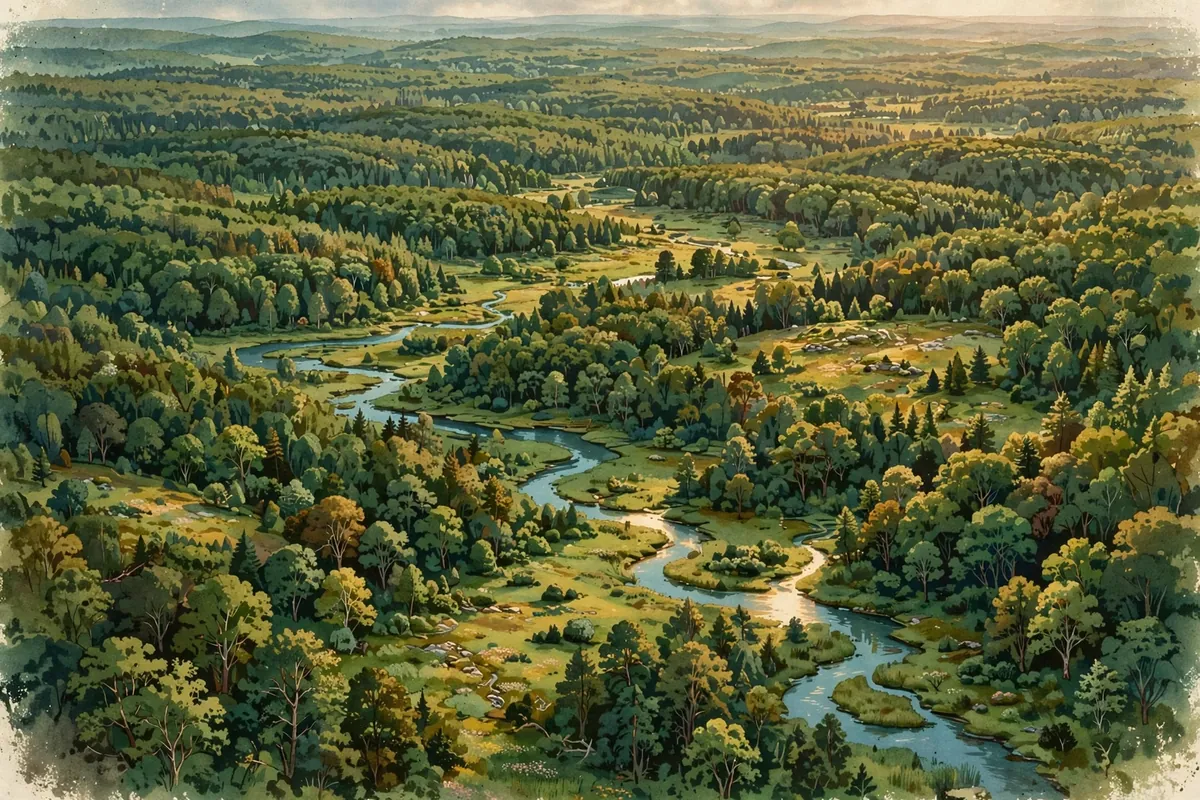
Look out the window and count the trees you can see. Maybe a dozen, maybe a hundred. Now try to imagine counting every tree in every forest, jungle, and backyard on the planet. It sounds impossible, but a team of scientists decided to try.
Their answer: about 3.04 trillion trees. That figure comes from a 2015 study led by ecologist Thomas Crowther. It was about eight times higher than earlier estimates. It also comes with a sobering footnote. Since humans began farming, the number of trees on Earth has fallen by nearly half.
How Do You Count Three Trillion Trees?
Nobody walked through the world's forests with a clipboard. Instead, researchers used tree densities measured on more than 400,000 plots of land and combined that ground data with satellite observations to estimate how many trees grow across the planet.
The researchers are upfront that it's an estimate with a wide margin of error. One reason is that most of the sample plots were in Europe and North America, while many tropical forests are less well studied. Still, it's the best big-picture count we have.
The counting effort has kept growing since then. In 2016, Crowther co-founded the Global Forest Biodiversity Initiative, whose database now holds more than 30 million tree measurements from 1.2 million locations around the world.
Where All Those Trees Grow
The trees aren't spread out evenly. About 1.39 trillion, or 46 percent, grow in the tropics and subtropics. Around 0.74 trillion stand in the cold northern coniferous forests, and about 0.61 trillion grow in temperate regions like much of the United States. With roughly 8 billion people on Earth, that's somewhere around 375 trees for every person.
There's huge variety, too. Estimates of the number of tree species range from about 60,000 to more than 79,000, depending on the study. South America is home to the most, with about 43 percent of all tree species.
The Trees We've Lost
Here's the sobering part. In the roughly 12,000 years since people began farming, the number of trees worldwide has dropped by about 46 percent. Today, an estimated 15 billion trees are cut down each year, while about 5 billion are planted.
That works out to a net loss of around 10 billion trees a year. It's a big number, but it's also a small slice of a very large total, which is why scientists see room for recovery.
Room for a Trillion More
Crowther's later research estimated there's about 0.9 billion hectares of land where trees could naturally grow outside of cities and farmland, enough room for roughly a trillion new trees. That idea inspired the Trillion Trees initiative launched by the World Economic Forum in 2020.
Other scientists warned against treating tree planting as a simple fix for climate change. Crowther agreed, stressing that protecting existing forests and cutting emissions still matter most, and that restoring nature should be done carefully.
Trees have been around for a long time, too. The earliest ones appeared about 400 million years ago, and some living trees are several thousand years old. The tallest known tree, a coast redwood in California nicknamed Hyperion, stands about 380 feet tall.
So the next time you're out for a walk, take a moment to appreciate the trees around you. They're a few of the roughly three trillion that make our planet the green, leafy place it is.