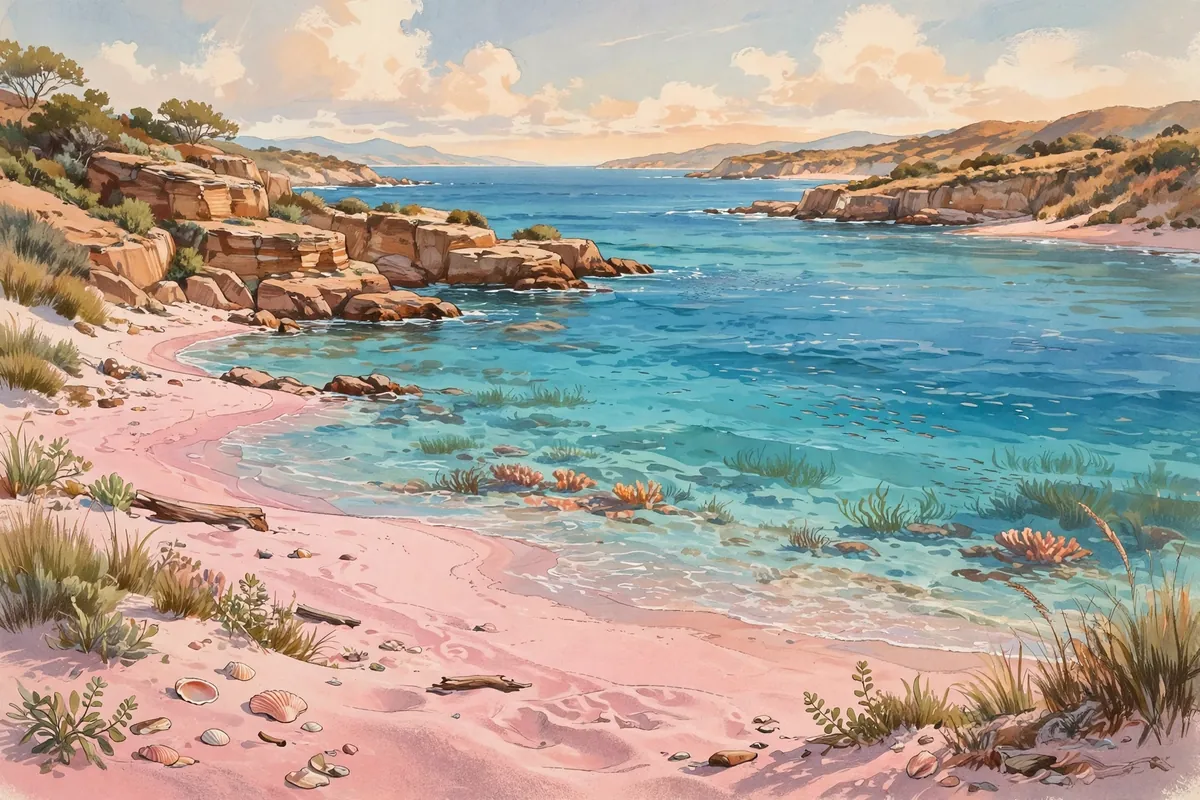
Most of us picture beach sand as white, tan, or golden. But on a handful of islands, the shoreline has a soft, rosy glow that looks almost too pretty to be real. Walk barefoot on Harbour Island in the Bahamas or along Bermuda's south shore and the sand under your toes is distinctly pink.
The color comes from something that was once alive. On beaches like these, the pink is mostly from foraminifera, tiny single-celled sea creatures with reddish-pink shells. In Bermuda, the key player is a bright red species called Homotrema rubrum. When the surf grinds its shells into sand-sized bits and mixes them with white sand, the whole beach takes on a pink tint.
Meet the Forams
Foraminifera, or forams for short, are single-celled organisms that usually build a shell around themselves. Many of those shells are made of calcium carbonate, the same basic material as seashells and coral. Most forams are smaller than a millimeter, though a few species grow much larger.
They're astonishingly varied. Scientists recognize more than 50,000 species, including both living ones and fossils. Most live in the ocean, many of them on or in the sediment of the seafloor.
Homotrema rubrum is a strong red and grows on coral rubble along tropical reefs. Waves break pieces loose and pound them into tiny grains, which then wash up on shore. Mixed with pale sand from crushed coral and shells, the red bits turn the beach a gentle pink.
Where to Find Pink Sand
Harbour Island in the Bahamas is famous for pink sand beaches that run along its entire east side. Bermuda's pink beaches and clear blue water are a big draw for visitors, and its reefs are close enough to shore for snorkelers to reach.
Pink sand shows up elsewhere too. Padar Island in Indonesia has bays with beaches of several colors, including white, gray, and pink. On Greece's island of Crete, the beach at Elafonisi gets its pink color from pigmented microorganisms that live alongside the local seaweed and are washed ashore by tides and waves.
Please Don't Take It Home
Pink sand is so pretty that visitors have often scooped up some as a souvenir. At Elafonisi, that became a real problem. The Greek government eventually declared the area a nature reserve and banned removing the sand. Even now, the color there is reportedly only about 10 percent as rich as it was in the early twentieth century.
It's a good reminder that these beaches took a very long time to build, one tiny shell at a time.
Sand Comes in Many Colors
Pink is only one of the surprises. Sand reflects what it's made of. Bright white tropical sand often comes from eroded limestone mixed with coral and shell bits. Sand rich in the mineral magnetite, or made from volcanic rock, can be dark or even black.
Some sands are green, thanks to minerals like olivine from volcanic lava. The famous white dunes of White Sands National Park in New Mexico are made of gypsum. And in parts of Southern Europe, iron inside quartz grains gives sand a deep yellow color.
So the next time you sink your toes into a beach, take a closer look. Every handful of sand is a tiny history of the rocks, reefs, and living things nearby. On a pink beach, that history happens to be especially lovely.