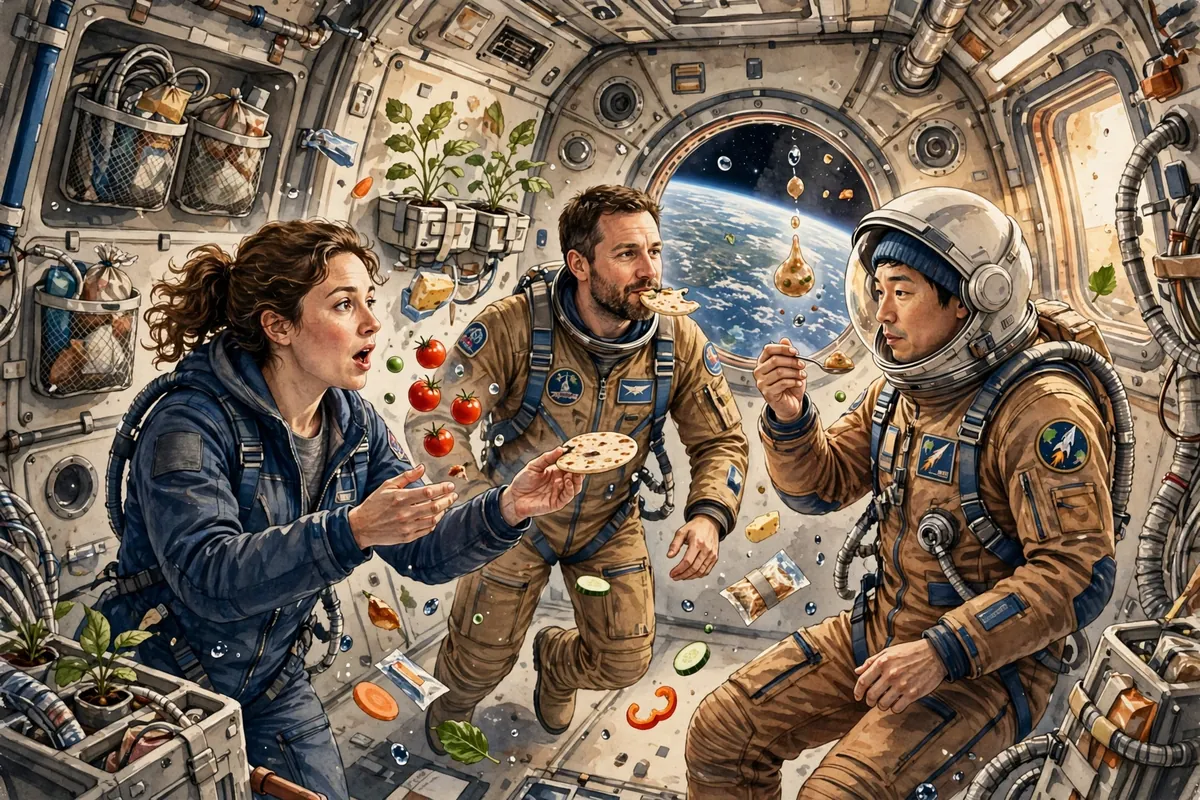
Eating seems simple enough. You sit down, take a bite, and swallow. But try doing it while you and your dinner are both floating, and suddenly every crumb, drip, and spill becomes a problem.
Here's the short answer. Astronauts eat specially designed food that's light, well packaged, and easy to clean up after. Much of it is freeze-dried and rehydrated with water before eating, and crumbly foods are avoided. That's why tortillas are a favorite substitute for bread. And swallowing works just fine in orbit, because the muscles of the esophagus push food along without help from gravity.
The Early Days: Tubes and Cubes
In the early 1960s, some experts worried that weightlessness might make swallowing impossible. When John Glenn became the first American to orbit Earth in 1962, part of his job was to test eating in space. He had no trouble at all, and he's credited as the first American astronaut to eat from an aluminum tube. The menu item was applesauce.
Early space food came as bite-sized cubes, freeze-dried powders, and thick pastes squeezed from tubes. Astronauts of the Mercury era didn't love it. They found it unappetizing, had trouble rehydrating the powders, and disliked chasing crumbs.
The Smuggled Sandwich
That crumb problem led to one of the funniest moments in space history. Gemini 3, launched on March 23, 1965, was the first time two American astronauts flew into space together. Pilot John Young secretly brought along a corned beef sandwich for commander Gus Grissom, who loved them.
The bread started shedding floating crumbs, which could have caused trouble in the cramped capsule, so Grissom put it away. NASA mildly scolded the astronauts, and a congressional hearing followed. Afterward, NASA kept a much closer eye on what astronauts brought aboard.
Meals Get Better
Things improved with Apollo. Hot water made rehydrated food taste better, and a new spoon bowl let astronauts eat with an actual spoon, since moist food clings to it. Apollo 17 moonwalker Harrison Schmitt loved the bacon squares, while Buzz Aldrin favored the shrimp.
The Skylab space station of 1973 and 1974 went further still. It was roomy enough for a refrigerator and a freezer, so crews could enjoy frozen foods, which turned out to be their favorites. It even had a dedicated dining area with a table where the crew could share meals.
Today, the International Space Station has rehydration equipment and food warmers. Drinks like coffee, tea, and lemonade come as powders in sealed pouches. Fresh fruits, vegetables, and tortillas arrive on resupply missions, but they must be eaten within about two days before they spoil. They're partly a morale boost for crews who are far from home for months.
Why Space Food Tastes Different
Here's a surprise. Food often tastes blander in orbit. Weightlessness causes sinus congestion, which dulls the senses of taste and smell. Astronauts on the Skylab station in the 1970s especially enjoyed spicy foods for that reason.
China's Tiangong space station handles it with bold flavors. It stocks around 120 types of food, from kung pao chicken to black pepper beef, plus condiments like Sichuan pepper sauce to make up for those dulled taste buds.
So the next time you brush a few crumbs off the kitchen table, consider yourself lucky. In space, a simple sandwich can become a floating mess, and a warm tortilla is a small luxury worth celebrating.