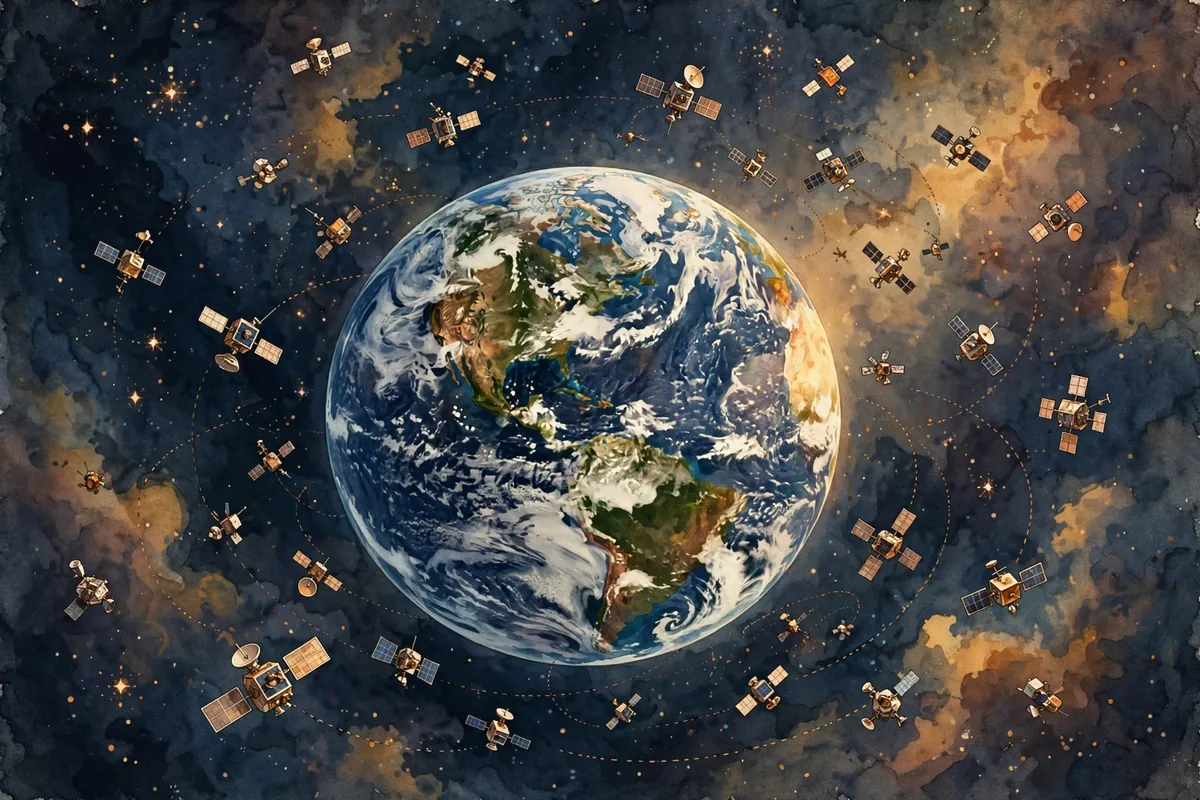
We tend to think of space as clean and empty. But since the first satellites went up in the 1950s, people have been leaving things behind. Dead satellites, spent rocket parts, and countless tiny fragments are still whizzing around our planet, and the pile keeps growing.
Here's the short answer: as of January 2019, scientists estimated there were about 34,000 pieces of debris larger than 10 centimeters (about 4 inches) orbiting Earth. There were also roughly 900,000 pieces between 1 and 10 centimeters, and more than 128 million pieces smaller than 1 centimeter. By June 2023, the count of large pieces had reached at least 37,000.
Small Doesn't Mean Harmless
A fleck of paint doesn't sound scary. In orbit, though, speed changes everything. In low Earth orbit, the average collision happens at about 10 kilometers per second, more than 22,000 miles per hour. At that speed, even a tiny piece can damage a spacecraft.
Even those numbers are estimates. Only objects that are big enough, and in orbits that make tracking possible, can be followed directly. Some old satellites sit in orbits so high above the Northern Hemisphere that they can't be tracked at all.
That's why space agencies track the bigger objects carefully. In 2007, for example, NASA's Terra environmental satellite had to steer out of the way of debris to avoid a hit.
When Satellites Collide
The first major crash between two satellites happened on February 10, 2009, about 500 miles above northern Siberia. A dead Russian military satellite, Kosmos 2251, slammed into a working Iridium communications satellite at roughly 26,000 miles per hour. Both were destroyed, and thousands of new fragments joined the swarm.
Two years earlier, China tested an anti-satellite missile by blowing up one of its own satellites. It became the largest single debris event in history, creating more than 2,300 pieces the size of a golf ball or larger and about a million pieces at least a millimeter across.
Some Very Odd Litter
Not all space junk is rocket parts. Astronaut Ed White lost a glove during the first American spacewalk. Michael Collins lost a camera near Gemini 10. Over the years, the list has grown to include a wrench, a toothbrush, a pair of pliers, and a tool bag about the size of a briefcase. Soviet cosmonauts on the Mir station also tossed out garbage bags.
Some of the junk is a piece of history. The U.S. satellite Vanguard 1, launched in 1958, and the upper stage of its rocket are the oldest human-made objects still in orbit. They're expected to stay up there until after the year 2250.
The Chain Reaction Scientists Worry About
The biggest concern has a name: Kessler syndrome. The idea is that if debris gets dense enough, one collision could create fragments that cause more collisions, setting off a runaway chain reaction. In the worst case, some orbits could become too risky to use for a very long time.
Cleaning up isn't easy. Grabbing a dead satellite and dragging it down has rarely been tried, because it's so costly and complicated. The European Space Agency has funded a mission called ClearSpace-1 to try it with a single small satellite.
So the next time you spot a satellite gliding across the night sky, remember it has plenty of company. Keeping space tidy may be one of the quieter challenges of the space age, but it matters for every GPS map, weather forecast, and satellite TV signal we rely on.