On a clear night, Mars stands out from the other lights in the sky with its warm, orange-red glow. Ancient sky watchers noticed it, and more than one culture linked it to a god of war. Today we call it the Red Planet. But what actually gives it that color?
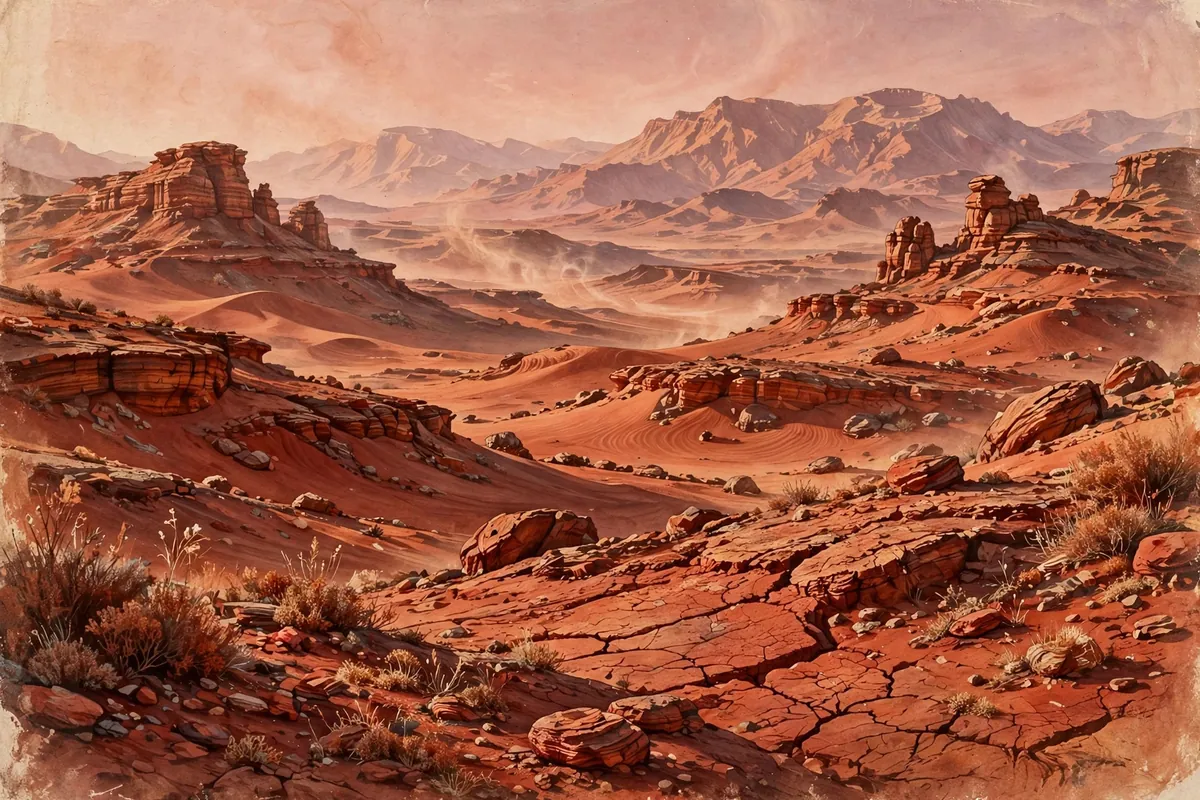
The short answer is rust. Much of the Martian surface is covered in fine dust and rocks rich in iron oxide, the same family of compounds that forms when iron rusts here on Earth. That rusty dust coats the ground and even floats in the thin air, giving the whole planet its reddish look.
A Planet Covered in Rust
Scientists say the red-orange color comes from iron(III) oxide and a related rusty mineral called goethite. Much of the surface is deeply covered by very fine iron oxide dust. Up close, though, Mars isn't just one shade of red. Depending on the minerals, the ground can look butterscotch, golden, brown, tan, or even greenish.
When you see an old nail or a garden tool turn orange, that's iron reacting and forming iron oxide. Mars went through its own version of that on a planet-wide scale.
How Did Mars Get So Rusty?
Scientists think most of that rusting happened a few billion years ago, back when Mars was warmer and wetter than it is today. Rivers once flowed there, and liquid water may have shaped the valleys and gullies we see now.
Today Mars is cold and dry, so a different process may be doing some of the work. One idea is that ultraviolet rays from the Sun create a highly reactive chemical on the surface of minerals, which can rust them even without liquid water.
A Dusty Pink Sky and Blue Sunsets
Mars dust is so fine that plenty of it stays floating in the air, giving the sky a reddish tint. Mars also has the biggest dust storms in the solar system, with winds over 100 miles per hour. Some grow large enough to cover the entire planet.
Here's a delightful twist. While a sunset on Earth glows orange and red, sunsets on Mars are usually blue. The fine dust in the thin Martian air scatters sunlight differently than our air does, which gives the glow around the setting Sun a bluish hue. The Sun also looks only about two-thirds as big as it does from Earth.
A Red Planet Through History
Mars is named after the Roman god of war, the equivalent of the Greek god Ares. Its two little moons, Phobos and Deimos, discovered in 1877, are named after Ares's twin sons, whose names mean panic and dread. The ancient Sumerians also linked the planet to a god of war.
In 1877, Italian astronomer Giovanni Schiaparelli mapped Mars and described long lines he called canali, meaning channels. In English, the word was mistranslated as canals, which helped spark popular ideas about intelligent Martians. The lines later turned out to be an optical illusion.
Mars is also home to Olympus Mons, the tallest volcano on the planet at about 13.6 miles high, and one of the largest canyons in the solar system, Valles Marineris, about 2,500 miles long.
So when you spot that rusty dot in the night sky, you're looking at a whole world dusted in rust. It's a little like a planet-sized antique, weathered by billions of years of sun and time.