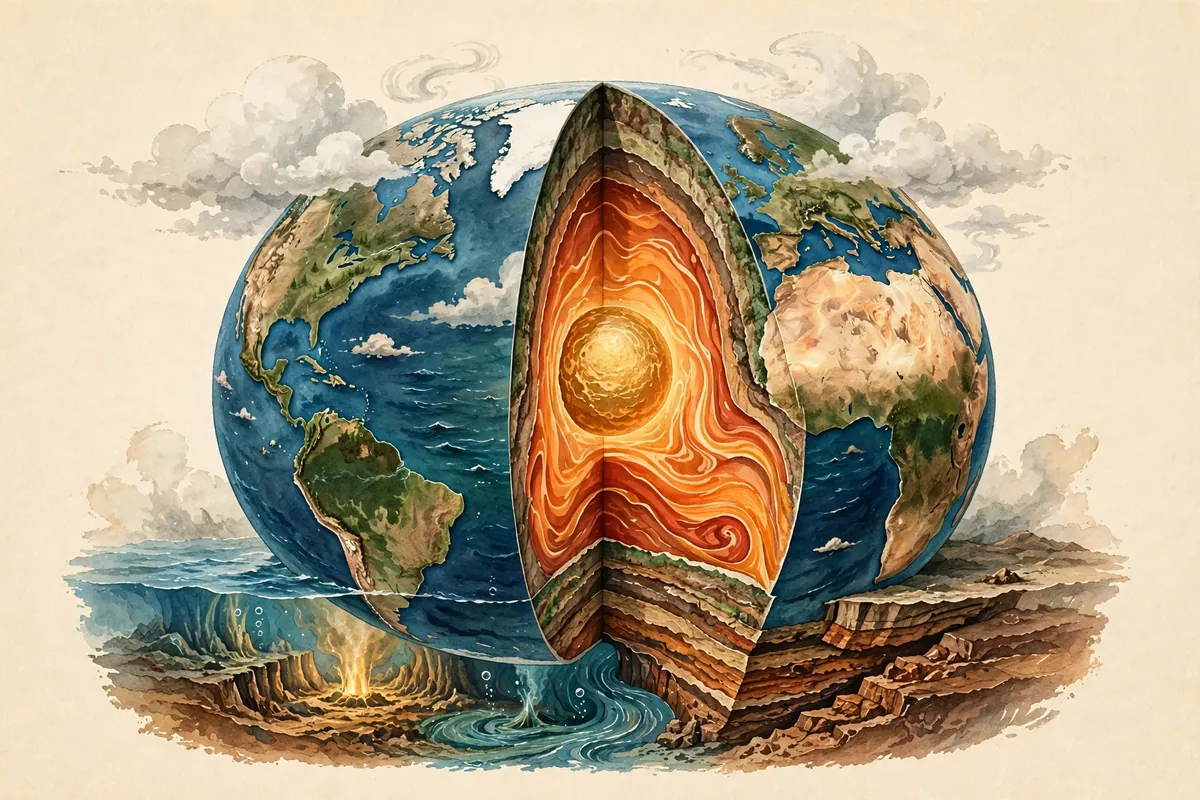
We spend our lives walking around on a thin, cool crust. But far below the basements, mines, and oil wells is a world nobody has ever seen. At the very center of our planet sits a ball of metal so hot it rivals the Sun.
Here's the short answer. The surface of Earth's inner core is estimated at about 9,800°F, roughly the temperature of the surface of the Sun. That heat comes from two main sources: heat left over from when Earth formed, and heat still being made by radioactive elements inside the planet. One important clarification: it matches the Sun's surface, not its center. The Sun's core is close to 15.7 million kelvins, far hotter.
Leftover Heat From Earth's Birth
When Earth formed, huge amounts of material crashed together and collapsed inward under gravity. All that energy turned into heat. Scientists call this primordial heat, and the planet has been slowly cooling off ever since.
The heat flowing out of the core into the layer above it is thought to come from this original warmth. Forming the dense iron core early in Earth's history may have superheated the planet's interior, giving the core a head start it's still burning through billions of years later.
A Slow-Burning Radioactive Furnace
The second source is radioactive decay. Elements in the mantle and crust, mainly two types of uranium, thorium, and potassium, slowly break down and release heat as they do. About half of Earth's internal heat is thought to come from this process.
All together, heat flowing from inside Earth to the surface adds up to about 47 terawatts. Scientists know that total fairly well, but they still aren't sure exactly how it splits between leftover heat and radioactive heat.
So Why Isn't It Melted?
Here's the surprising part. The inner core is so hot it should be liquid, yet it's mostly solid. The reason is pressure. Iron at Earth's center is squeezed by the weight of the entire planet above it, and at those crushing pressures, iron's melting point shoots way up. So even at sunlike temperatures, the inner core stays solid.
It's made mostly of iron and nickel, with a bit of lighter elements mixed in. The inner core is about 760 miles in radius, around 70 percent the radius of the Moon. Around it is a liquid outer core of molten metal.
Scientists aren't completely certain about the exact temperature. One 2002 estimate put it between about 9,300°F and 9,800°F, while a 2013 experiment suggested iron melts at a higher temperature under those conditions, closer to 10,750°F.
How We Know Without Ever Going There
Nobody can drill to the core, so how do we know any of this? Earthquakes. Seismic waves travel through the planet and bend or bounce depending on what they pass through. In 1936, Danish seismologist Inge Lehmann studied waves from earthquakes in New Zealand and realized they were reflecting off something solid inside the liquid core. She had discovered the inner core. In 1952, Francis Birch concluded it was probably crystalline iron, and its solid nature was confirmed in 1971.
That hidden heat matters for life up here. Heat flowing from the core keeps the outer core churning, which helps create Earth's magnetic field. So the next time you see a compass needle point north, you can thank the sunlike furnace thousands of miles below your feet.