A news alert pops up: a magnitude 6.0 earthquake has struck somewhere. Most of us nod and think of the Richter scale. But what does that number actually mean, and how do scientists come up with it?
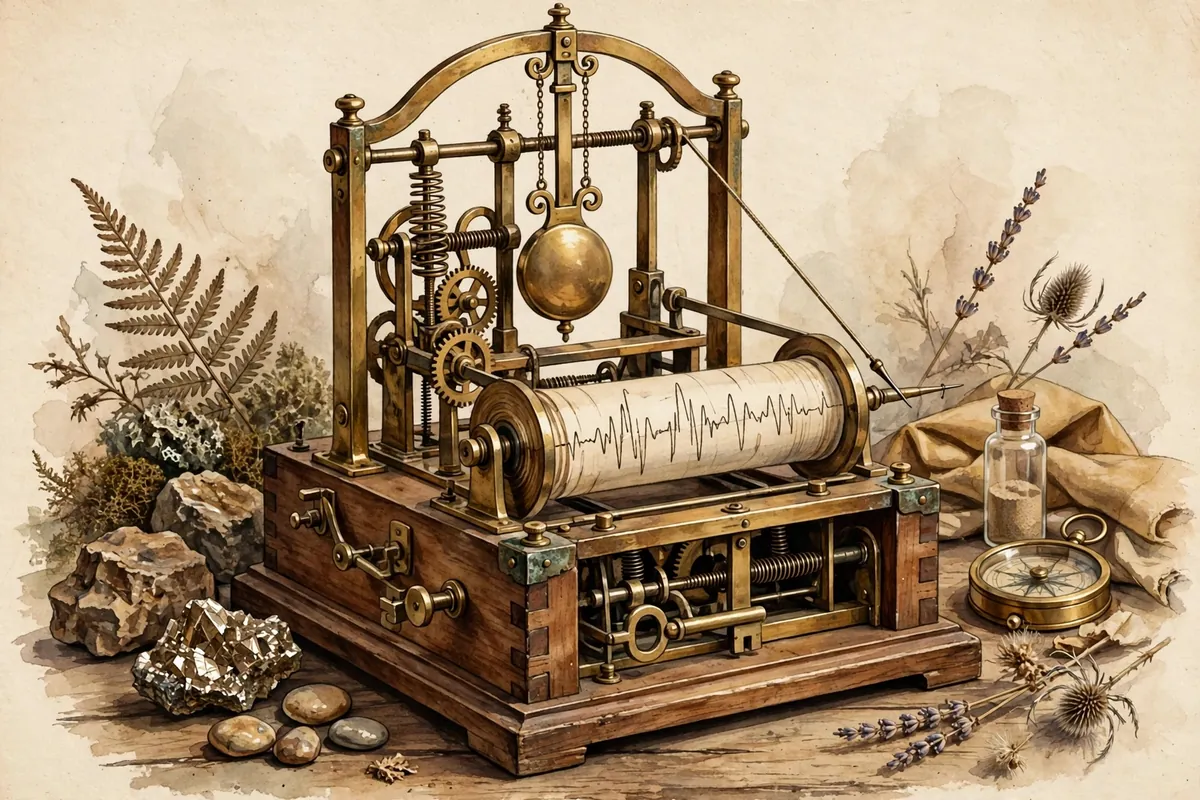
Here's the short answer. Earthquakes are measured with instruments called seismometers, which record how the ground shakes. Scientists use those recordings to calculate a magnitude. Today, the standard is the moment magnitude scale, not the original Richter scale, even though news outlets often still say Richter.
Richter's Original Idea
In 1935, seismologist Charles F. Richter published the first scale for measuring earthquake magnitudes. He built on work by Japanese seismologist Kiyoo Wadati, who had shown that the size of seismic waves shrinks with distance in a predictable way.
Richter's breakthrough was a logarithmic scale. Each whole step up meant a tenfold jump in the size of the waves recorded on a seismograph. He even set a specific zero point, based on how far a particular kind of seismograph needle would move for a quake about 62 miles away.
But Richter designed his scale using earthquakes in Southern California and Nevada. It turned out to be inaccurate elsewhere, including east of the Rocky Mountains, where the Earth's crust is different. It also struggled with the very biggest earthquakes.
The Modern Scale
In 1979, scientists Thomas Hanks and Hiroo Kanamori defined the moment magnitude scale. It's based on the physical size of the earthquake and is more directly tied to the energy it releases. Unlike older scales, it doesn't underestimate the largest quakes.
Agencies like the United States Geological Survey now use it to report earthquakes above about magnitude 4. For small quakes, the numbers come out roughly the same as on Richter's scale, which is one reason the old name stuck around in the news.
Why One Point Matters So Much
Here's the part that surprises most people. Each step up on the moment magnitude scale means about 32 times more energy released. Two steps means 1,000 times more. So a magnitude 7.0 earthquake releases about 1,000 times as much energy as a 5.0.
The strongest earthquake ever recorded struck Chile on May 22, 1960. Most studies place it between 9.4 and 9.6, and it shook for about 10 minutes, sending tsunamis as far as Hawaii and Japan.
Magnitude Versus Intensity
Magnitude measures the strength of the earthquake itself. A separate scale, the Modified Mercalli intensity scale, measures how strongly the shaking was felt at a particular spot. It grew out of a scale created by Giuseppe Mercalli in 1902.
Intensity depends on where you are. Shaking usually weakens with distance from the epicenter, and deeper quakes tend to be felt less at the surface. Because intensity is based on what people noticed, it even helps scientists estimate the size of historic earthquakes from before modern instruments.
People have been trying to detect earthquakes for a very long time. In the year 132, Chinese inventor Zhang Heng is said to have built a bronze device with eight dragon heads. When the ground shook, a dragon would drop a bronze ball into a bronze toad below. According to the old account, it once signaled a quake somewhere to the east, and days later a rider arrived to report it. Today's instruments are far more precise, but the curiosity is the same.