A sunflower looks like the very definition of a flower. One big golden face on a tall green stalk, smiling at the summer sky. Kids draw them, farmers grow fields of them, and Kansas even made it the state flower. But take a closer look at that face. Is it really just one flower?
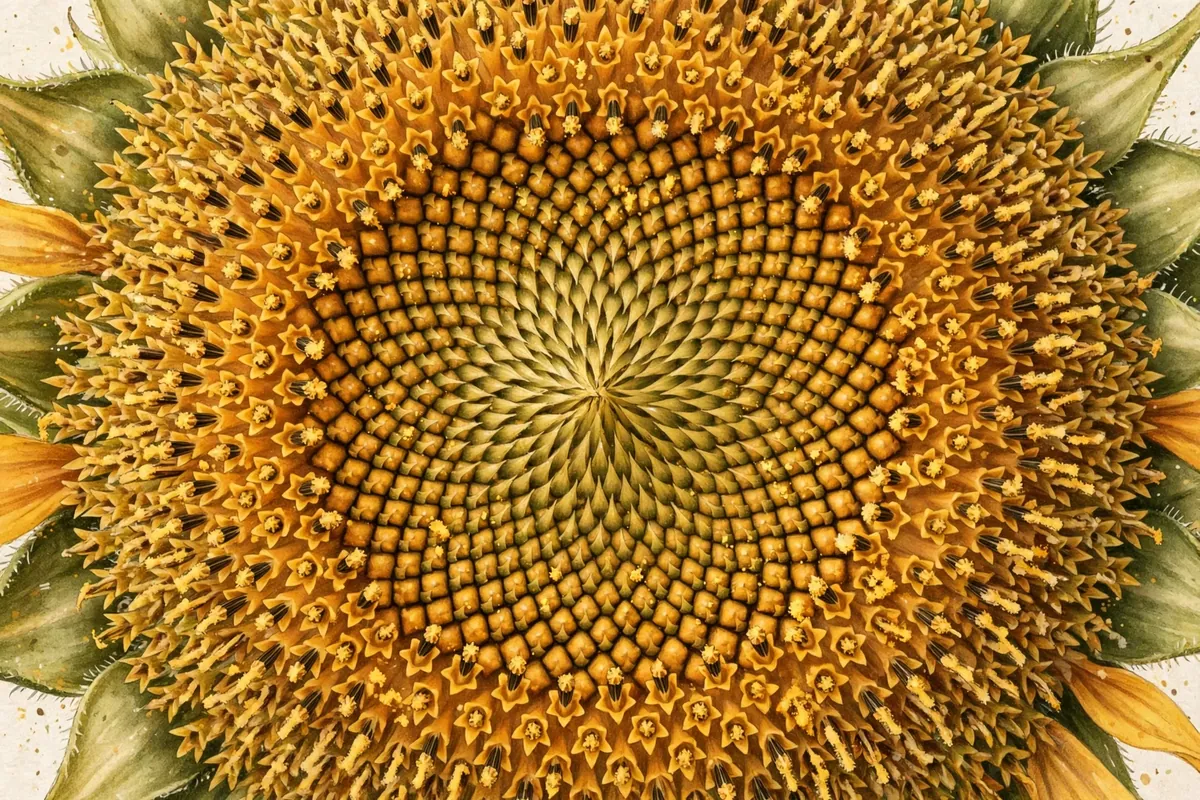
The short answer is no. What we call a sunflower is actually a flower head, made of many small individual flowers called florets packed tightly together. The yellow "petals" around the edge are actually separate flowers, called ray flowers. The tiny flowers crowded into the center are called disk flowers, and each one can become a sunflower seed.
A False Flower
Botanists have a name for this arrangement: a pseudanthium, from ancient Greek for "false flower." It's a cluster that groups anywhere from a few to hundreds or even thousands of small flowers into what looks like a single bloom. Daisies use the same trick, and so do many other members of the daisy family, which includes the sunflower. In a sense, every sunflower head is a whole bouquet that grew on a single stem.
Each tiny flower in a sunflower head has five petals of its own. In the ray flowers around the rim, those petals are fused into one long, showy strap. Those outer ray flowers can't make seeds. Their job is to be eye-catching. The real seed makers are the disk flowers in the middle, which mature into the sunflower seeds we snack on.
The Spiral Secret
The florets in the center aren't scattered at random. Each one is turned from the one before by about 137.5 degrees, a special number called the golden angle. That creates a pattern of interlocking spirals curving both left and right.
Count the spirals and you'll usually find 34 going one way and 55 the other. In a very large head, there can be 89 and 144. Those are all Fibonacci numbers, the famous sequence where each number is the sum of the two before it. This arrangement packs the seeds together as efficiently as mathematically possible.
Do Sunflowers Really Follow the Sun?
Here's a common belief that's only half right. Young sunflowers do track the Sun. At dawn, the bud faces east, follows the Sun west through the day, and swings back east overnight to be ready for morning. This is driven by an internal daily clock, so it keeps going even on cloudy days.
But once a sunflower fully matures and starts blooming, it stops moving and faces east for good. That morning sunshine warms the flower head quickly, which brings more visits from pollinators. As far back as 1597, the English botanist John Gerard noted that he had never seen his sunflowers turn with the Sun.
Giants of the Garden
Sunflowers commonly grow to around 10 feet tall, but the tallest one on record reached 35 feet 9 inches. The plant was first domesticated in the Americas, and its seeds were carried to Europe in the 1500s, where the seeds and their oil became a popular cooking ingredient.
So the next time you pass a field of sunflowers all facing the morning sky, remember what you're really seeing. Each golden head is a whole neighborhood of tiny flowers, lined up in a perfect mathematical spiral and turned toward the sunrise together.