Most of us have tasted seawater by accident and remember how salty it was. Now imagine water so loaded with salt that the ground around it is crusted white and the water simply refuses to freeze, even in Antarctica. That place is real.
Here's the honest answer. No lake is literally nearly all salt, since even the saltiest ones are still mostly water. But Antarctica's Don Juan Pond comes remarkably close, with a reported salinity of more than 40%. That's well beyond the famous Dead Sea, which measured about 34% in 2011. Ordinary ocean water is roughly a tenth as salty as the Dead Sea.
A Pond That Laughs at Winter
Don Juan Pond is a small, very shallow lake in Wright Valley, part of Antarctica's McMurdo Dry Valleys. It's the saltiest of the Antarctic lakes and the only salty Antarctic lake that almost never freezes.
All that salt lowers the water's freezing point dramatically. The pond can stay liquid at temperatures as low as minus 58°F. For comparison, fresh water freezes at 32°F.
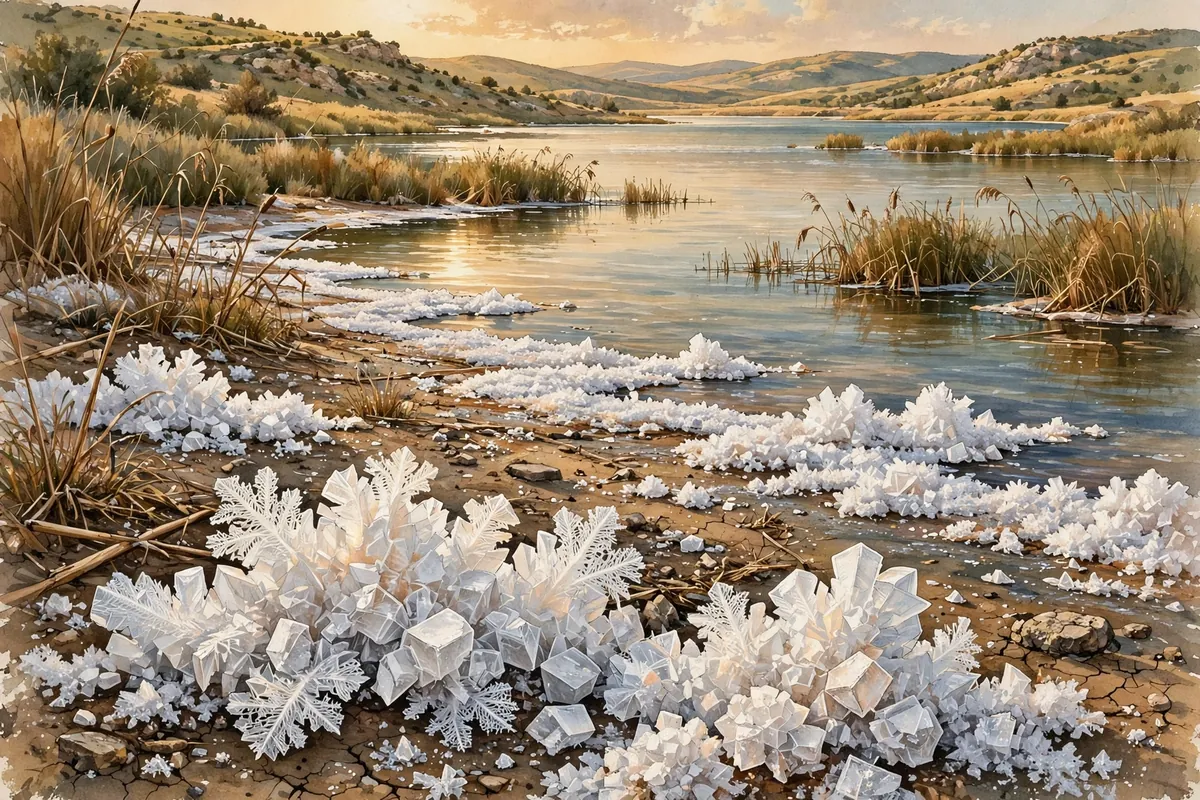
Its salt is mostly calcium chloride, unlike the sodium chloride of table salt. That's part of what makes it so unusual. The ground around the pond is covered with salt crystals left behind as water evaporated.
A Funny Name and a Shrinking Pond
The pond was discovered in 1961. It has a playful name with a practical origin. It was named for two helicopter pilots, Lt. Don Roe and Lt. John Hickey, who flew the first field party sent to study it.
Don't picture a big lake. In the 1990s, it was described as about a foot deep, and by late 1998 it was nearly dry except for a small area. Most of the remaining water sat in hollows around large boulders. Scientists are still studying exactly where its water and salt come from.
The Dead Sea: Saltiest Famous Lake
The Dead Sea, on the border region of Israel, Jordan, and the West Bank, is the salty lake most people know. As of 2011, it was about 9.6 times as salty as the ocean. The water is so dense that swimming feels more like floating.
Its shores are the lowest land on Earth, about 1,443 feet below sea level as of 2025. It's also the deepest hypersaline lake in the world, at about 997 feet. Its name comes from the scarcity of life in such salty water.
Interestingly, the Dead Sea's salt is quite different from ocean salt. Ocean salt is about 85% sodium chloride. In the Dead Sea, magnesium chloride makes up the largest share, around half.
Until the winter of 1978 to 1979, the Dead Sea was split into two layers that didn't mix. The deep layer was so packed with salt that it couldn't hold any more sodium chloride. The extra salt crystallized and settled onto the sea floor, like sugar at the bottom of an over-sweetened glass of iced tea.
Other Super-Salty Spots
The Dead Sea has some salty rivals. Lake Vanda in Antarctica, Lake Assal in the African country of Djibouti, and the Garabogazköl lagoon off the Caspian Sea have all reported salinities around 35%.
So while no lake is truly all salt, a few come startlingly close. Next time you add a pinch of salt to your soup, think of a tiny pond at the bottom of the world that never stops at a pinch.