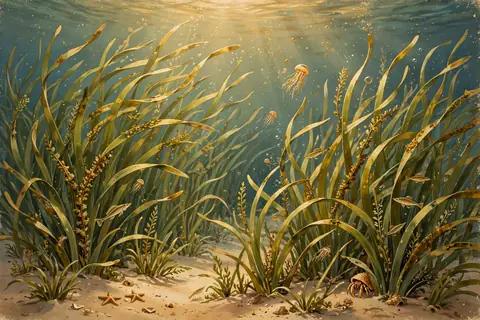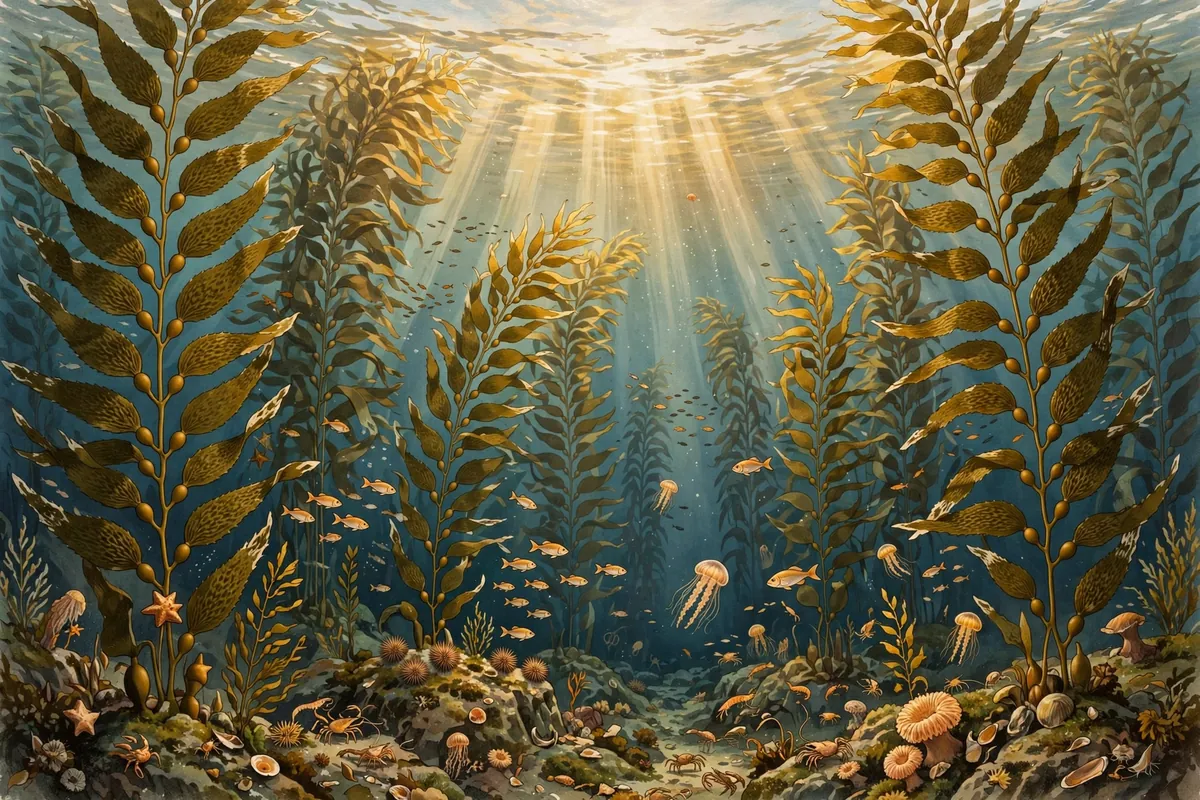
Picture a forest where the trees sway gently back and forth, sunlight streams down in golden beams, and fish glide between the trunks like birds. Now picture it all underwater. That's not a fantasy. It's a kelp forest, and they line many of the world's coastlines.
Kelp forests are underwater areas packed with tall, dense kelp, a type of large brown algae. They grow in cool coastal waters around the world and are among the most productive and lively ecosystems on Earth. The biggest kelp can grow taller than a 10-story building, and astonishingly fast.
Not Quite Trees, Not Even Plants
Kelp looks like a plant, but it isn't one. It's a kind of algae. Instead of roots, it has a holdfast, a root-like mass that grips the sea floor just to anchor it, without soaking up nutrients like real roots do. A stalk called a stipe rises up like a trunk, and leaf-like blades called fronds grow from it.
How does it stand up without a stiff trunk? Many kelps have little gas-filled bladders near the base of their fronds. These act like tiny balloons, holding the kelp upright in the water so it can reach toward the sunlight.
The Speed Champion of the Sea
The most famous kind is giant kelp. A single one can grow more than 150 feet long, and it can grow as much as 2 feet in a single day. It's common along the Pacific coast of North America, from Baja California up to southeast Alaska, and it's also found near South America, South Africa, Australia, and New Zealand.
Kelp forests usually thrive in cool, nutrient-rich water. They often grow where currents bring up nutrients from the deep, which feeds the kelp and, in turn, everything that lives among it.
A Neighborhood Full of Life
A kelp forest is a busy neighborhood. Fish like rockfish shelter among the stalks, along with shrimp, snails, worms, and brittle stars. Seals, sea lions, whales, and sea otters visit or live there, and birds like gulls, terns, herons, and cormorants hunt nearby.
Sea otters play a starring role. In Alaska's kelp forests, otters eat sea urchins, which graze on kelp. When otters disappear, urchin numbers can explode and chew the forest down, leaving a bare seafloor called an urchin barren. That's why scientists call the sea otter a keystone species there. In Southern California, lobsters and fish like the California sheephead help keep urchins in check.
Why Kelp Matters to Us
Kelp forests have been important to people for thousands of years. Some researchers think early travelers may have followed a kind of kelp highway along the Pacific coast during the last ice age, finding food and calmer water along the way as they reached the Americas.
Kelp is still useful today. A substance from it called alginate is used in products like toothpaste, antacids, and ice cream. But kelp forests face threats from overfishing, pollution, and warming water, and they've nearly vanished in some places, including parts of Northern California. Protected marine areas are one way people are trying to help.
If you'd like to see one without getting wet, the Monterey Bay Aquarium was the first aquarium to display a living kelp forest. It's a magical reminder that some of the world's most beautiful forests never feel a breath of wind.