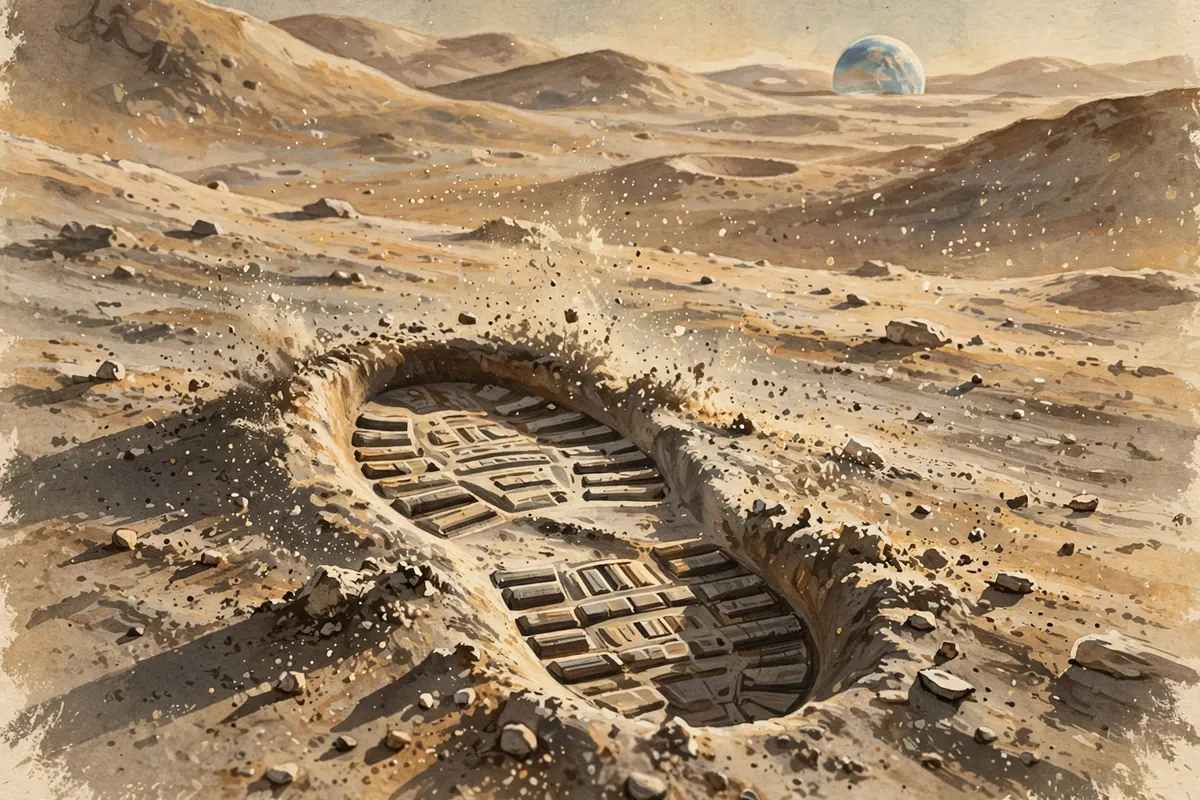
In July 1969, Neil Armstrong stepped off the Eagle's landing pad and pressed his boot into the gray lunar dust. Photos of those crisp bootprints became some of the most famous images ever taken. You've probably heard they'll sit there, untouched, for millions of years.
That's partly true and partly a stretch. The Moon has no weather to wear footprints away, so they can last a very long time by human standards. But the surface isn't perfectly still. A steady rain of tiny meteorites slowly stirs the top layer of soil, and a 2016 study suggests the top centimeter gets churned over in roughly 80,000 years, not the 10 million years scientists long assumed.
Why Nothing Wipes Them Away
On Earth, a footprint in the sand rarely survives the next tide or breeze. The Moon is different. It has almost no atmosphere, no weather, and no recent geological activity, which is why so many of its craters are well preserved.
Without air, there's no wind to blow dust around. Without water, there's no rain to wash it smooth. Bodies that lack an atmosphere generally lack these kinds of erosion altogether.
The dust itself is unusual, too. Armstrong described it as “very fine-grained” and “almost like a powder.” Unlike Earth dust, which has rounded edges, lunar dust has sharp edges that catch against each other. That's part of why Armstrong and Aldrin struggled to push their flagpole more than about seven inches into the ground.
The Slow, Invisible Eraser
The Moon is constantly peppered by micrometeorites, tiny specks of space rock. Each impact stirs and mixes the loose soil, called regolith, in a process known as impact gardening, or lunar gardening.
For years, scientists estimated that the top centimeter of the lunar surface was overturned once every 10 million years. Then a 2016 analysis using NASA's Lunar Reconnaissance Orbiter put the figure closer to 80,000 years. That suggests shallow marks like bootprints will soften and fade much sooner than the famous millions-of-years figure, though still over a span far longer than recorded human history.
There's another slow change, too. Space weathering gradually darkens and reddens lunar soil. That's why young craters show bright streaks of fresh material, while older ones fade into the background.
Rocket Blasts and Faded Flags
Some marks didn't even last the day. Buzz Aldrin reported that the Apollo 11 flag, planted about 27 feet from the lander, was blown over by rocket exhaust when Eagle took off. Later crews set their flags farther away.
Other flags have held up better. Photos from the Lunar Reconnaissance Orbiter showed the flags from Apollo 12, 16, and 17 still standing as of 2012. Some experts think their colors may have faded to white under harsh sunlight and solar wind.
Only Twelve Sets of Footprints
Just twelve people have ever walked on the Moon, across six Apollo landings between 1969 and 1972. Their tracks are still up there, along with plenty of gear, including the descent stage of Apollo 11's lander, Eagle. Crews stayed for up to three days, and some astronauts spent up to a full day in total roaming the surface.
So those famous footprints won't last forever, but they aren't going anywhere fast. Long after all of us are gone, the marks of the first moonwalkers will still be slowly softening in the silent gray dust.