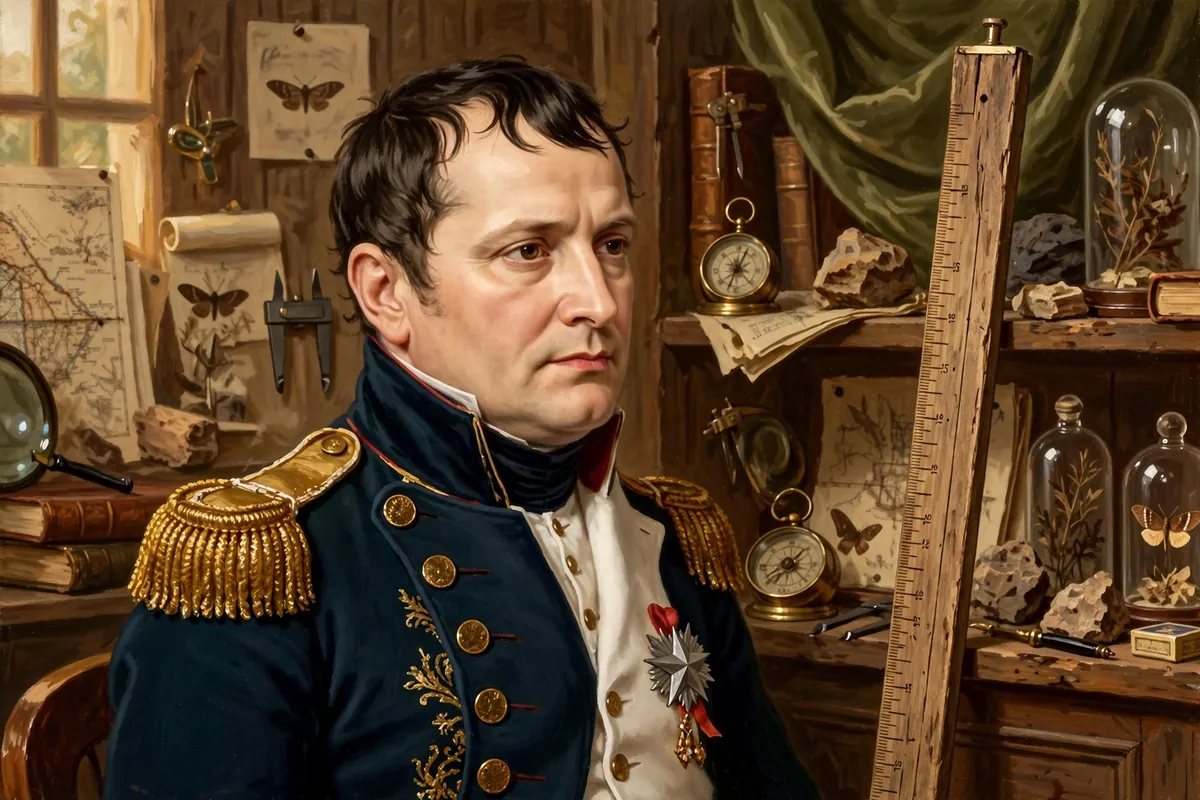
Say the name Napoleon and many people picture a tiny man in a big hat, puffing out his chest. His name is even attached to a stereotype about short men who act tough. But was the French emperor actually short?
No, not really. Napoleon stood about 5 feet 6 or 5 feet 7 inches tall in modern measurements, which was about average for a Frenchman of his day. His small reputation came largely from a measurement mix-up and from British cartoonists who loved to poke fun at him.
The Inch That Wasn't an Inch
After Napoleon died in 1821, his height was recorded as 5 feet 2 inches. That sounds short, but those were French feet and inches, which were longer than the English ones. Converted to English measurements, it works out to about 5 feet 7 inches.
Historians don't all agree on the exact figure. Some estimates put him at about 1.67 meters, just under 5 feet 6 inches, while others say 1.70 meters. Those who favor the taller number point out that he was measured on the island of Saint Helena 28 years after France adopted the metric system. Either way, he lands right around average.
Average for His Time
Napoleon was the height of an average French man around 1800. He was a bit short for an aristocrat or an army officer, but among ordinary Frenchmen he would have blended right in.
His own soldiers may not have done him any favors, though. His elite foot grenadiers of the Imperial Guard were drawn from the army's most experienced and tallest men. Standing beside them, almost anyone would have looked a little small.
How the Cartoons Shrank Him
During the Napoleonic Wars, the British press painted Napoleon as a dangerous tyrant ready to invade. A nursery rhyme even warned children that he ate naughty people, turning him into a kind of bogeyman. He was mocked as a short-tempered small man and nicknamed "Little Boney."
The cartoonist James Gillray, often called the father of the political cartoon, did a great deal to fix that picture in people's minds. He ridiculed Napoleon in print after print. His work was displayed in a London shop window where eager crowds gathered to look, and it circulated across Britain and the rest of Europe.
Toward the end of his life, Napoleon allegedly said that Gillray's cartoons of him as unusually short "did more than all the armies of Europe to bring me down." Whether or not he really said it, the drawings certainly outlived the facts.
The Complex Named After Him
The image stuck so well that it found its way into psychology. Alfred Adler used Napoleon to describe an inferiority complex in which short people act overly aggressive to make up for their height. That idea inspired the term Napoleon complex.
Does it really exist? Research has produced mixed results. A 2007 study at the University of Central Lancashire even found that shorter men were less likely to lose their temper than men of average height. Today the Napoleon complex is widely regarded as a derogatory stereotype.
So Napoleon wasn't a tiny man with giant ambitions. He was an average-sized man with giant ambitions, which makes for a less funny joke but a more accurate history lesson. He's also proof that a good cartoon can outlast the truth by a couple hundred years.