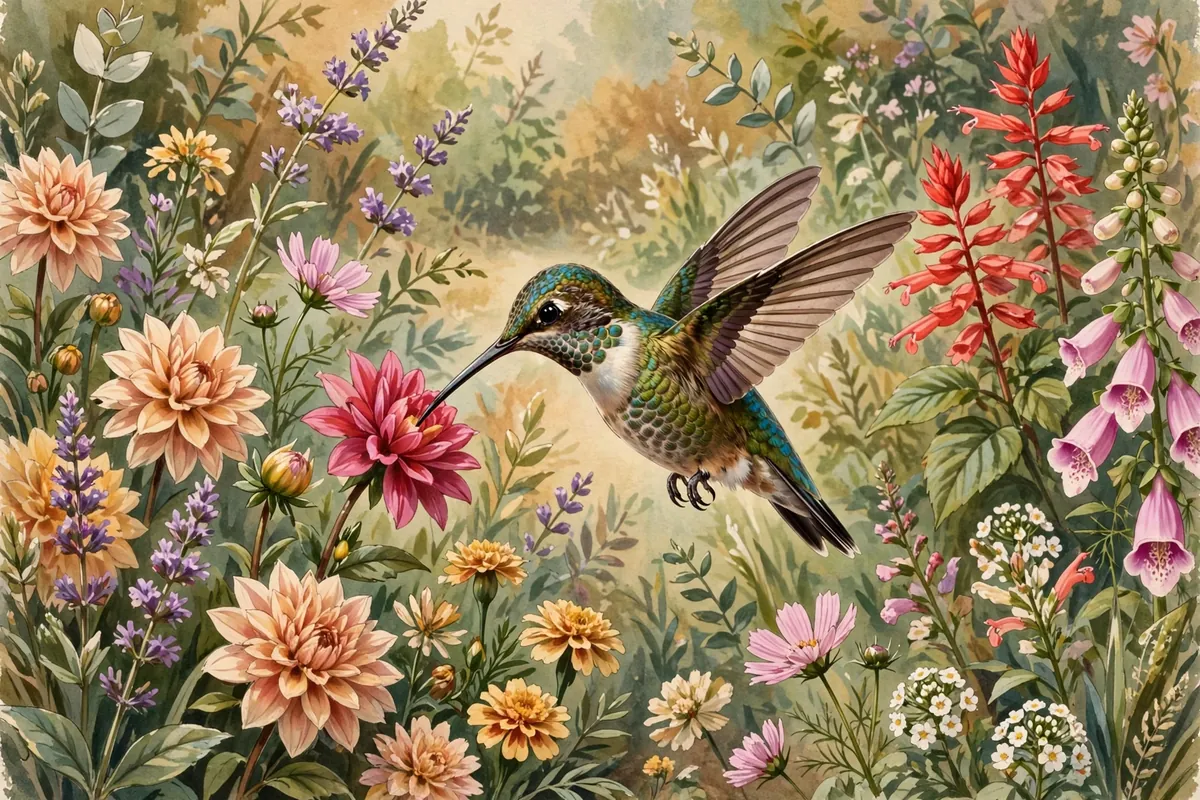
Watch a hummingbird work a garden and it can look like pure frenzy: zip, hover, sip, zip again. But there's more planning going on than you might think. These tiny birds seem to know which blooms they've already visited, and they don't waste much time on empty ones.
The short answer is that hummingbirds have an excellent spatial memory. They have an enlarged hippocampus, the part of the brain that helps with remembering places, and they use it to map flowers they've already visited while feeding. Experiments show they can even learn how long a flower takes to refill. Nobody has shown they remember literally every flower, but their memory for food is remarkable.
Why a Good Memory Matters
Hummingbirds live life at full throttle. They have the highest metabolism of any animal with a backbone. While flying and hovering, their flight muscles use about 10 times more oxygen per gram than an elite human athlete's muscles.
That kind of engine needs constant fuel. A hummingbird eats many small meals and drinks around half its body weight in nectar each day. Because they're so vulnerable to running out of energy, they pay very close attention to where the food is. Many North American species even guard a favorite feeder from other hummingbirds.
The Fake Flower Experiments
Scientists tested this memory with rufous hummingbirds. They made artificial flowers from small painted cardboard disks, each with a syringe tip in the center holding a little sugar water.
The birds quickly learned which flowers held a reward. Colors and flower types helped them learn faster, but they didn't need those clues. Even when every flower looked identical, the hummingbirds remembered that only the center flower had nectar.
When researchers spread the flowers farther apart, the birds still remembered their positions relative to each other. And when the whole arrangement was moved, the hummingbirds kept track of which flowers held nectar, even when that put an empty flower right where a full one used to be.
They Even Keep a Schedule
In another test, some artificial flowers were refilled 10 minutes after being emptied, and others after 20 minutes. Over time, the rufous hummingbirds learned the timing. They visited the 10-minute flowers much more often than the 20-minute ones.
That suggests a kind of planning, so the birds avoid pointless trips and wasted energy. A similar ability has been seen in another species, the green-backed firecrown. In effect, these birds are keeping track of what, where, and when, which is no small feat for a brain that size.
Built for Speed, Inside and Out
Their brains are tuned for flight, too. Hummingbirds have an unusually large region for handling fast-moving images, along with a dense packing of cells in the eye. That helps them see clearly while hovering and darting at high speed.
When food runs short or night falls, they have a backup plan called torpor. It's a deep, hibernation-like sleep in which their metabolism can drop to about one-fifteenth of its normal rate. One hummingbird recorded high in the Andes let its body temperature fall to about 38°F overnight, the lowest known for any bird.
So if a hummingbird seems to skip right past a flower in your garden, it may not be picky. It may simply remember that it already emptied that one, and that it won't be ready again for a little while.