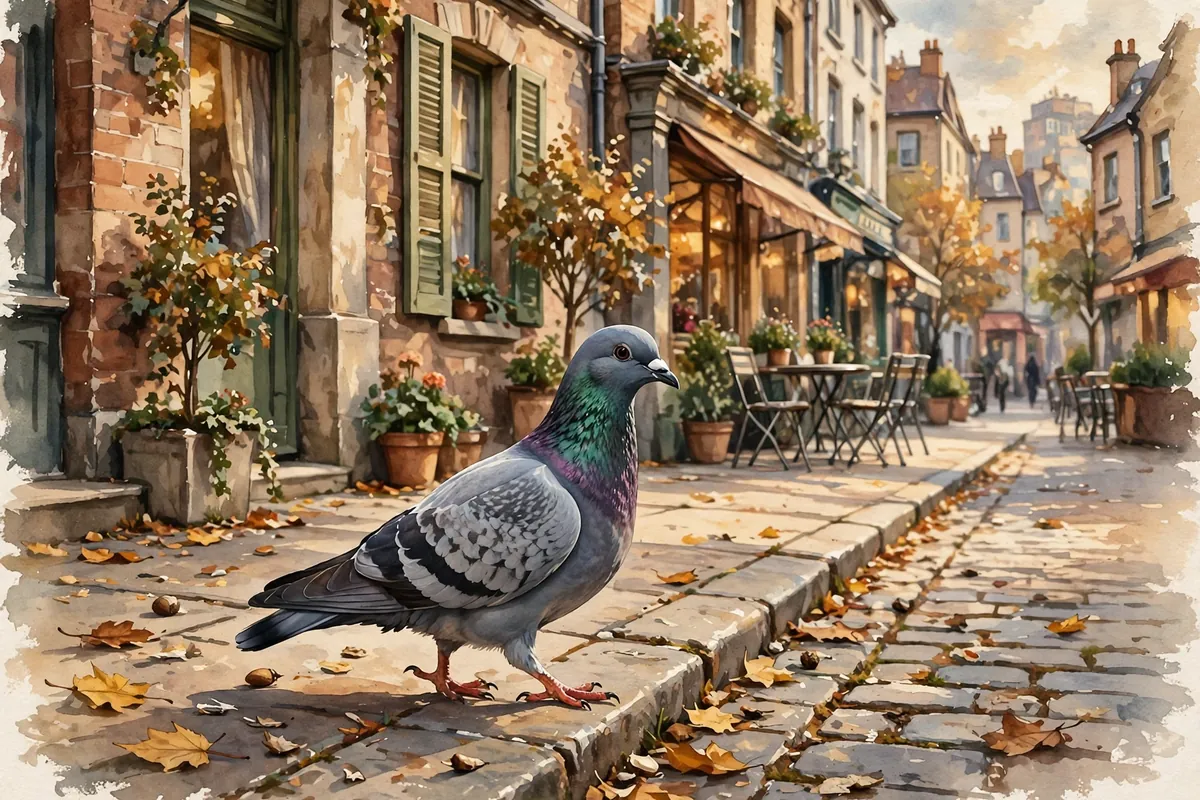
Sit on a park bench for five minutes and you'll see it. A pigeon waddles past, and with every step its head jerks back and forth like it's keeping time to music only it can hear. It looks a little silly. But is there a reason behind it?
There is, and it's all about eyesight. Experiments have shown that the head bob is the bird's way of keeping its view of the world steady while it walks. The proof came from an unusual experiment: when pigeons walked on a treadmill, where their surroundings stayed the same, they stopped bobbing their heads altogether.
The Treadmill Test
In 1975, a researcher named Mark B. Friedman ran a series of experiments with doves, close cousins of pigeons. His work showed that the familiar head bobbing comes from the birds' drive to keep their vision constant.
Then in 1978, a scientist named Barrie J. Frost tried something memorable. He placed pigeons on treadmills. The birds were walking, legs moving just as they would on a sidewalk, but the scene around them wasn't changing. And without a shifting view to deal with, they didn't bob their heads.
That simple test pointed straight to the answer. If bobbing were just part of the walking motion, it would have continued on the treadmill. Because it stopped, scientists concluded that the bob is about what the bird sees, not how it moves its legs.
Eyes Built for the Side View
To understand why a pigeon would go to all this trouble, it helps to know how bird eyes work. Vision is the most important sense for birds. Pigeons have such good eyesight that one description calls them 'two eyes with wings.'
Birds also have the largest eyes relative to their size in the animal kingdom. Because those eyes are so big, they can't move much within their bony sockets. A person can glance around just by shifting their eyes. A bird often has to move its whole head instead.
Pigeons see the world mostly out of the sides of their heads. Their sideways vision is twice as sharp as their forward vision, which is the opposite of ours. Many birds even turn their heads sideways to get a better look at distant objects.
Super-Fast Vision
Pigeons also take in motion much faster than we do. Humans see a light flickering more than 50 to 60 times a second as a steady glow. Pigeons, chickens, and budgies can detect flicker at rates above 100 times a second.
That helps explain why a steady view matters so much to them. For a bird watching for food on the ground or a hawk overhead, a smooth, clear picture of the world could mean the difference between a meal and becoming one.
The Pigeons on Your Sidewalk
The pigeons we see in cities descend from the wild rock dove, a bird that originally lived on cliffs and rocky ledges in Europe, North Africa, and western Asia. People domesticated it long ago, and escaped domestic pigeons became the feral flocks found around the world today.
Rock doves were carried to much of the rest of the world aboard European ships starting in 1603. Today there may be as many as 120 million wild and feral rock doves worldwide.
So the next time a pigeon struts past your bench, nodding with every step, give it a little credit. It isn't being goofy. It's keeping a careful, steady eye on its surroundings, one bob at a time.