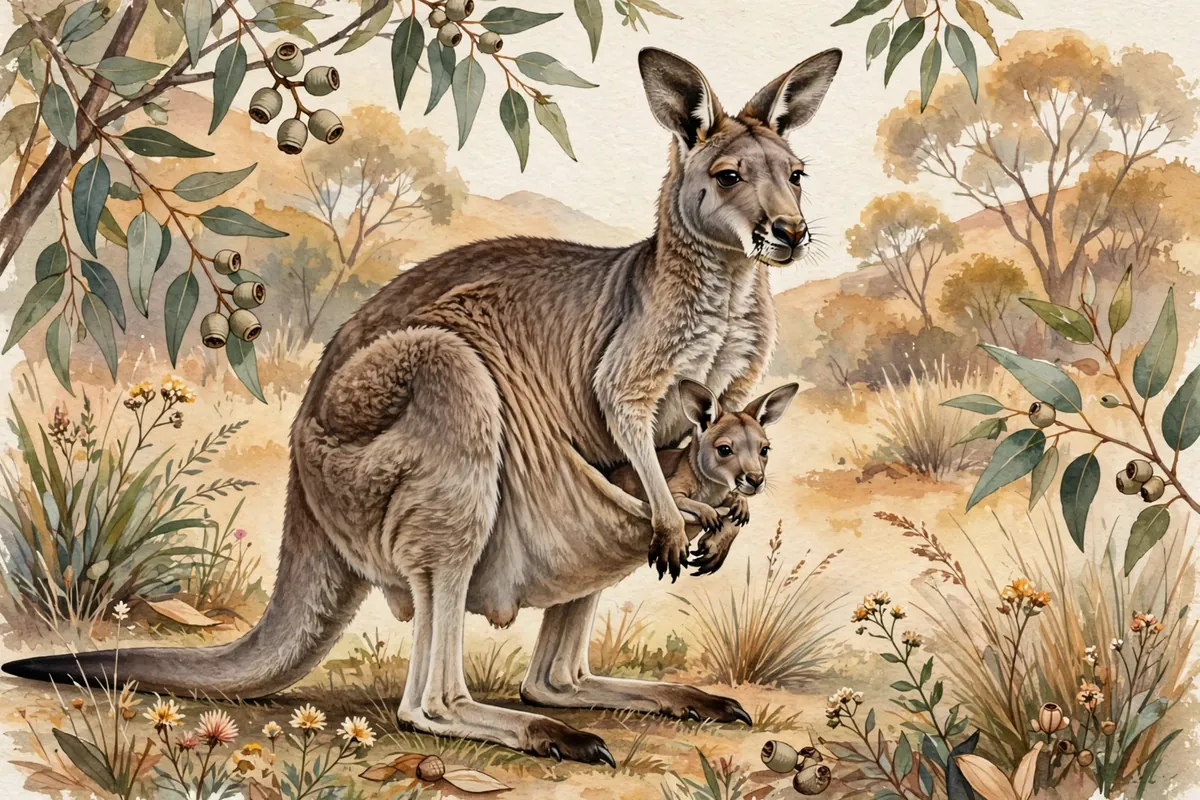
Raising one baby is a lot of work. Now imagine having a youngster in your pocket, another one on the way, and the ability to tell the one on the way to just wait. For a mother kangaroo, that isn't a fantasy. It's how her body works.
Female kangaroos can freeze the development of an embryo until their previous joey is ready to leave the pouch. Scientists call this embryonic diapause. It also tends to happen during droughts and in places where food is scarce, which helps the mother avoid raising a baby when conditions are tough.
A Very Short Pregnancy
To understand the pause, it helps to know how kangaroo babies arrive. Even in the largest species, the red kangaroo, the newborn emerges after only about 33 days. Usually just one is born at a time.
That newborn is tiny: blind, hairless, and only a few centimeters long, with back legs that are mere stumps. Using its stronger front legs, it climbs through the thick fur on its mother's belly and into the pouch, a trip that takes about three to five minutes. Once inside, it latches onto a teat and starts to feed.
Where the Pause Comes In
Almost as soon as the newborn is safely in the pouch, the mother's reproductive cycle starts again. She can mate and conceive a second embryo. But that embryo doesn't keep growing the way you'd expect. Its development is put on hold.
Meanwhile, the joey in the pouch grows fast. After about 190 days, it's big enough to pop out fully, after spending a few weeks just sticking its head out to check the world. At about 235 days, it leaves the pouch for the last time. Once the pouch is free, the waiting embryo can pick up where it left off.
Because of this system, a female kangaroo is often described as being almost permanently pregnant, except on the day she gives birth.
Two Kinds of Milk at Once
The surprises don't stop there. A kangaroo mother can produce two different kinds of milk at the same time: one suited to a tiny newborn and another for an older joey that is still nursing. The makeup of her milk changes to match what each youngster needs.
So at one point in time, a single mother might have an older joey hopping at her side, a tiny newborn attached inside the pouch, and a dormant embryo waiting its turn. That's a well-organized family.
Not Just Kangaroos
Kangaroos aren't alone. Embryonic diapause has been found in about 130 kinds of mammals, which is less than 2 percent of all mammal species. The list includes some seals, rodents, bears, armadillos, weasels, and badgers. In the deer family, the roe deer is a well-known example.
In mammals, the pause usually happens at an early stage when the embryo is a tiny ball of cells called a blastocyst. Cell division slows dramatically or stops. When conditions are right, development starts again, and no harmful effects have been seen after an embryo resumes growing.
The big advantage is timing. A mother can match the birth of her young to the best possible conditions, no matter when mating happened. Food supply, temperature, the time of year, and nursing an older baby can all trigger the pause in different species.
Nature's Waiting Room
Most kangaroos in the wild live around six years on average, though some in captivity live past 20. In a life that short, being able to time each baby wisely is a real edge.
The next time you see a picture of a joey peeking out of a pouch, remember there may be a little sibling already waiting patiently in line. Mother kangaroos, it turns out, are excellent planners.