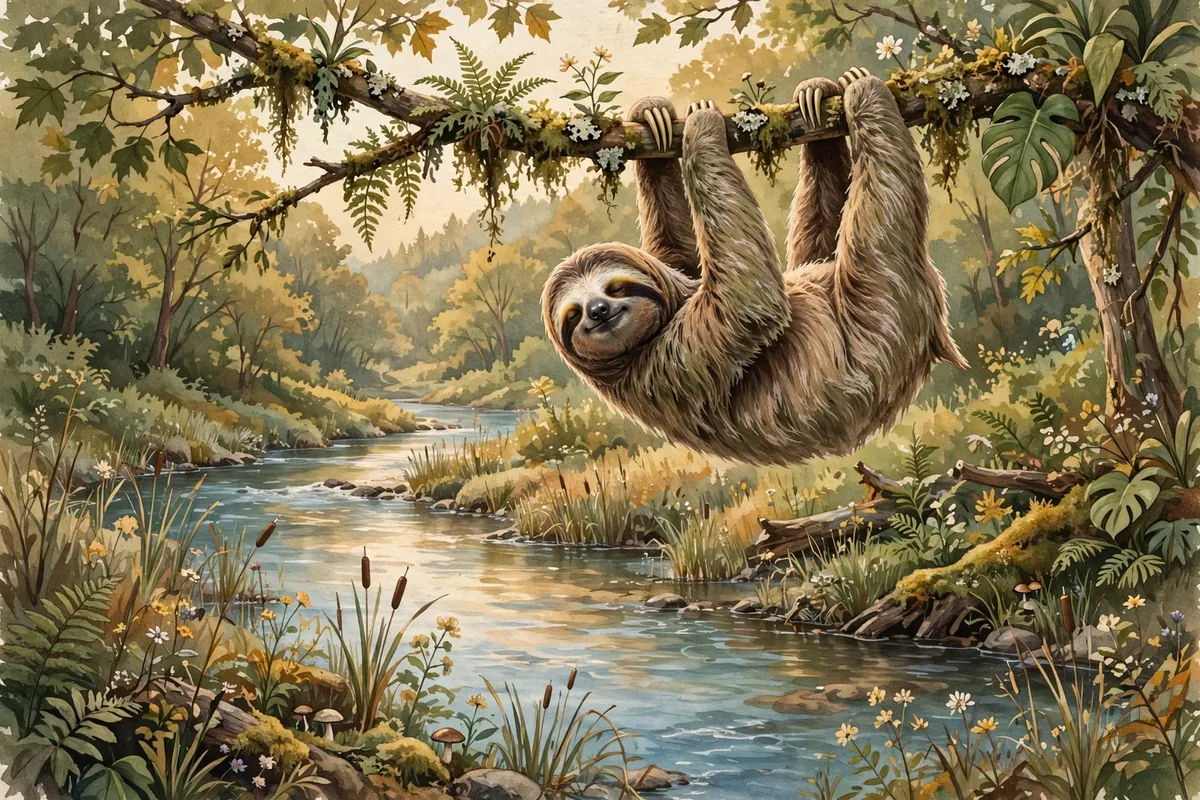
Sloths have a reputation, and it isn't flattering. Their very name means laziness, and in several other languages their names also translate to something like lazy. They spend most of their lives hanging upside down in rainforest trees, moving so slowly you might wonder if they're moving at all.
Yet these unhurried animals are surprisingly strong swimmers, and they can hold their breath underwater for up to 40 minutes. The trick is the same thing that makes them slow on land: an extremely low-energy body. A sloth can turn its already slow metabolism down even further and drop its heart rate to less than a third of normal, so it uses oxygen very sparingly.
Built for Saving Energy
Everything about a sloth is designed around conserving energy. Its resting metabolism runs at about half of what you'd expect for a mammal its size. Its body temperature is low too, around 86 to 93 degrees Fahrenheit when active and even lower when resting.
Unlike most mammals, sloths don't keep a steady temperature. Their bodies can warm or cool with their surroundings, normally ranging from about 77 to 95 degrees Fahrenheit. When they cool down to about 68 degrees, they can slip into torpor, a kind of deep energy-saving rest.
That thrifty system makes sense when you look at the menu. Leaves are a poor source of energy and hard to digest. Sloths have large, slow-acting stomachs with several chambers, where helpful bacteria break down the tough leaves. Digesting a meal can take a month or more, and as much as two-thirds of a well-fed sloth's weight can be the contents of its stomach.
The Surprising Swimmer
On the ground, sloths are almost helpless. In the water, it's another story. They paddle with their long arms and can reach speeds of about 44 feet per minute, which is faster than many people would expect from a sloth.
Swimming lets sloths cross rivers and even move between islands. Scientists think swimming may have helped ancient sloth relatives spread long ago, reaching islands in the Caribbean and even arriving in North America well before land connected it to South America.
One extinct relative went even further. A sloth called Thalassocnus, which lived along the coasts of what are now Peru and Chile, gradually became adapted to life in the sea over millions of years, feeding on seagrass along the bottom.
A Walking Ecosystem
A sloth's shaggy coat is a world of its own. The grooved hairs host green algae that help camouflage the animal from jaguars, ocelots, and harpy eagles. The fur also hosts insects and other tiny creatures, including moths that seem to help fertilize the algae.
Even their hair grows the opposite way from most mammals. Because sloths spend so much time hanging with their limbs above their bodies, their hair grows away from the hands and feet, which helps protect them from the weather while they hang upside down.
Two Toes or Three?
There are seven living sloth species, grouped as two-toed and three-toed sloths. Despite the names, all sloths have three toes on their back feet. The two-toed kinds simply have two digits on each front limb. The two groups aren't even closely related, and scientists think they evolved their similar bodies separately from ground-dwelling ancestors.
So the sloth may be the champion of slowing down, but that talent comes with a hidden bonus. The same body that lets it nap through the afternoon also lets it slip under the surface of a river and stay there longer than almost anyone would guess.