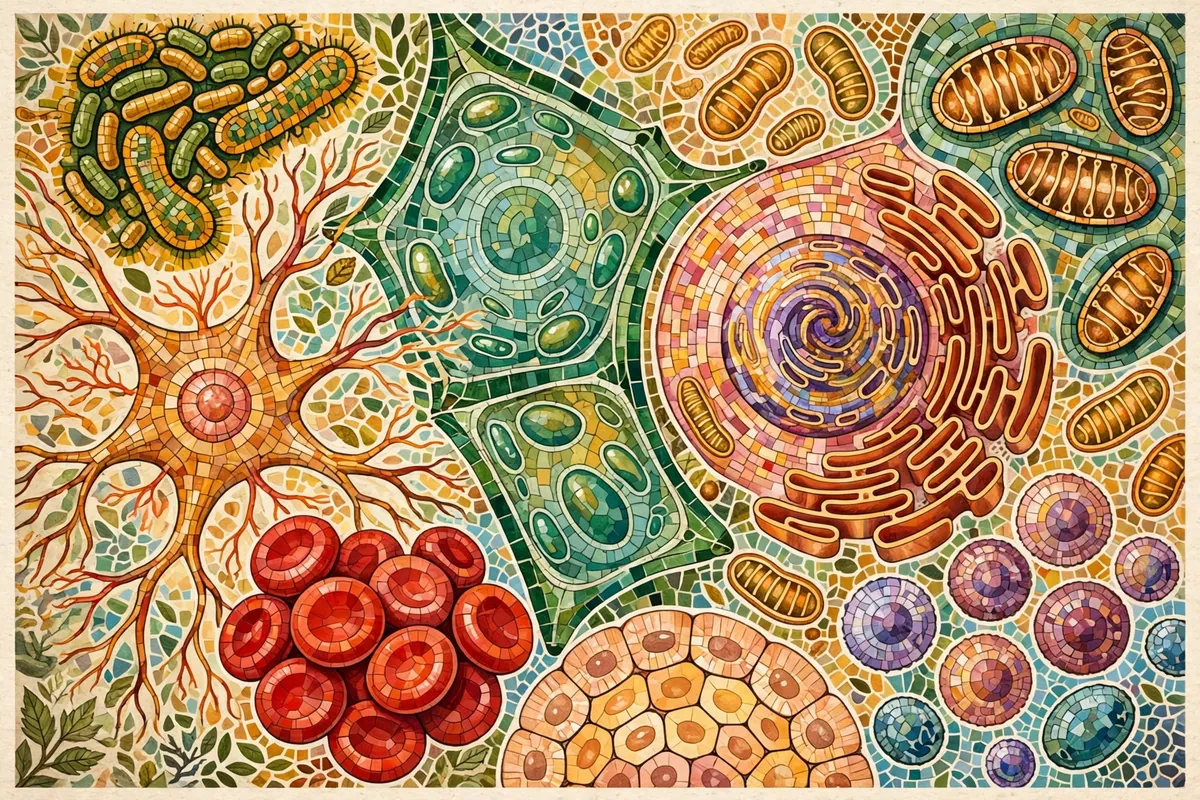
You started life as a single cell. Today you're made of so many that the number is hard to picture. Every heartbeat, every thought, and every step depends on these tiny living units working together. So just how many are there?
Here's the short answer: a typical adult human body contains roughly 30 trillion human cells. Estimates put the average man at around 36 trillion and the average woman at around 28 trillion. Written out, 30 trillion is 30,000,000,000,000, give or take a few trillion.
How Do You Count Trillions?
Nobody sat down with a microscope and counted every cell one by one. Instead, researchers built the estimate by adding up the cell numbers for each organ and each cell type in the body. Piece by piece, those totals add up to the full count.
Those cells come in an estimated 200 different types. There are muscle cells, nerve cells, skin cells, bone cells, and many more, each shaped for its own job. But when it comes to sheer numbers, one type dominates.
Red Blood Cells Win by a Landslide
Most of the cells in your body are red blood cells. An adult has roughly 20 to 30 trillion of them at any given time. Depending on the estimate, that's somewhere around 70 to 84 percent of all your cells by count.
Red blood cells are unusual. They're shaped like flexible disks pinched in the middle, and mature ones have no nucleus at all. They push it out as they develop, leaving more room for hemoglobin, the protein that carries oxygen. In a way, they're little sacks of hemoglobin wrapped in a thin skin.
They're also constantly being replaced. Your bone marrow makes about 2.4 million new red blood cells every second. Each one circulates for about 100 to 120 days before its parts are recycled.
They also vastly outnumber everything else floating in your blood. A single microliter of blood, a speck far smaller than a drop, holds about 4 to 5 million red blood cells in women and 5 to 6 million in men. The same speck has only about 4,000 to 11,000 white blood cells and 150,000 to 400,000 platelets.
You're Not Alone in There
Here's a twist. Your body also hosts an enormous population of bacteria, mostly living in your gut. The current estimate is about 38 trillion bacterial cells, which puts them in the same ballpark as your own cells.
Here's a twist. Your body also hosts an enormous population of bacteria, with the gut being an especially crowded neighborhood. The current estimate is about 38 trillion bacterial cells, which puts them in the same ballpark as your own cells.
Their genes add up too. Your resident bacteria carry an estimated 2 million genes, about 100 times more than the roughly 20,000 human genes. Many of these microbes live alongside us without causing harm, and some actually help us.
Surprisingly, not every part of you is made of cells. Cells sit in a supporting framework called the extracellular matrix, built from proteins such as collagen and surrounded by fluid. It's a bit like the mortar between bricks.
So the next time you feel like just one person, remember that you're really a bustling city of about 30 trillion cells, plus trillions of tiny guests. It's quite a crowd to be carrying around, and every one of them is working for you right now.