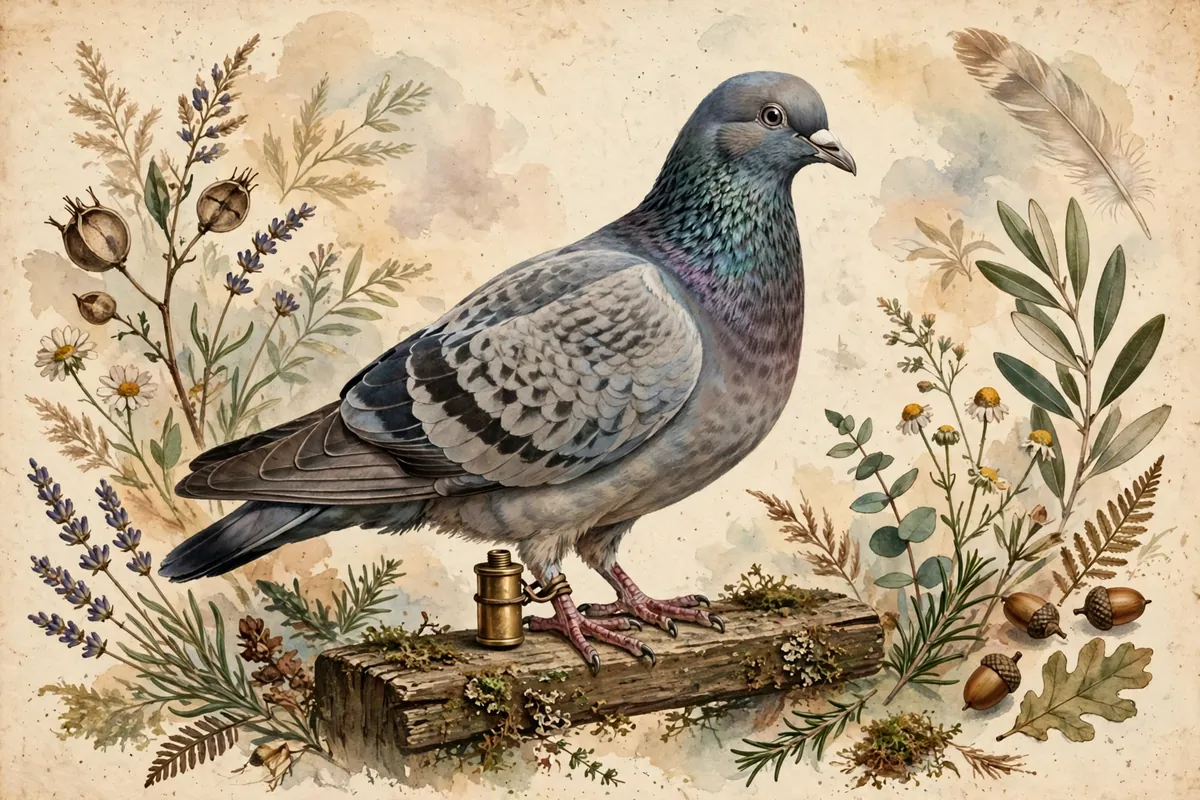
In the Smithsonian's National Museum of American History, among the uniforms and weapons of America's wars, sits a small, stuffed pigeon with one leg. His name is Cher Ami, French for "dear friend." More than a century after World War I, he's still one of the most famous birds in American history.
Cher Ami really was decorated for his service. He received France's Croix de Guerre, a military honor, for delivering 12 important messages at Verdun, and he was badly wounded carrying a message during the war. But the best-known part of his story, that he single-handedly saved the trapped Lost Battalion, is less certain than the legend suggests.
Feathered Messengers of the Great War
Homing pigeons have carried messages for thousands of years because they instinctively fly back to their home loft. In World War I they served as a communication method of last resort for front-line troops. A message was written on thin paper, tucked into a small canister on the bird's leg, and read when the pigeon got home.
The U.S. Army Signal Corps set up its Pigeon Service in November 1917. Cher Ami was one of 600 English-bred birds donated to it in May 1918. His leg band suggests he hatched that same spring, possibly at a loft in Norfolk, England.
The Legend of the Lost Battalion
In October 1918, during the Meuse-Argonne Offensive, several hundred American soldiers under Major Charles Whittlesey were cut off in a ravine in the Argonne Forest. They were short on food and supplies. On October 4, American artillery mistakenly began shelling their position.
Whittlesey scribbled a note: "Our artillery is dropping a barrage directly on us. For heavens sake stop it." According to the popular account, the soldiers' last pigeon was Cher Ami. German troops opened fire as he took off, and he was shot down but flew again, reaching his loft about 25 miles away in roughly 25 minutes. Only 194 men walked out of the forest when the group was finally rescued.
What the Records Actually Show
Here's where history gets messy. Army records confirm that Cher Ami came home shot in the breast, with a leg shot away and the message dangling by a ligament. What they don't clearly show is when and where that happened.
Frank A. Blazich Jr., a Smithsonian curator, has written that there is nothing conclusive linking Cher Ami to the Lost Battalion. The official Signal Corps record places his wounding later in October, on a flight from the town of Grandpré. The Army, he argues, chose to link the bird to the famous rescue to promote the Pigeon Service. Even in the popular telling, the bird reached his loft about five minutes after the shelling had stopped.
Some popular details are definitely wrong. Despite news reports at the time, Cher Ami did not receive the Distinguished Service Cross from General Pershing. Stories that he lost an eye don't match photographs taken in 1919.
A Hero's Homecoming
Whatever the exact facts, Cher Ami was a genuinely wounded veteran. Army medics worked to save him, and once he could travel, the one-legged bird was shipped to the United States, with Pershing seeing him off. He arrived in April 1919 and became a celebrity at press events.
His wounds caught up with him, and he died at Fort Monmouth, New Jersey, in June 1919. He has been on display at the Smithsonian since 1921. In 2021, a DNA test confirmed what his label had always said: Cher Ami was a male.
Legend or not, a little bird flew through gunfire with a message and made it home. That's a story worth remembering, even if history keeps a question mark next to the details.