Imagine leaving your hometown as a kid, wandering an ocean with no roads or signs for years, then returning to the exact street where you were born. No map, no phone. That's roughly what many salmon do.
Here's the short answer scientists have pieced together. Out in the ocean, salmon are thought to use the Earth's magnetic field to find the general area of their home river. Once they get close, they switch to their powerful sense of smell, following the unique scent of their birth stream all the way upstream.
A Life Between Two Worlds
Salmon are anadromous, a fancy word meaning they're born in fresh water but spend their adult lives in the sea. Young salmon grow up in rivers or lakes, then migrate out to the ocean, where they do most of their growing.
When they reach maturity, they head back upstream to spawn on gravel beds in small creeks. They usually return with uncanny precision to the river where they hatched, and often to the very spawning ground where they began life.
Following Their Noses Home
People suspected that smell played a role as far back as the 1800s. In 1951, a researcher named Hasler proposed that every stream has its own chemical signature, and that salmon could smell their way back to it.
Hasler and his students later backed this up. The smell of a salmon's home river gets imprinted on the fish when it becomes a smolt, the stage just before it heads out to sea. On the way home, the salmon can also recognize the distinct smells of side streams as it moves up the main river, choosing the right turns like someone following familiar scents back to grandma's kitchen.
A Built-In Compass
Smell works well near the coast, but the open ocean is a different story. Scientists have looked at several possible guides out there, including the sun, temperature and salt levels, and the Earth's magnetic and electric fields.
There's evidence for the magnetic idea. In 1988, researchers found tiny particles of an iron mineral called magnetite in the skulls of sockeye salmon, in amounts large enough to sense magnetism. Earlier work showed Atlantic salmon react to electric fields as weak as those found in the ocean. The exact details are still being studied.
The Hardest Swim of Their Lives
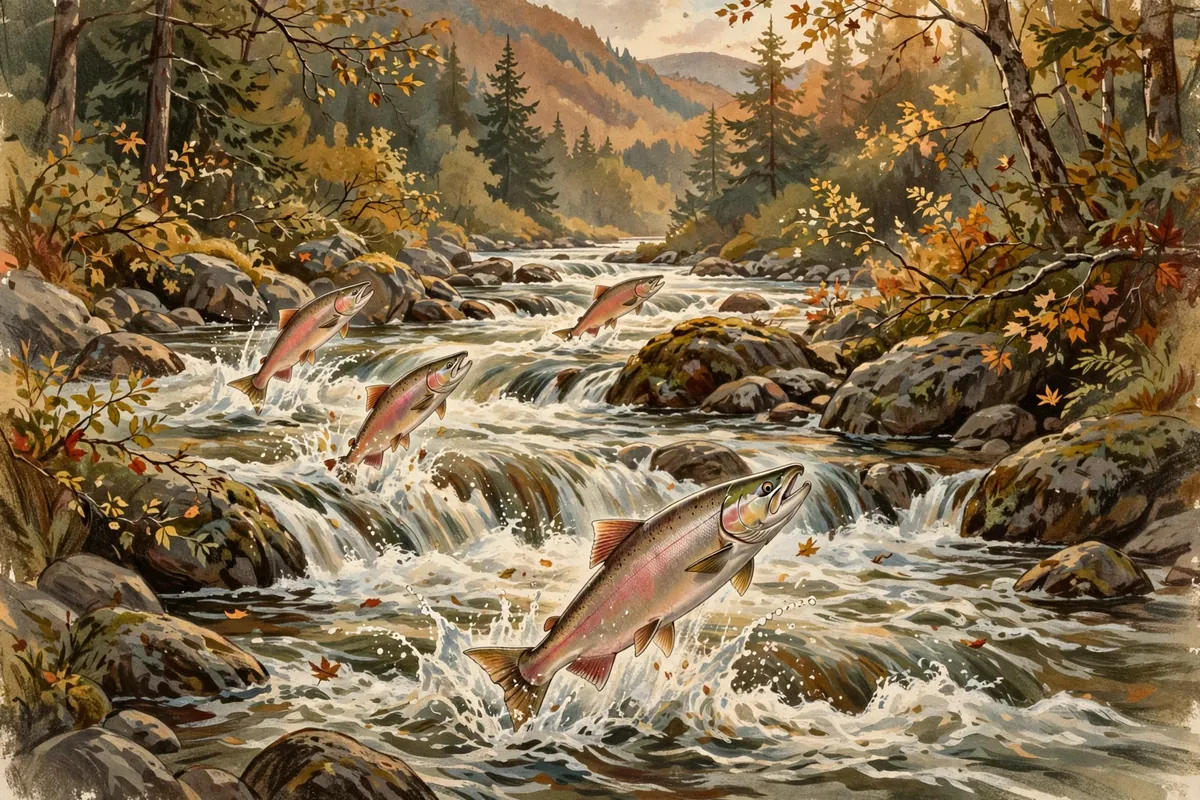
The return trip is brutal. Salmon start the run in peak condition because they need it. They battle rapids and leap up waterfalls, and they've been recorded jumping as high as 12 feet straight up.
Hungry predators are waiting. Grizzly bears, which usually live alone, gather by rivers during the run, joined by bald eagles and seals. After spawning, all species of Pacific salmon and most Atlantic salmon die. Even that feeds the forest, since their bodies carry ocean nutrients like nitrogen and phosphorus deep inland to streams, animals and riverside trees.
Why a Few Get Lost on Purpose
Not every salmon makes it to the right address. Tagging studies show that a small number end up in a different, usually nearby, stream. That's actually useful. Without a few wanderers, salmon could never spread to new rivers.
So when you see a picture of a salmon flying up a waterfall, remember what's going on in its head. It's carrying a compass and a scent memory from its childhood, and it's using both to get home.