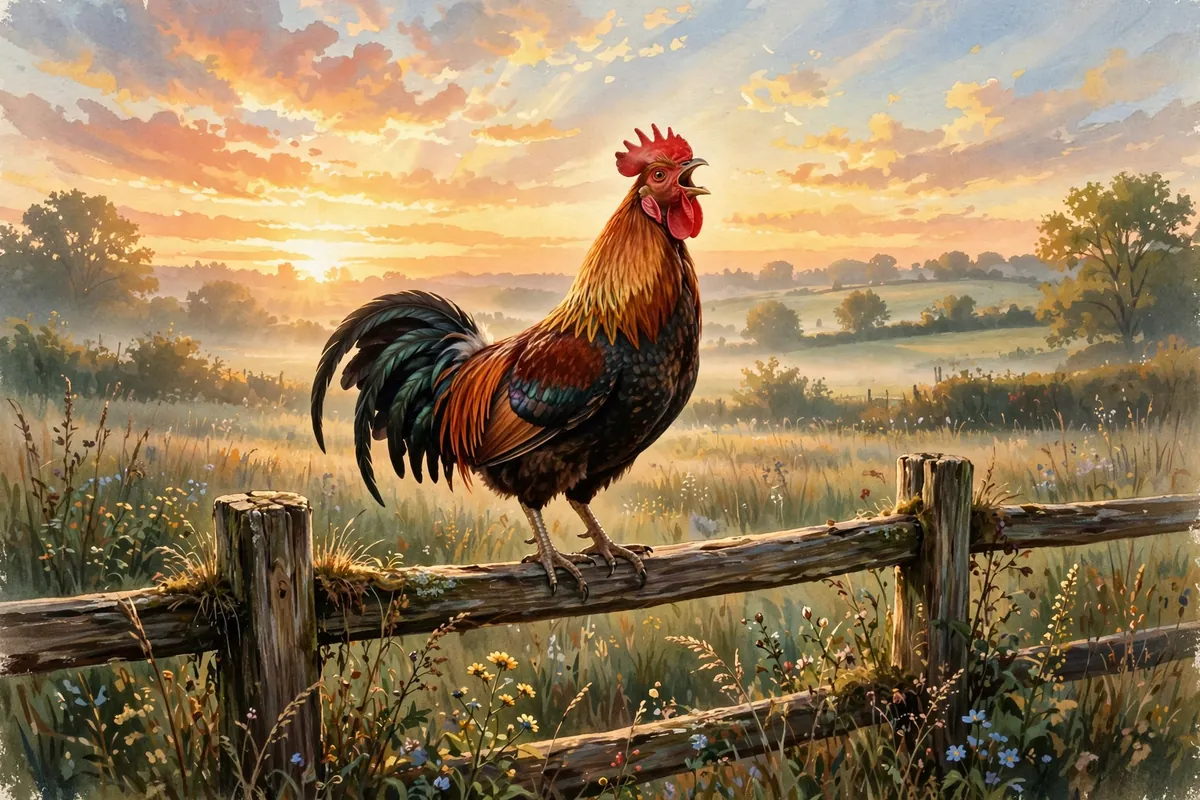
Anyone who has spent a night on a farm knows the sound. Just as the sky starts to brighten, a rooster throws back his head and lets out a full-throated cock-a-doodle-doo. It's so reliable that the rooster has been a symbol of morning for centuries. But how does he know it's time?
The short answer: a rooster's crowing is controlled by his circadian clock, the internal timekeeper that runs on a roughly 24-hour cycle. That clock helps him greet the break of day. And the crow itself is a message, announcing his presence to hens and warning other males that this territory is taken.
A Built-In Alarm Clock
Nearly all living things have circadian rhythms. Scientists have found them in animals, plants, fungi, and even some bacteria. These natural cycles repeat about every 24 hours and are generated inside the body. They aren't completely self-running, though. Outside signals, especially light, keep resetting them so they stay in sync with the real day.
It's the same system that gives travelers jet lag. When you fly across several time zones, your inner clock needs a few days to catch up with the local sunrise. A rooster's clock works on the same basic principle, which is why his morning crow tends to come right around the break of dawn.
The Boss Always Crows First
Here's the surprising part. Chickens live in flocks with a strict social ranking, the original pecking order. Among roosters, that ranking even decides the morning wake-up call.
The top-ranking rooster always crows first. Then the others follow, one after another, in descending order of social rank. When one rooster announces the break of dawn, others nearby quickly join in, so a whole neighborhood of roosters can go off in a kind of chain reaction.
The idea of the pecking order itself comes from chickens. A researcher named Thorleif Schjelderup-Ebbe described it in hens in 1921, and the phrase has since become an everyday expression for who's in charge.
What the Crow Really Means
A crow is loud for a reason. It's a territorial signal to other males, a bit like posting a no-trespassing sign made of sound. It also helps attract mates and lets rival roosters know they'd be risking a fight with a competitor. When those disputes do turn physical, roosters tend to leap at each other and use their claws.
That's also why roosters don't only crow at dawn. They crow in response to sudden disturbances, too, so a slammed door or a passing truck can set one off in the middle of the afternoon. The dawn chorus is simply the most famous performance.
A Call With Deep Roots
Domestic chickens descend from the red junglefowl, a wild bird native to Southeast Asia, and were first domesticated around 8,000 years ago. Wild junglefowl males crow too, but their call is shorter than a farm rooster's and cuts off abruptly at the end.
Chickens have plenty of other things to say. Hens cluck loudly after laying an egg and to call their chicks. The flock even has different warning calls depending on whether a predator is coming from the sky or on the ground.
So the next time a rooster wakes you before you're ready, try not to take it personally. He's just following his inner clock, keeping his place in line, and making sure everyone within earshot knows whose yard it is.