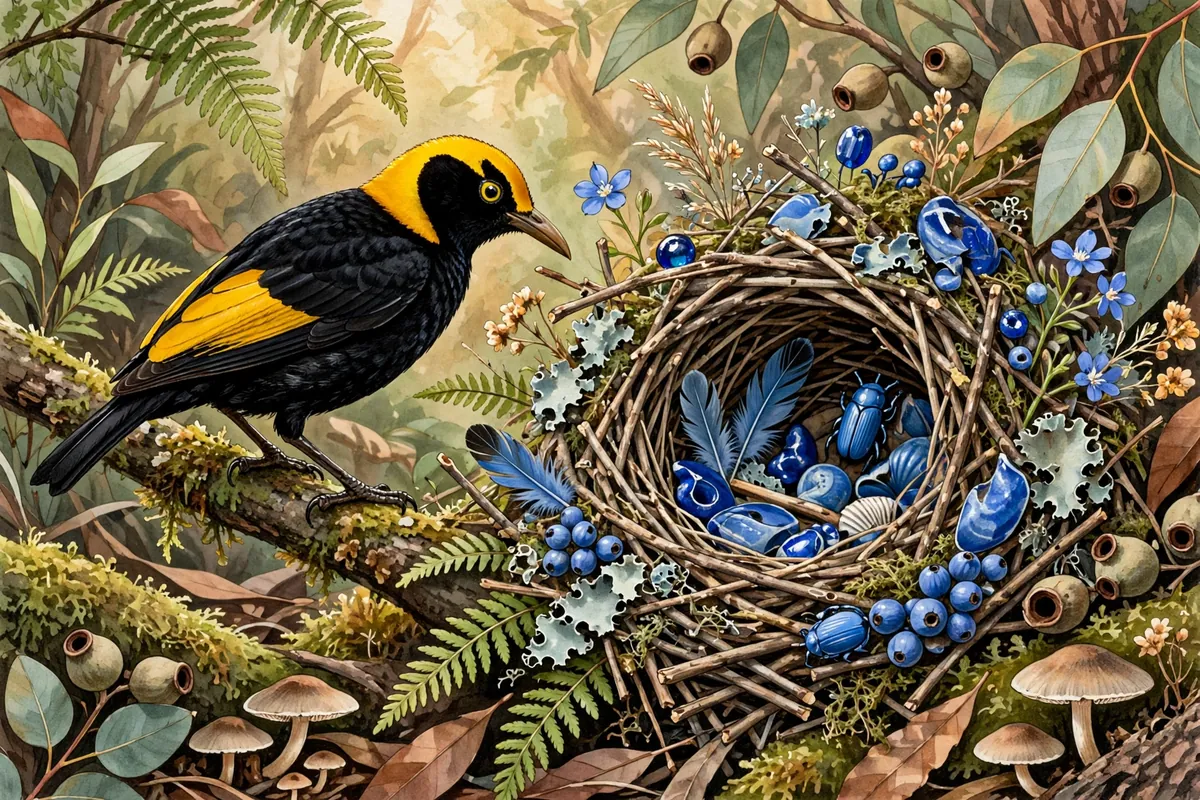
Imagine walking through a rainforest and finding a neat little hut made of sticks, with a tidy mossy front yard covered in flowers, berries, and shiny beetle wings. It looks like someone moved in and decorated. The builder is a bird, and it's often called the fanciest home-builder in nature.
Here's the twist: it isn't a house at all. The structure, called a bower, is built by a male bowerbird to impress females. Nobody lives in it and no eggs are laid there. The female builds her own plain nest somewhere else and raises the chicks on her own.
A Showroom, Not a Nest
There are 23 species of bowerbirds, found in New Guinea and Australia. In most of them, the male's whole job in courtship is to build and decorate a bower, then put on a show in front of it. Females visit different bowers and choose which male they'll mate with.
After that, the female does the rest. She builds a nest by laying soft leaves, ferns, and vine tendrils on a loose base of sticks, and she raises the young alone. The only exception is the catbirds, which pair up for life, raise chicks together, and don't build bowers at all.
Two Kinds of Bowers
Bowers come in two main styles. Some species build a "maypole" bower by piling sticks around a young tree, and a few top it with a roof, so it looks like a little hut. Others build an "avenue" bower: two parallel walls of upright sticks with a path between them.
The Vogelkop bowerbird of western New Guinea is a champion builder. The bird itself is plain olive brown, one of the dullest-looking members of the family. Yet it builds a cone-shaped hut about 3 feet tall and over 5 feet across, with a cleared front lawn laid out with moss and decorated with flowers, fruit, and shiny beetle wings.
The Bird That Loves Blue
The satin bowerbird of eastern Australia is famous for its taste in color. Males decorate their avenue bowers with blue, yellow, and shiny objects: berries, flowers, snail shells, and even ballpoint pens, drinking straws, and clothespins. As the males get older, they use more blue than any other color.
Nobody is sure why blue. One idea is that it shows off the male's own feathers, which look deep, shiny blue-black. Several studies on different bowerbirds have found that the colors males pick tend to match what females prefer.
Collectors, Decorators, and Thieves
Depending on the species, a bower can be surrounded by hundreds of shells, leaves, flowers, feathers, stones, and berries. Some birds add coins, nails, pieces of glass, or bits of plastic. Males spend hours arranging their collections, replacing items as they wilt, and they often steal decorations from neighboring bowers.
Then comes the performance. Males dance and display for visiting females, and research suggests they adjust their act depending on how the female responds. Many bowerbirds are also skilled mimics. MacGregor's bowerbird has been heard imitating pigs, waterfalls, and human chatter.
For young satin bowerbird females, the look of the bower seems to matter most. Older females pay more attention to the male's dance. In other words, the decorating gets a male noticed, but the moves help seal the deal.
A Long Time to Get It Right
Male satin bowerbirds don't reach full maturity until they're about seven or eight years old, when they finally get their blue-black adult feathers. That's a long apprenticeship for a builder.
So the bowerbird isn't really nature's fanciest homeowner. It's something even more charming: a hopeful romantic who builds a beautiful stage, fills it with treasures, and waits for the right visitor to stop by.