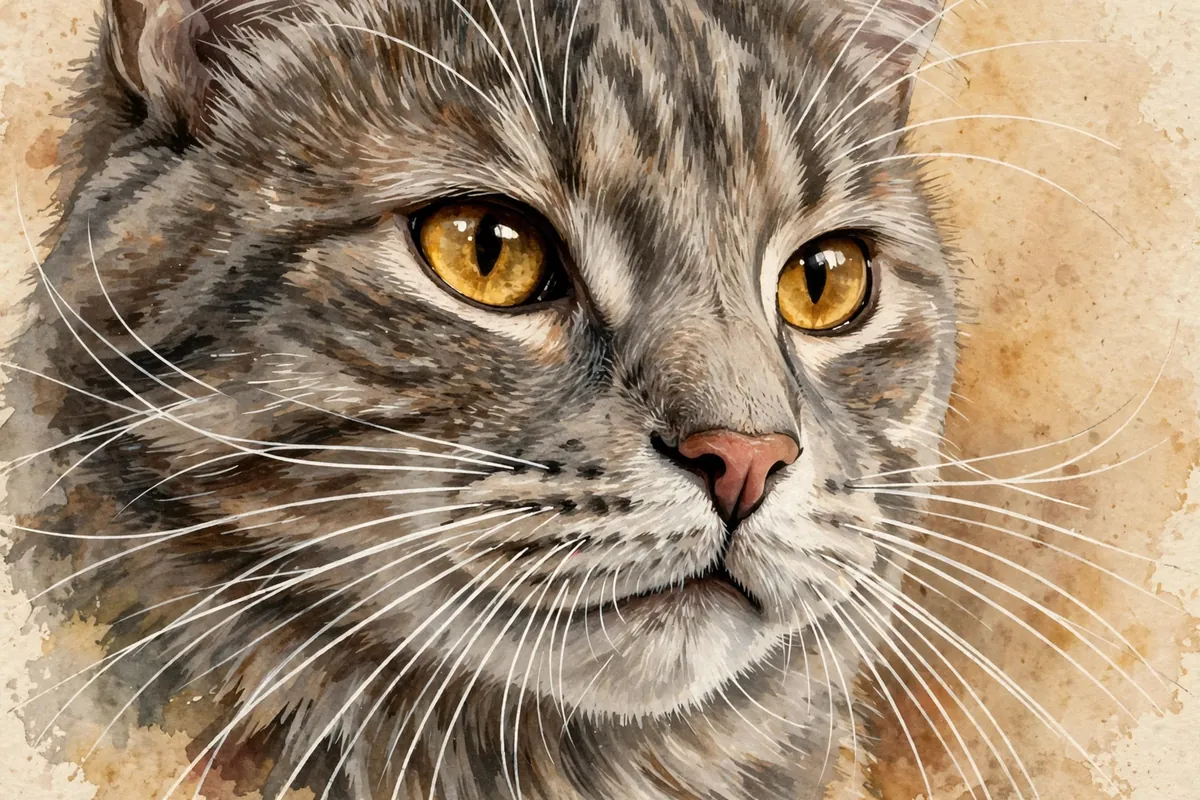
Look closely at a cat's face and you'll see them: long, stiff whiskers fanning out from the cheeks like antennae. Most of us think of them as decoration, the finishing touch on a cute face. But those hairs are doing serious work every minute your cat is awake.
The short answer is that whiskers are touch sensors. Scientists call them vibrissae, and their roots are wired with nerve endings that tell a cat about nearby objects and even tiny movements in the air. They help cats get around without seeing, and they play a surprising role in catching prey.
Not Ordinary Hair
A cat's whiskers are more than twice as thick as its regular fur, and their roots sit about three times deeper in the skin. At the base of each one are numerous nerve endings. So when a whisker brushes against something, or even feels a slight draft, the cat gets a detailed message.
That lets a cat know it's near an obstacle without needing to see it. It's a handy skill for an animal that evolved to hunt at dawn and dusk, when the light is low.
A typical cat has about 24 movable whiskers on its upper lip, in four rows on each side of the nose. The top two rows can move separately from the bottom two, which gives the cat more precision. And there are more whiskers than most people realize: a few on the cheeks, tufts over the eyes, bristles on the chin, and a few on the inner wrists and the backs of the legs.
A Secret Weapon for Hunting
Here's the part that surprises most cat owners. Cats appear to be nearsighted, so they don't see things very close to their faces especially well. That's a problem when prey is right under their nose.
High-speed photography shows what happens next. When prey is too close to the mouth to see, a cat's whiskers swing forward and form a sort of basket around the muzzle, pinpointing exactly where the prey is. A cat with damaged whiskers may bite the wrong part of its prey, which shows how much information those hairs provide.
A Map Made of Touch
The part of the brain that handles signals from the whiskers is organized in a way that resembles the part that handles vision. That helps a cat build a three-dimensional sense of its surroundings.
Still, it isn't a kind of seeing. Whisker sensing is touch, and the cat builds up its picture of the world bit by bit, one brush and bump at a time.
Whiskers Talk, Too
Across many mammals, whisker movements can also reveal an animal's state of mind, such as fear or curiosity. Whiskers can even trigger reflexes that help protect the eyes.
Cats aren't alone in having them. Most mammals have whiskers, including all primates other than humans. Some species take it to extremes: a chinchilla's whiskers can be more than a third as long as its body. Even a seabird called the whiskered auklet uses stiff face feathers in a similar way. In one experiment, auklets with those feathers taped back bumped their heads more than twice as often in a maze of tunnels.
So the next time your cat glides through a dark hallway or pounces with perfect aim, give a little credit to those elegant whiskers. They're not just for looks. They're one of the best tools a cat has.