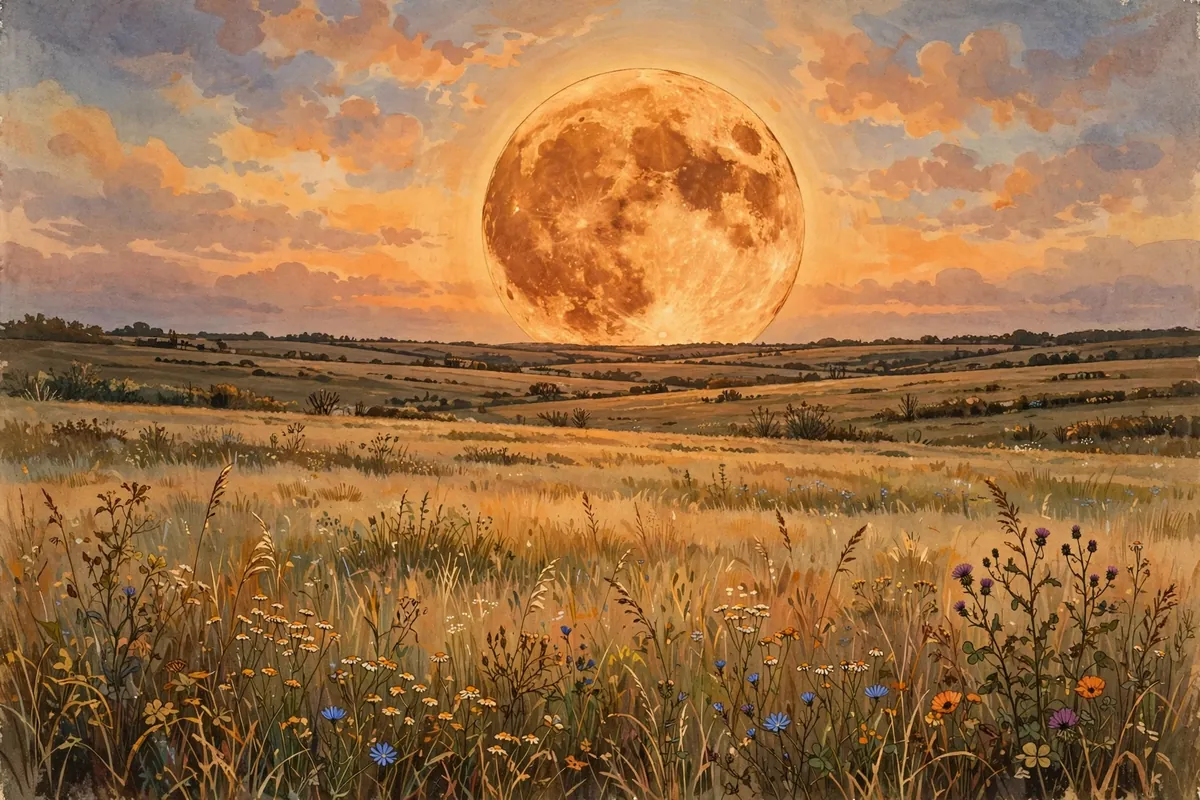
Few sights stop people in their tracks like a giant full moon peeking over the horizon. It looks swollen and close, as if it drifted nearer to Earth just for the evening. Then, a few hours later, the same moon sits high in the sky looking perfectly ordinary.
Here's the answer: the moon doesn't actually get bigger. It's an optical illusion, known as the Moon illusion, and it happens inside your head. In fact, the moon at the horizon is about 1.5 percent farther away from you than when it's overhead, so it's technically a tiny bit smaller. Scientists agree it's an illusion, but they still debate exactly why our brains fall for it.
How We Know It's an Illusion
Measurements tell the story. Instruments that measure angles show that the moon takes up the same amount of sky whether it's rising or high overhead. Photos taken at different heights show the same size, too.
You can test it yourself. Hold a small pebble, about a third of an inch wide, at arm's length and close one eye. Position it so it just covers the full moon when the moon is high in the sky. Later, try the same thing when the moon is huge on the horizon. The same pebble will cover it.
The Leading Explanation
The explanation found most often in textbooks has to do with distance. When the moon sits near the horizon, you see it beyond a stretch of land filled with trees, buildings, and hills. All those clues tell your brain the moon is very far away. Overhead, there's only empty sky, and those clues disappear.
Your brain tries to correct for distance. Since the moon makes the same size image on your eye either way, the brain decides that a moon which seems farther away must be bigger. Experiments in 1962 by Kaufman and Rock found that the land between you and the horizon is a crucial factor. When researchers removed those distance cues, the horizon moon looked smaller.
Still a Puzzle
The explanation isn't airtight. Oddly, most people say the horizon moon looks both bigger and closer, not farther away. Researchers have proposed other ideas, too. One suggests the moon looks big next to small details on the horizon, the same way a circle looks larger when surrounded by smaller circles.
After reviewing many theories, two researchers concluded in a 2002 book that no single theory has emerged victorious. They found the illusion usually makes the moon look about 50 percent wider, with the sight of the landscape being the most important factor.
A fun twist: looking at the horizon moon upside down, by bending over and peering between your legs, noticeably shrinks the illusion. That may be because the image is flipped.
An Ancient Mystery
People have puzzled over this for thousands of years. Aristotle mentioned it, and so did Ptolemy, Leonardo da Vinci, and Descartes. Early thinkers blamed the air bending the moon's light, and by the 17th century it was accepted as a trick of the mind.
So the next time a giant moon rises over the treetops, enjoy it anyway. Knowing it's an illusion doesn't make it go away. Even the philosopher Immanuel Kant admitted that an astronomer can't stop himself from seeing the rising moon as larger, even though he knows better.