Look up on the right evening and you might spot a bright white dot gliding steadily across the sky. No blinking lights, no sound. That's the International Space Station, home to astronauts, and it's moving far faster than anything you've ever ridden in.
The station travels at about 17,200 miles per hour, or roughly 4.8 miles every second. You'll often see the figure rounded up to about 17,500 mph. At that speed, it circles the entire Earth roughly every 93 minutes, which works out to about 15.5 trips around the planet every day.
Why It Has to Go So Fast
The space station orbits about 250 miles above Earth. At that height, gravity is still pulling on it strongly. So why doesn't it fall? In a way, it is falling, all the time.
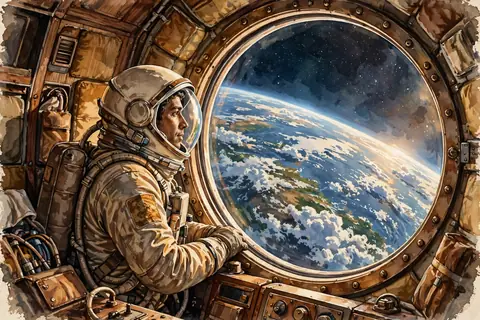
The trick is speed. The station is moving sideways so fast that, as it falls toward Earth, the curved surface of the planet keeps dropping away beneath it. It keeps falling around the Earth instead of into it. That constant falling is also why astronauts float: they, and everything around them, are falling together.
There's a small catch. Even at 250 miles up, there's a whisper of atmosphere. That thin air drags on the station and lowers its altitude by about 1.2 miles a month on average. To fix that, engines give it a regular push, called a reboost, to bring it back up.
Sixteen Sunrises a Day
Moving this fast does strange things to a day. Because the station loops around the planet so often, the crew experiences about 16 sunrises and 16 sunsets every 24 hours.
That would make sleeping tricky, so the station's windows are covered during scheduled sleep periods to create a sense of night. Astronauts live on a set schedule rather than following the sun.
A Football Field in the Sky
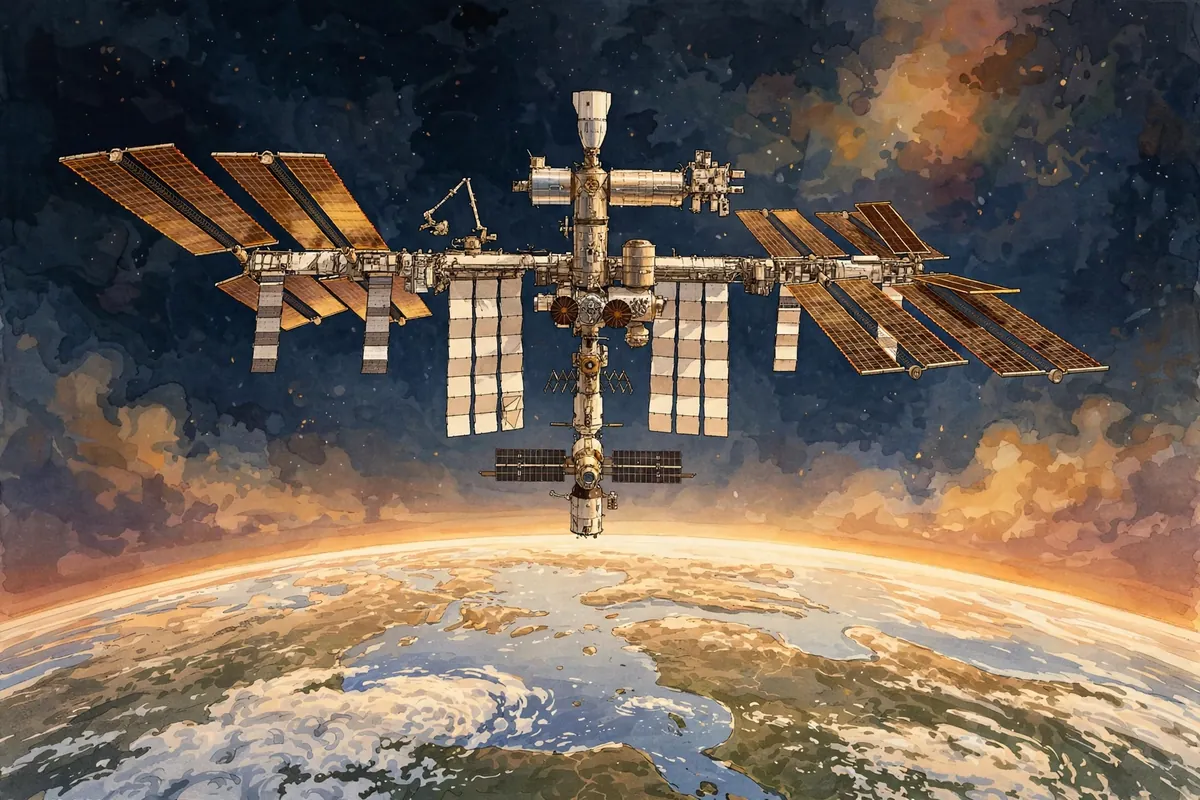
What's most impressive is the size of the thing moving at this speed. With its solar panels spread out, the station measures about 358 feet by 239 feet, roughly as big as a football field. Inside, the pressurized living and working space is comparable to a Boeing 747 airliner.
The first piece was launched in 1998. People have lived aboard continuously since November 2, 2000, making it the longest continuous human presence in space. As of August 2025, 290 people from 26 countries had visited. The station is expected to keep operating until the end of 2030, after which it is planned to be steered out of orbit.
How to See It Yourself
You don't need a telescope. The station is visible to the naked eye as a bright, steadily moving white dot. The best time to look is around twilight, shortly after sunset or before sunrise, when the sky around you is dark but the station high above is still lit by the sun.
Depending on its path, a pass can last up to about 10 minutes, though you may only see part of it as the station slips into or out of Earth's shadow. It comes back around roughly every 90 minutes, though the viewing times shift over a few weeks.
So next time you see that silent dot sliding overhead, give it a wave. By the time you've finished waving, the astronauts on board will already be dozens of miles farther down the road.