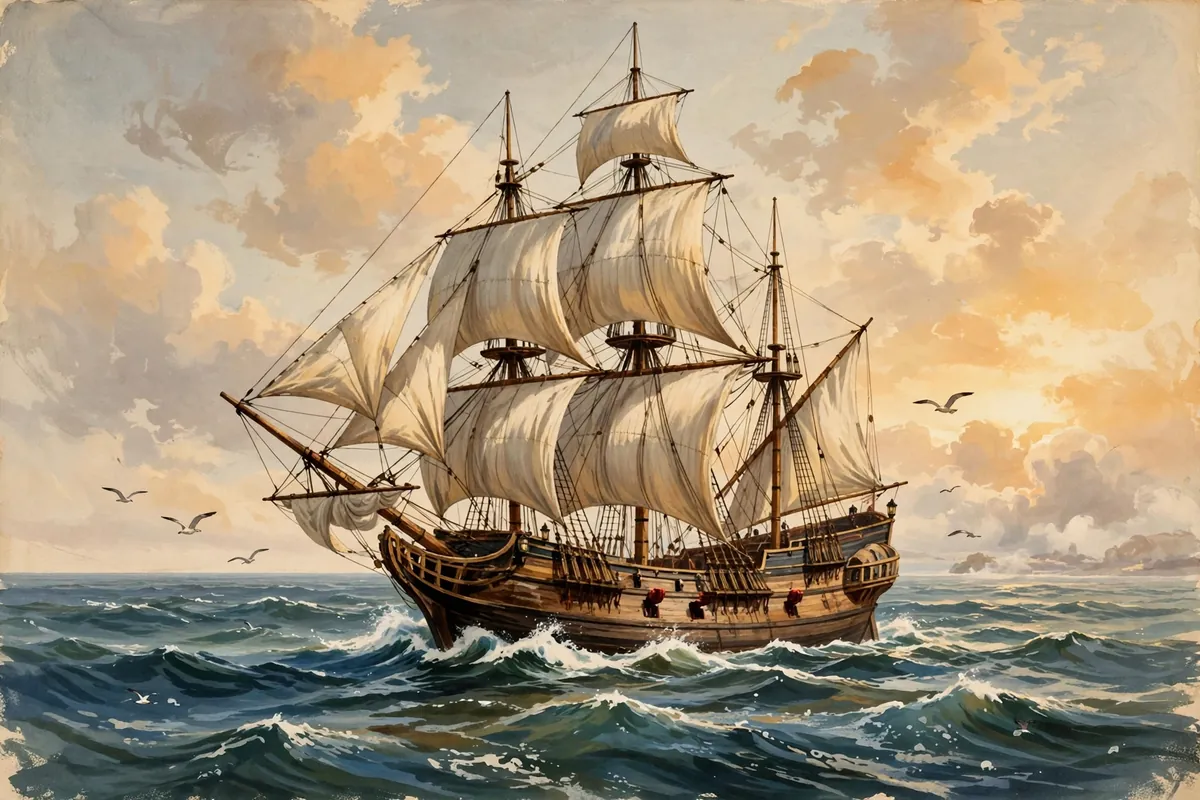
Plymouth Rock, Cape Cod, the first Thanksgiving in Massachusetts. The Pilgrim story is so tied to New England that it's hard to imagine it anywhere else. But when the Mayflower set out in 1620, New England wasn't where the passengers were supposed to go.
Here's the short answer. The Pilgrims had permission to settle in the Colony of Virginia, arranged through the London investors who financed the trip. When they sighted Cape Cod in November 1620, they spent several days trying to sail south toward their planned destination. Rough winter seas forced them back, and with supplies running low, they anchored at the tip of Cape Cod instead.
Virginia Was a Lot Bigger Then
It helps to know that "Virginia" meant something larger in those days. Under King James's charter, the Virginia Company of London could plant colonies roughly between Cape Fear, in today's North Carolina, and Long Island Sound. The Pilgrims' own Mayflower Compact describes their voyage as an effort to plant a colony "in the northern parts of Virginia."
Not all the passengers were religious Separatists, either. More than a third were, but others were hired hands, servants, and farmers recruited by London merchants, all originally bound for Virginia.
A Rough Crossing
The trip got off to a bad start. The plan was to use two ships, but the smaller one, the Speedwell, proved unseaworthy and was left behind. The Mayflower finally sailed alone from Plymouth, England, on September 16, 1620, with 102 passengers and a crew of about 30. At about 180 tons, she was a fairly small cargo ship that had mostly carried goods between England and Bordeaux, France.
The ocean crossing was miserable. Passengers crouched in semi-darkness below deck, and seawater soaked everyone and everything. In mid-ocean, a storm badly damaged one of the ship's main beams. Luckily, a colonist had brought a large metal jackscrew from Holland to help build houses. The crew used it to brace the beam and keep the ship seaworthy.
Turned Back at Cape Cod
After about 10 weeks at sea, the crew sighted Cape Cod on November 19, 1620. They tried to head south, but the strong winter seas forced them back to the harbor at the hook of the Cape, today's Provincetown Harbor. They dropped anchor on November 21. Today, Provincetown sits at the curled tip of the Cape, far from where the passengers expected to start their new lives.
A Problem That Led to the Mayflower Compact
Landing outside Virginia created a real problem. Some passengers argued that since they weren't settling where they had permission to go, nobody had the power to command them. To keep order, the leaders drew up the Mayflower Compact before going ashore, an agreement in which the settlers promised to follow the community's rules for the sake of order and survival.
It's often seen as an early example of self-government in America. One signer, Stephen Hopkins, is thought to be the same man who had once been sentenced to death for making a similar argument after a shipwreck on the way to Virginia, and was later pardoned.
The first winter was brutal, and only about half the Pilgrims survived it. But with help from their Native neighbors, the colony held on, and the next autumn came the famous harvest feast. So if the sea had been a little calmer that November, the Pilgrims might have stepped ashore somewhere else entirely, and the history books would read very differently.