Millions of people spend their workdays spinning gently in office chairs. It's such an ordinary object that we never think about where it came from. But one of America's Founding Fathers had a hand in its story.
Here's the short answer. In 1775, Thomas Jefferson took an English-style Windsor chair and heavily modified it so the seat could rotate. He split it into top and bottom parts joined by a central iron spindle, and the seat turned on small rollers like those used in old rope-hung windows. Jefferson is often credited with creating the swivel chair, and he's said to have drafted the Declaration of Independence while sitting in it.
How Jefferson's Chair Worked
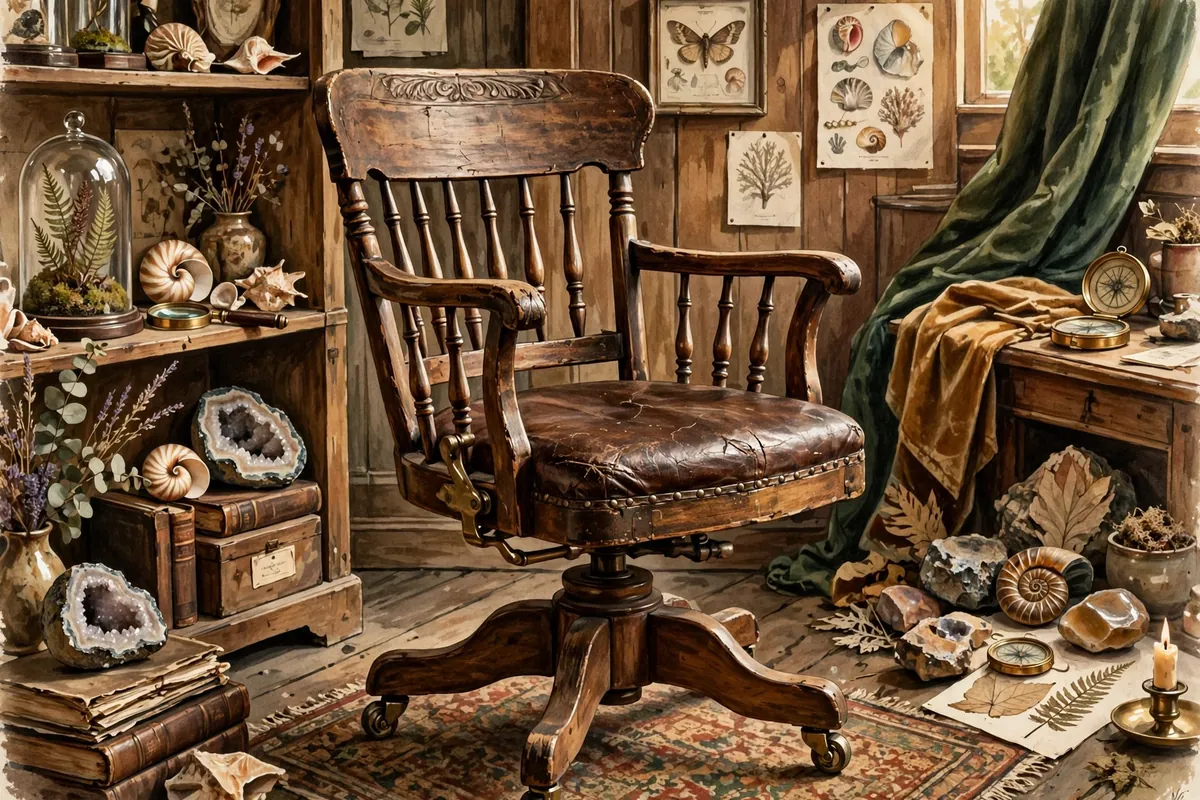
Jefferson started with a Windsor chair, a sturdy wooden design with a spindle back, possibly bought from a Philadelphia cabinetmaker such as Benjamin Randolph or Francis Trumble. He cut it into two halves: a fixed base and a seat on top. It was a hands-on project for a man who loved to tinker, and he did the redesign himself.
A central iron spindle connected the two parts. To make the seat turn smoothly, he used the same kind of rollers found in sash windows that slid up and down on ropes. Unlike today's office chairs, it had no wheels. You stayed in one spot and simply turned.
Jefferson later sent the chair to Monticello, his Virginia plantation. In August 1791, he added a writing paddle to its side, a small built-in desk for taking notes.
The Declaration Connection
When the Second Continental Congress met in Philadelphia, Jefferson is said to have sat in this swivel chair while drafting the Declaration of Independence in 1776. Sources describe that story as purported rather than proven, but it's a popular piece of American lore.
Either way, the chair itself survived. Since 1836, it has been owned by the American Philosophical Society in Philadelphia.
Was He Really First?
Not quite. The idea of a rotating chair is older. In 1505, a German nobleman named Martin Löffelholz von Kolberg illustrated a chair with swiveling casters in his illuminated manuscript of technical drawings, now known as the Codex Löffelholz. He imagined a seat that could twist on its legs and adjust its height.
Wheels came later too. Today's typical office chair combines both ideas, a seat that spins and casters that roll, and usually adds a gas lift to adjust the height. One of the earliest innovators of the modern office chair was naturalist Charles Darwin, who put wheels on the chair in his study so he could get to his specimens more quickly.
A Lifelong Tinkerer
The swivel chair was just one of Jefferson's many projects. He designed a revolving book stand and a Great Clock powered by the pull of cannonball weights. He improved the pedometer, a writing-copying device called the polygraph, and the moldboard plow, an improvement he never patented and gave freely to the world.
He even shaped American patent law. As secretary of state, he served on the three-person board that reviewed patents from 1790 to 1793. He drafted reforms that drastically changed the patent system, and those reforms led to his being relieved of that duty in 1793. So the next time you spin around in your desk chair, give a little nod to Jefferson. The man who helped write the nation's founding document also liked his comfort.