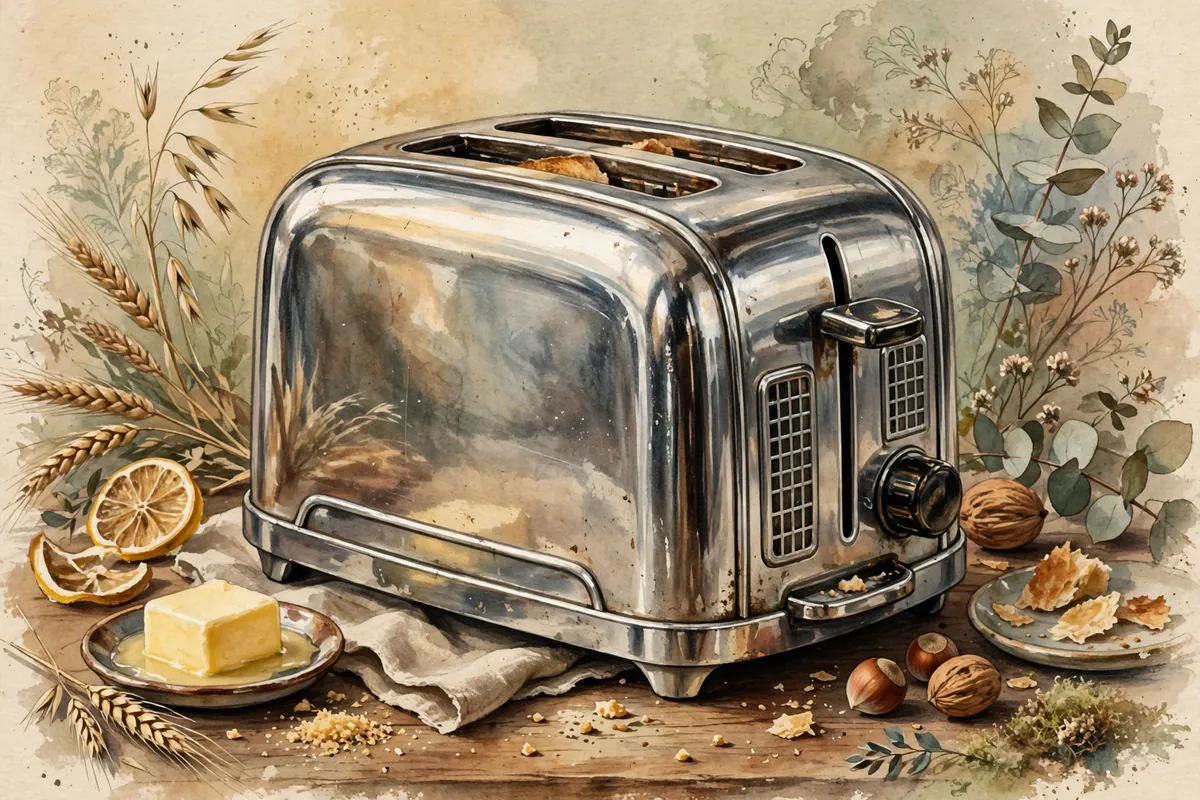
Drop in the bread, push down the lever, and walk away. A minute or two later, up pops a golden slice. It's so easy that we rarely think about it. But for most of history, toast took attention, patience, and a fair amount of luck.
The pop-up toaster changed that. Charles Strite patented the first automatic pop-up toaster in 1921 after getting tired of burnt toast in a factory cafeteria. His design heated both sides of the bread at once and used a spring to pop the toast up when it was done, so nobody had to stand guard.
Toast Before Electricity
Before electric toasters, people held bread near a fire in a metal frame or on a long-handled toasting fork. Long forks were used for toasting from the 16th century on, and decorative wrought-iron toasters appeared in Scotland in the 1600s. In America, iron tools for toasting bread over an open flame showed up in the early 1800s.
The Trouble With Early Toasters
Making an electric toaster turned out to be tricky. Engineers needed a wire that could glow red-hot again and again without breaking. The first stand-alone electric toaster, the Eclipse, was made in England in 1893, but its bare wires toasted only one side of the bread at a time.
The big breakthrough came in 1905, when a young engineer named Albert Marsh created nichrome, an alloy of nickel and chromium that could handle the heat. General Electric introduced the first commercially successful electric toaster in 1909.
Still, these early machines cooked only one side. You had to flip the bread by hand and keep a close eye on it. In 1913, Lloyd and Hazel Copeman introduced a toaster that could turn the bread automatically, which was a step forward, but you still had to watch it.
A Fed-Up Factory Worker
During World War I, Charles Strite worked at a manufacturing plant in Stillwater, Minnesota. He noticed the cafeteria kept serving burnt toast. Electric toasters existed, but they had to be watched constantly to keep the toast from burning, and they could only toast one side at a time.
Strite started working on a solution in 1919. His toaster had heating elements on both sides of the bread and a spring that pushed the toast up when it was finished. He patented it in 1921.
In 1925, the Waters Genter Company introduced a redesigned version called the Toastmaster Model 1-A-1. It was the first automatic pop-up toaster for the home that could brown both sides at once, run on a timer, and eject the toast when done.
The Perfect Partner Arrives
Just a few years later, toast got another boost. In 1928, a bakery in Chillicothe, Missouri, began selling bread cut by Otto Rohwedder's new slicing machine. With pre-sliced bread and a toaster that minded itself, a hands-off slice of toast became a simple part of the morning routine.
Toasters kept evolving. From the late 1940s, some Sunbeam models lowered the bread by themselves and sensed when the toast was done, even if it started out frozen. In 1990, inventors even built a toaster that could be controlled over the internet.
So the next time your toast pops up just right, give a little nod to Charles Strite and his burnt cafeteria breakfast. Sometimes the best inventions start with a small, everyday annoyance.