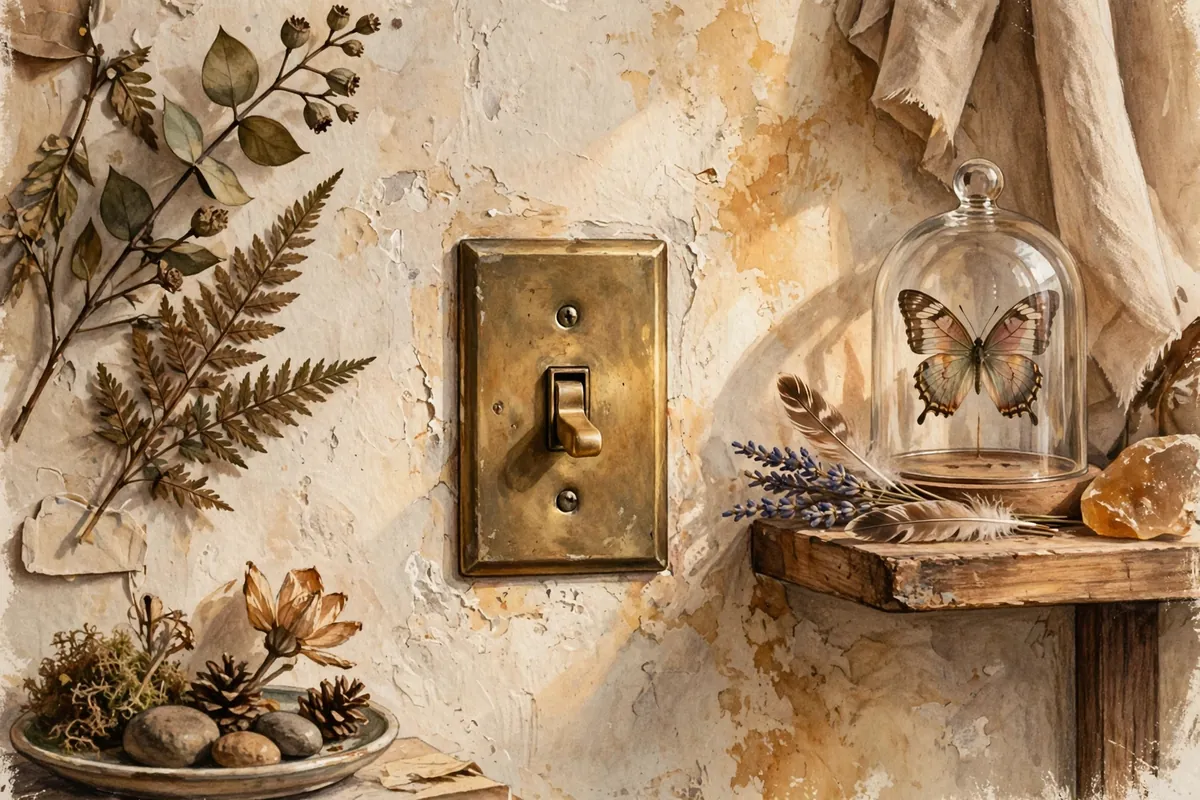
Walk into a dark room in an American house and your hand knows exactly what to do. Find the switch, push it up, and the lights come on. It feels so natural that it seems like it must be a law of the universe, or at least a law of electricians.
Here's the short answer: "up for on" is a convention, not a universal rule. In the United States, Canada, and Finland, the on position of a toggle switch is usually up. But in the United Kingdom, Ireland, and many other European countries, as well as India, Australia, New Zealand, Egypt, and China, down usually means on. There's no physical reason it has to be either way. It's simply the habit each country settled into.
A Habit Older Than the Toggle
There may be a hint in an older design. Before toggles, many U.S. homes had push-button light switches with two buttons, one for on and one for off. The buttons were usually black, and the on button often had a white mother-of-pearl inlay so you could tell which was which.
By custom, those switches were installed with the on button on top. So even before the toggle came along, Americans were already used to reaching up to turn the lights on.
Enter the Toggle Switch
The familiar toggle switch was patented in 1916 by William J. Newton and Morris Goldberg. Its secret is a spring. When you push the lever, the spring stretches until the mechanism passes a center point. Then the spring snaps the contacts together or apart with that satisfying click. The design is safe, reliable, and durable, which helps explain why it's still around more than a century later.
That quick snap matters. Back in 1884, an Englishman named John Henry Holmes invented the first switch with quick-break technology. Slow-moving contacts can create electric sparks called arcs, which pit and dirty the metal and wear the switch out. Making the contacts move quickly leaves no time for an arc to form. Nearly every ordinary light switch in the world still uses the idea, and there are billions of them.
When Up Doesn't Mean On
Even in America, up doesn't always mean on. If a light is controlled by two or more switches, like at the top and bottom of a staircase, each switch's position depends on the others. So a switch can be down while the light is on. That's why stairway switches sometimes seem to have a mind of their own.
Newer rocker switches are the flat, wide kind that sit almost flush with the wall. In the U.S., they're often called "Decora" switches, a trademark of the company Leviton that has become a common name for the whole style.
Switches That Last a Lifetime
Light switches change surprisingly slowly. They often stay in service for decades and get replaced only when part of a house is rewired. It isn't unusual to find century-old switches still working. Some older models even had a tiny neon lamp that glowed faintly when the switch was off, to help you find it in the dark.
So if you ever reach for a switch overseas and find yourself flipping it the wrong way, don't worry. You're not confused, just very well trained. Your hand learned the local custom a long time ago.