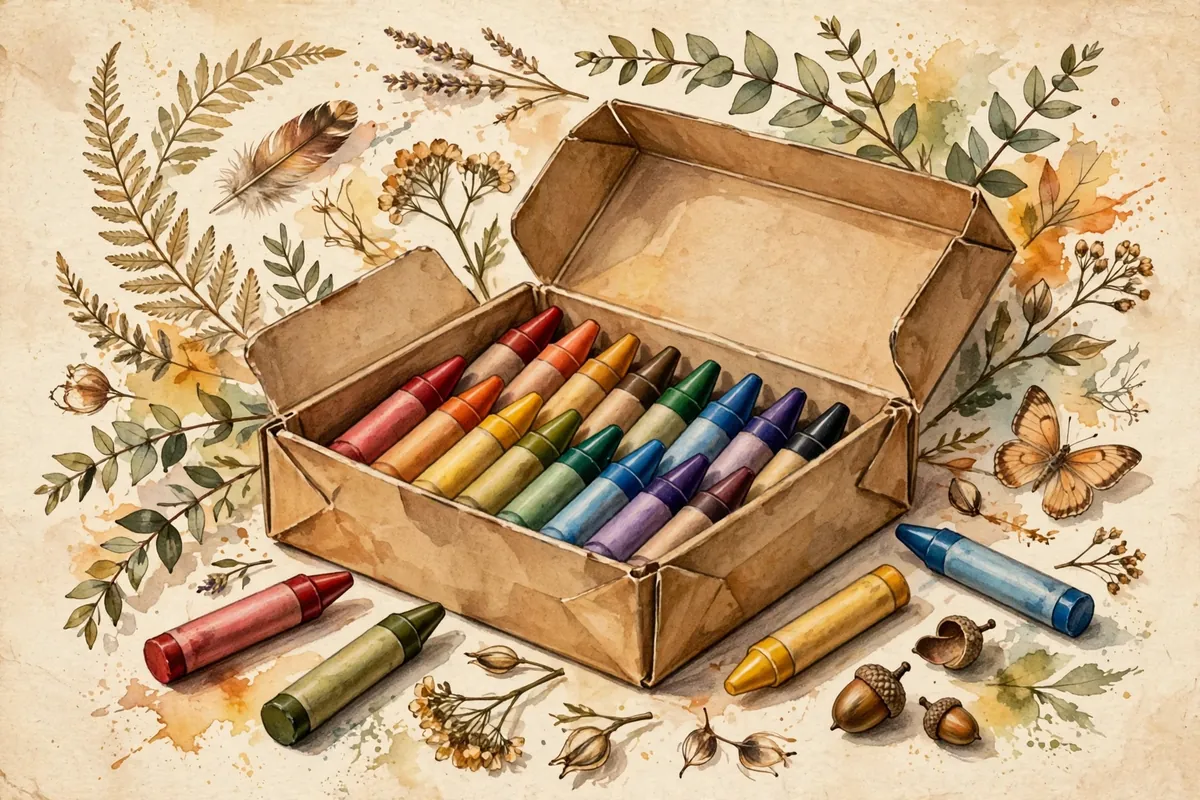
Few smells take grown-ups back to childhood faster than a fresh box of crayons. Peel back the lid and there they are, rows of perfect points in every color you can imagine. But how did a simple stick of wax end up in hundreds of shades with names like Bluetiful?
Here's the short answer. A wax crayon is made mostly of paraffin wax that's heated and then colored. The company that made Crayola famous, Binney & Smith, already had a head start on color. Before crayons, its founders made industrial pigments. In 1903 they launched Crayola crayons, and over the decades the lineup grew from small boxes to more than 200 colors.
From Barn Paint to Blackboards
Edwin Binney and Harold Smith built their business making colorants for industry. Their early products included red iron oxide pigment used in barn paint and carbon black used to make tires black and help them last longer. Their black colorant even won a gold medal at the 1900 Paris Exposition.
They soon turned to schools. In 1900 they began making slate school pencils, and Binney's experiments led to the first dustless white chalk, which won a gold medal at the 1904 St. Louis World's Fair. In 1902, the company introduced a marking crayon called Staonal.
A Name Coined by a Teacher
Crayola crayons arrived on June 10, 1903. Edwin Binney developed them with his wife, Alice Stead Binney, a former schoolteacher, who came up with the name. It blends craie, the French word for chalk, with ola from oleaginous, meaning oily, a nod to the paraffin wax inside.
Crayola didn't start with just one box. By 1905, there were 18 different box sizes. A box of six crayons in the artist line sold for just five cents. The company proudly printed its chalk award medal on the front of its boxes, a design that lasted for more than 50 years.
How the Rainbow Grew
In 1926, Binney & Smith bought another crayon line from the Munsell Color Company and gained 22 new colors. A box of 48 came along in 1949. Then, in 1957, Crayola introduced the famous 64-color box with the company's first built-in crayon sharpener. A Smithsonian curator called it a watershed moment in crayon history.
Colors kept multiplying, reaching 120 by 1998. Since then, new colors have only been added by retiring old ones. In 2017, Crayola retired Dandelion and introduced Bluetiful, a shade based on a new blue discovered by scientists at Oregon State University who were experimenting with electronics.
Glitter, Glow, and Scratch-and-Sniff
Over the years, Crayola got creative. Fluorescent crayons that glow under black light arrived in 1972. In 1994, the company even made crayons that released fragrances. A year later, it swapped out food scents like cherry, chocolate, and blueberry after parents complained that the crayons smelled good enough to eat.
Most Crayola crayons are still made in the United States. In 1996, Fred Rogers himself molded the company's official 100 billionth crayon at its plant in Easton, Pennsylvania. The company also picked up the rights to Silly Putty in 1977, and launched Crayola markers in 1978 to celebrate the crayon's 75th birthday.
So the next time you pick up a crayon, remember its colorful roots in barn paint and tire factories. From a few small boxes in 1903 to more than 200 shades, every crayon is a little piece of American history you can draw with.