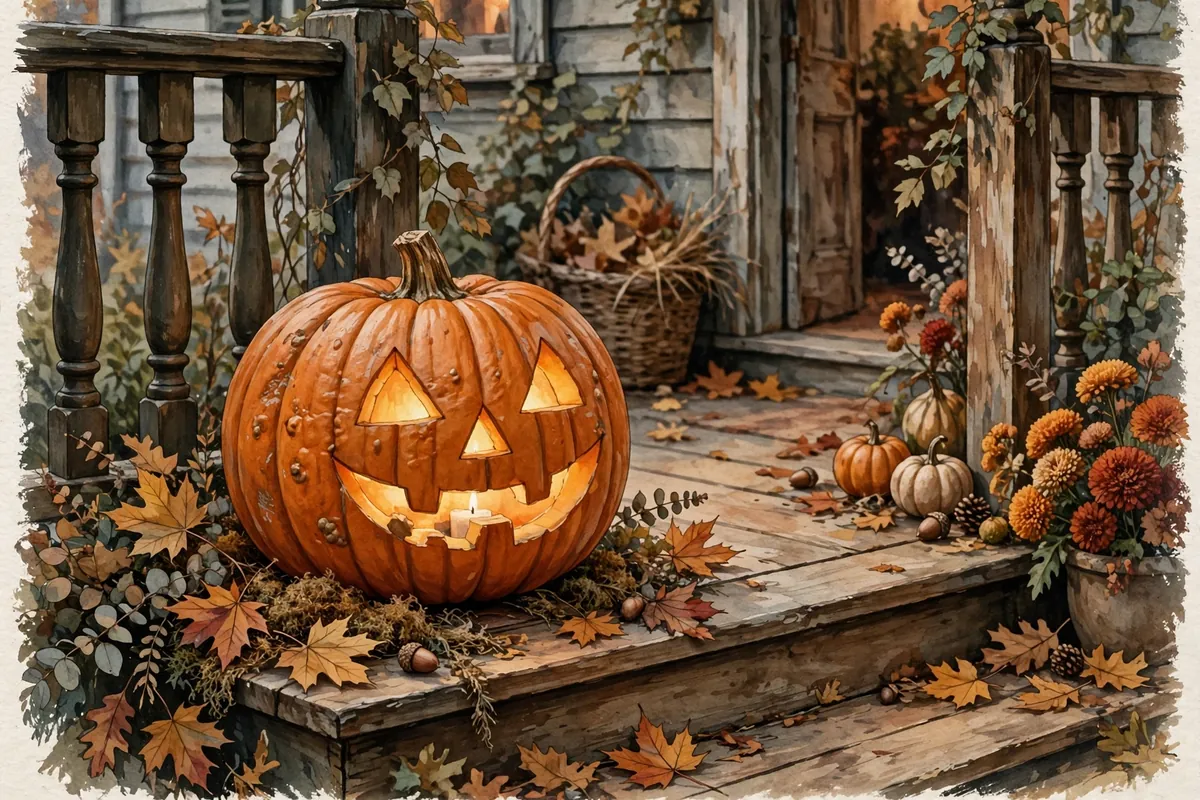
Every October, porches across America light up with grinning, glowing pumpkins. Families spread newspaper on the kitchen table, scoop out the seeds, and argue over whether this year's face should be scary or silly. It's such a familiar ritual that it's easy to forget it had to start somewhere.
The jack-o'-lantern started out as a turnip. In the 19th century, people in parts of England, Ireland, Wales, and Scotland hollowed out turnips and mangelwurzels, a kind of large beet, carved them with grotesque faces, and used them as lanterns at Halloween. In North America, the big, easy-to-carve pumpkin took over, and the carved pumpkin eventually became a symbol of Halloween.
Spirit Nights and Glowing Faces
In Gaelic-speaking regions, Halloween coincided with the festival of Samhain, seen as a time when supernatural beings walked the earth. In Wales, these were called spirit nights. Carved lanterns with spooky faces fit right in on such a night.
Lantern traditions popped up in different places. In Somerset, England, children made them for an autumn custom called Punkie Night. There's even evidence of carved turnip lanterns called Hoberdy's Lanterns in Worcestershire at the end of the 1700s.
The Legend of Stingy Jack
The name has a spooky backstory. Jack-o'-lantern originally described the strange flickering lights sometimes seen over peat bogs, also known as will-o'-the-wisps. The name may also be tied to an Irish folk tale about a man called Stingy Jack.
In one version, Jack is a lazy but clever blacksmith who tricks Satan into climbing an apple tree, then traps him there by carving a cross into the bark. Jack only lets him down after Satan promises never to take his soul.
When Jack finally dies, he's too sinful for Heaven, and Satan keeps his promise and won't let him into Hell either. With nowhere to go, Jack is tossed a burning coal to light his way. He puts it inside a hollowed-out turnip and wanders the earth forever as Jack of the Lantern. Jack's bad reputation stuck around. An 1879 book of funny nursery rhymes warned children not to be like Master Jack o' Lantern, a wicked, deceiving boy who dances and jumps like a will-o'-the-wisp.
How the Pumpkin Took Over
In the United States and Canada, carved pumpkins were first linked to the harvest season in general, not Halloween. Poet John Greenleaf Whittier's 1850 poem "The Pumpkin" fondly recalls carving wild, ugly faces lit by a candle, and it mentions Thanksgiving, not Halloween. As late as 1895, one article suggested a lit jack-o'-lantern as a prize for children's Thanksgiving games.
The Halloween connection was growing, though. On November 1, 1866, a newspaper in Kingston, Ontario, described youngsters celebrating Halloween with pumpkins carved into glowing faces lit by tallow candles. By 1885, one writer was contrasting Britain's Halloween bonfires with American boys and their grinning pumpkin lanterns.
A Headless Myth
Many people picture the Headless Horseman from "The Legend of Sleepy Hollow" holding a jack-o'-lantern. In Washington Irving's original 1820 story, though, all that's found the next morning is a shattered pumpkin near Ichabod Crane's hat. The story never mentions jack-o'-lanterns or Halloween. The glowing pumpkin head was added by later adaptations.
So when you carve your pumpkin this year, you're keeping alive a tradition that began with turnips, bonfires, and a trickster named Jack. The pumpkin is just a lot easier to carve.